
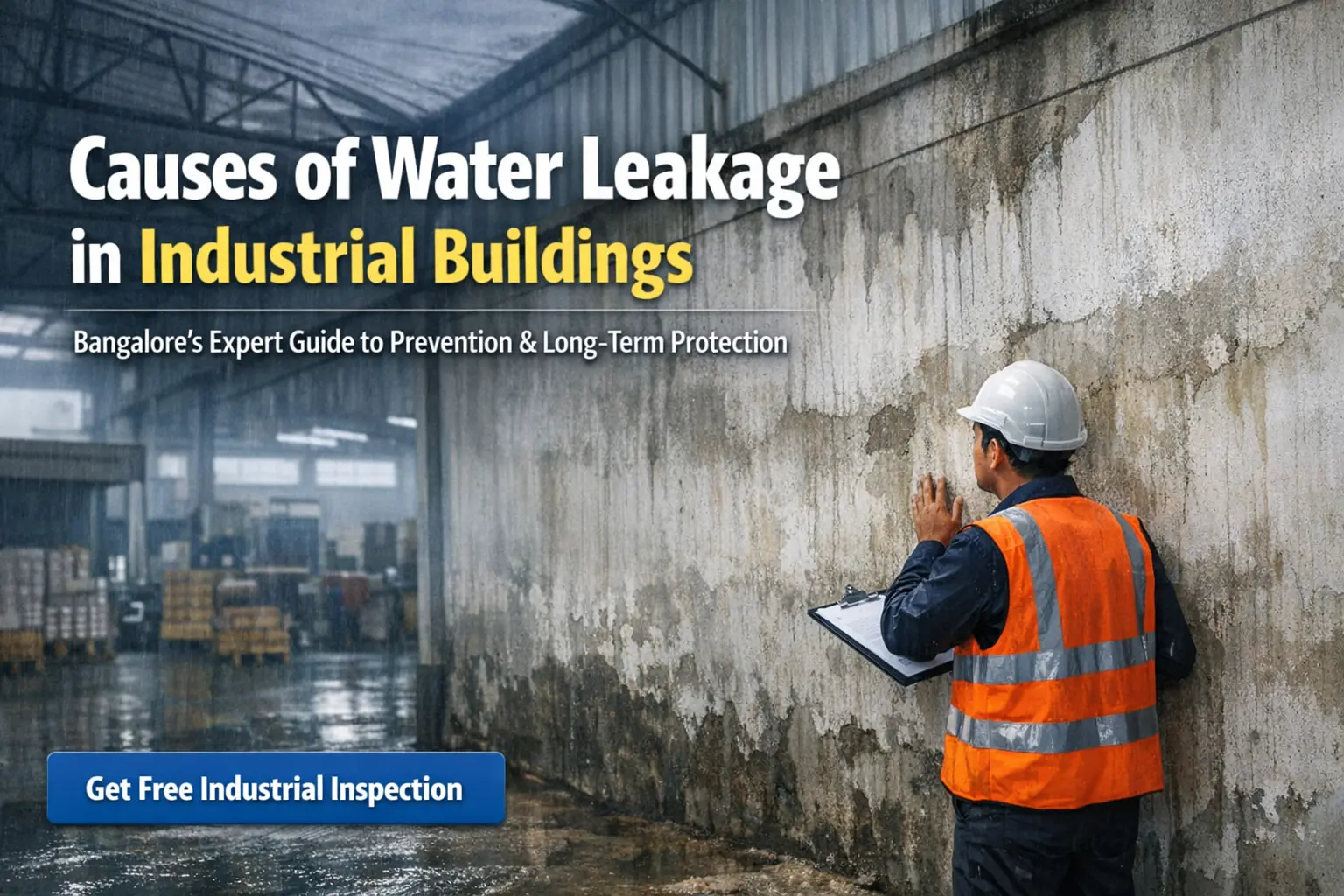
Industrial operations in a booming hub like Bangalore are the backbone of the economy. However, many facility managers and warehouse operators face a silent, destructive enemy: water seepage. It is estimated that nearly 70% of industrial buildings in India show signs of moisture-related issues within the first two years post-handover. Ignoring the causes of water leakage in industrial buildings in Bangalore doesn’t just lead to damp walls; it leads to structural instability, ruined inventory, and expensive operational downtime. Whether you are an architect, a civil contractor, or a property owner, understanding the “why” and “how” of waterproofing is essential to protecting your investment. In this guide, Aqua Blue Waterproofing explores the root causes of industrial leaks in the local climate and provides a roadmap for long-term prevention. Need Immediate Assistance? Call Aqua Blue Waterproofing at +91 88920 26121 for a professional site audit. Table of Contents Main Causes of Industrial Water Leakage in Bangalore Why Early Detection and Inspection Matters Best Industrial Waterproofing Solutions Step-By-Step Prevention Guide Cost of Industrial Waterproofing in Bangalore Choosing the Best Contractor Frequently Asked Questions What Are the Main Causes of Water Leakage in Industrial Buildings in Bangalore? Bangalore’s geography and rapid industrialization create a unique set of challenges. Identifying the causes of water leakage in industrial buildings in Bangalore is the first step toward a dry facility. 1. Poor Waterproofing Design or Specification Many industrial units are built with “residential-grade” waterproofing. Heavy industrial settings require systems that can withstand chemical exposure and heavy foot traffic. When the wrong membrane is specified, it fails under the stress of daily operations. 2. Structural Cracks & Construction Defects Large-span concrete slabs are prone to shrinkage cracks. These industrial building seepage reasons often stem from poor curing during construction or high-vibration machinery that widens hairline fractures over time. 3. Inadequate Drainage & Ponding of Water In areas like Peenya or Electronic City, heavy monsoon downpours often overwhelm undersized gutter systems. When water “ponds” on a flat roof for more than 48 hours, it exerts hydrostatic pressure, forcing moisture through the smallest pores in the concrete. 4. Aging Infrastructure & Material Degradation Older factories often suffer from wall dampness in industrial structures. Over decades, original bitumen layers become brittle and crack due to Bangalore’s UV exposure, leading to widespread infiltration. 5. Faulty or Hidden Plumbing Lines In large warehouses, miles of concealed piping can develop pinhole leaks. These are the most common answers to what causes water leakage in large buildings, often staying hidden until a wall becomes structurally compromised. 6. Monsoon Stress & Climate Load Bangalore has moved toward more erratic, high-intensity rainfall patterns. This “Climate Load” puts immense pressure on expansion joints, which are often the first point of failure during a heavy October monsoon. Why Early Detection and Inspection Matters Proactive Bangalore industrial building maintenance can save millions in emergency repairs. Professional Inspection: Using industrial leakage inspection services ensures that you catch “capillary rise” (moisture moving up from the ground) before it reaches your electrical panels. Signs to Watch For: Facility teams should look for efflorescence (white salty powder), rust stains near pillars, and a musty odor in storage zones. Advanced Tools: At Aqua Blue Waterproofing, we utilize thermal imaging cameras and moisture meters to “see” through walls, identifying leaks without breaking a single brick. Best Industrial Waterproofing Solutions to Prevent Leakage Choosing the right industrial waterproofing solutions for buildings depends on the specific substrate and usage. Choosing the Right System TPO/EPDM Membranes: Ideal for large metal roofs (PEBs) as they expand and contract with temperature changes. Polyurethane (PU) Coatings: Excellent for RCC slabs, offering a seamless, UV-resistant barrier. Crystalline Waterproofing: Best for basements and lift pits, as it becomes part of the concrete matrix. Why Customized Systems Are Superior Aqua Blue Waterproofing industrial solutions are never “one-size-fits-all.” We customize the chemical composition based on whether your facility handles chemicals, cold storage, or heavy machinery. Case Example: A warehouse in Hoskote faced severe roof leakage. Our inspection found failed expansion joints. We applied a specialized multi-layer PU system, resulting in a 100% leak-free facility through two monsoon seasons. Step-By-Step Prevention Guide (How-To) Follow these steps to ensure industrial leak repair in Bangalore is done correctly: Conduct Comprehensive Inspection: Map out all damp spots and measure moisture levels. Identify Root Cause: Determine if it’s a roof issue, a plumbing leak, or groundwater seepage. Select Suitable System: Use high-build elastomeric coatings for walls and heavy-duty membranes for roofs. Fix Structural Cracks: Use pressure grouting or epoxy injections to seal cracks from the inside out. Improve Drainage: Ensure a minimum 1:100 slope on all flat surfaces and clear all debris from gutters. Routine Maintenance: Schedule bi-annual checks before April and October (Bangalore’s peak rain months). How Much Does Industrial Waterproofing & Leak Repair Cost? One of the most frequent questions facility managers ask is about the budget. However, in an industrial setting, waterproofing is not a fixed-rate commodity; it is a strategic investment in asset protection. At Aqua Blue Waterproofing, we believe in providing transparent, project-specific pricing rather than “one-size-fits-all” estimates. The final cost of industrial waterproofing services in Bangalore depends on several technical variables: Key Factors That Influence Your Investment: The Type of Material Used: Think of this as choosing the “shield” for your building. High-end materials like Polyurea or Specialized PU coatings are more of an upfront investment, but they can last 15+ years. Traditional options may be cheaper initially but might need repairs sooner. The Current State of Your Building: A brand-new warehouse is a “clean canvas” and is usually faster and cheaper to waterproof. Older factories, especially in Bangalore’s busy industrial zones like Peenya—often need extra work, such as cleaning off old debris, filling deep cracks, and preparing the surface before we can even begin. How Complex the Structure Is: A simple, flat roof is straightforward. However, if your roof has many “penetrations”—like AC vents, chimneys, or exhaust pipes—it requires more detailed hand-work and specialized sealing, which affects the labor and time involved. The
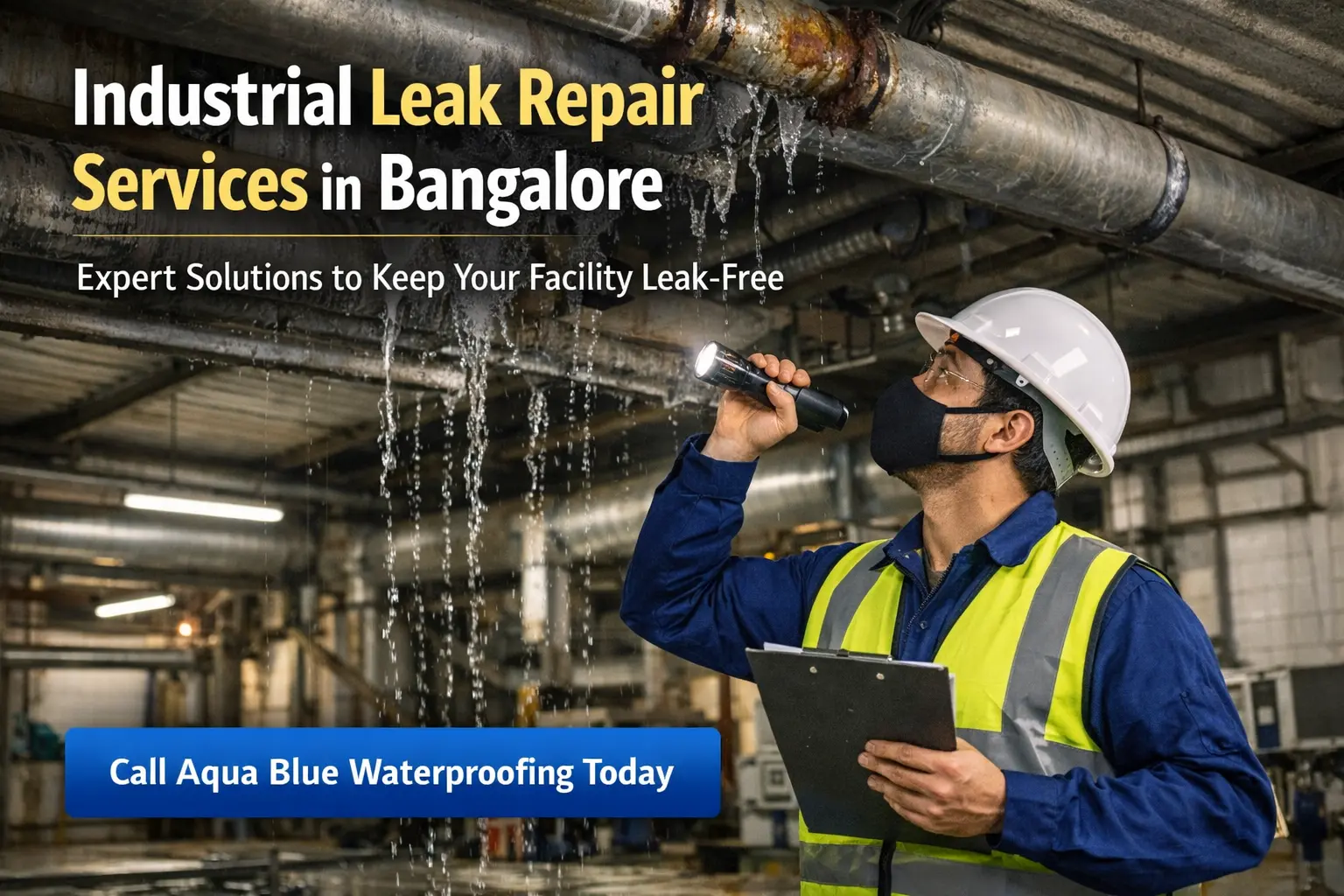
Industrial Leak Repair Services in Bangalore: Expert Solutions to Keep Your Facility Leak-Free
A single undetected leak in an industrial setup isn’t just a plumbing nuisance; it is a ticking financial time bomb. For Plant Managers and Facility Heads in Bangalore’s bustling industrial hubs like Peenya, Bidadi, or Electronic City, a leaking pipe or a damp warehouse wall can lead to catastrophic equipment failure, safety violations, and expensive operational downtime. Many facility managers mistakenly believe that minor seepage is “just part of the building’s age,” but ignoring these signs leads to irreversible structural degradation. This guide provides a comprehensive roadmap for Industrial Leak Repair Services in Bangalore, ensuring your facility remains compliant, safe, and 100% operational. At Aqua Blue Waterproofing, we specialize in high-stakes industrial environments where precision, speed, and durability are non-negotiable. Whether it is a hairline crack in a chemical tank or deep-seated seepage in a multi-level basement, our mission is to provide permanent fixes that keep your production lines moving. Need Immediate Assistance? Call Aqua Blue Waterproofing Today: +91 88920 26121 Table of Contents Introduction What Causes Industrial Leaks in Bangalore Facilities? How to Identify Signs You Need Industrial Leak Repair Best Methods for Industrial Leak Proofing & Prevention Specialized Services Offered by Aqua Blue Waterproofing Why Aqua Blue is the Top-Rated Industrial Contractor FAQs Conclusion What Causes Industrial Leaks in Facilities? Understanding the root cause is the first step in effective Industrial Leak Repair Services in Bangalore. Industrial structures in Karnataka face unique environmental and operational stresses that residential buildings simply don’t encounter. Aging Infrastructure and Structural Fatigue Many manufacturing units in areas like Rajajinagar or Bommasandra were built decades ago. Over time, concrete carbonation and steel reinforcement corrosion create invisible pathways for water. As the “Silicon Valley of India” expands, the vibration from nearby heavy transport and metro construction also contributes to structural settling, which opens up new leak points in older masonry. Bangalore’s Unique 2025-2026 Climate Shift According to recent meteorological data and urban development reports from CREDAI, Bangalore has seen a significant shift in rainfall patterns. We are now experiencing high-intensity “short-burst” rains. This puts immense hydrostatic pressure on industrial roofs and basements. When the drainage systems cannot keep up, water finds the path of least resistance—usually through failing membranes or expansion joints. Chemical and Thermal Stress In pharmaceutical and chemical plants located in Jigani, exposure to aggressive vapors and extreme temperature fluctuations can degrade traditional waterproofing seals 4x faster than in standard commercial buildings. Thermal expansion—where pipes and roofs expand during the day and contract at night—causes “sealant fatigue,” leading to persistent dripping. How to Identify Signs You Need Industrial Leak Repair Early detection is the difference between a minor patch-up and a multi-lakh rupee overhaul. Facility managers must train their staff to look for these signs you need industrial leak repair: Early Warning Signs to Watch For White powdery patches: If you see white, salt-like powder on your basement walls or pillars, water is leaching minerals out of the concrete. This indicates a deep-seated moisture problem that is weakening the structure. Rising Utility Costs: An unexplained spike in water bills or energy costs is a primary indicator. Damp air is harder to cool, meaning your HVAC systems work 20% harder, driving up electricity consumption. Strange Leak Sounds: Sometimes, you can hear a leak before you see it. A faint hissing sound near valves or pressurized lines often indicates a pinhole leak that could lead to a pipe burst. The High Risks of Delayed Action Ignoring these signs can lead to operational downtime—the most expensive cost for any factory. Dampness near electrical panels or sensitive CNC machinery can cause short circuits, leading to millions in equipment damage and potential safety hazards for your workforce. In the 2026 industrial landscape, safety audits are stricter than ever; a damp floor is a “slip and fall” liability that no company can afford. Best Methods for Industrial Leak Proofing Modern facility management requires moving beyond traditional “tar and felt” methods. Here are the best methods for industrial leak proofing currently used in world-class facilities: Advanced Preventive Measures Polyurethane (PU) Grouting: For active cracks in basements or water tanks, PU injection is the gold standard. The resin is injected at high pressure; it expands upon contact with water, sealing the leak from the inside out and creating a flexible, permanent seal. Crystalline Waterproofing: This involves applying a chemical treatment that penetrates deep into the concrete pores. When moisture enters, it triggers the growth of crystals that plug the pores, making the concrete itself waterproof. TPO & EPDM Membranes: Ideal for large factory roofs, these are heat-welded and provide exceptional resistance to Bangalore’s high UV exposure. These advanced techniques form the foundation of professional industrial waterproofing services in Bangalore, especially for large factories and high-risk facilities. Innovative Detection Techniques How do you find a leak you can’t see? At Aqua Blue, we utilize non-destructive leak detection methods: Thermal Imaging: Using infrared cameras to spot temperature differences caused by moisture trapped behind walls or under flooring. Moisture Mapping: Using electronic sensors to create a “heat map” of dampness levels across a large warehouse floor. Ultrasonic Testing: To detect leaks in high-pressure steam or air lines that are inaudible to the human ear. Leak Detection & Repair Services Offered by Aqua Blue At Aqua Blue Waterproofing, we understand that a factory in Whitefield has different needs than a logistics warehouse in Nelamangala. Our industrial leakage solution services are tailored to the specific demands of the Bangalore industrial sector. Comprehensive Leak Detection Services We don’t guess; we diagnose. Our team uses thermal scans and moisture detection probes to find the exact source of the leak, saving you from unnecessary demolition costs. This precision is why we are considered the Bangalore industrial leak prevention experts. Industrial Leakage Solution Services Our repair repertoire includes: Negative Side Waterproofing: Fixing basement leaks from the inside when the outside is inaccessible. Expansion Joint Sealing: Using industrial-grade polysulphide sealants that move with your building. Pipe and Flange Sealing: Rapid-set repairs for cooling towers and industrial plumbing. Hyper-Local Focus We
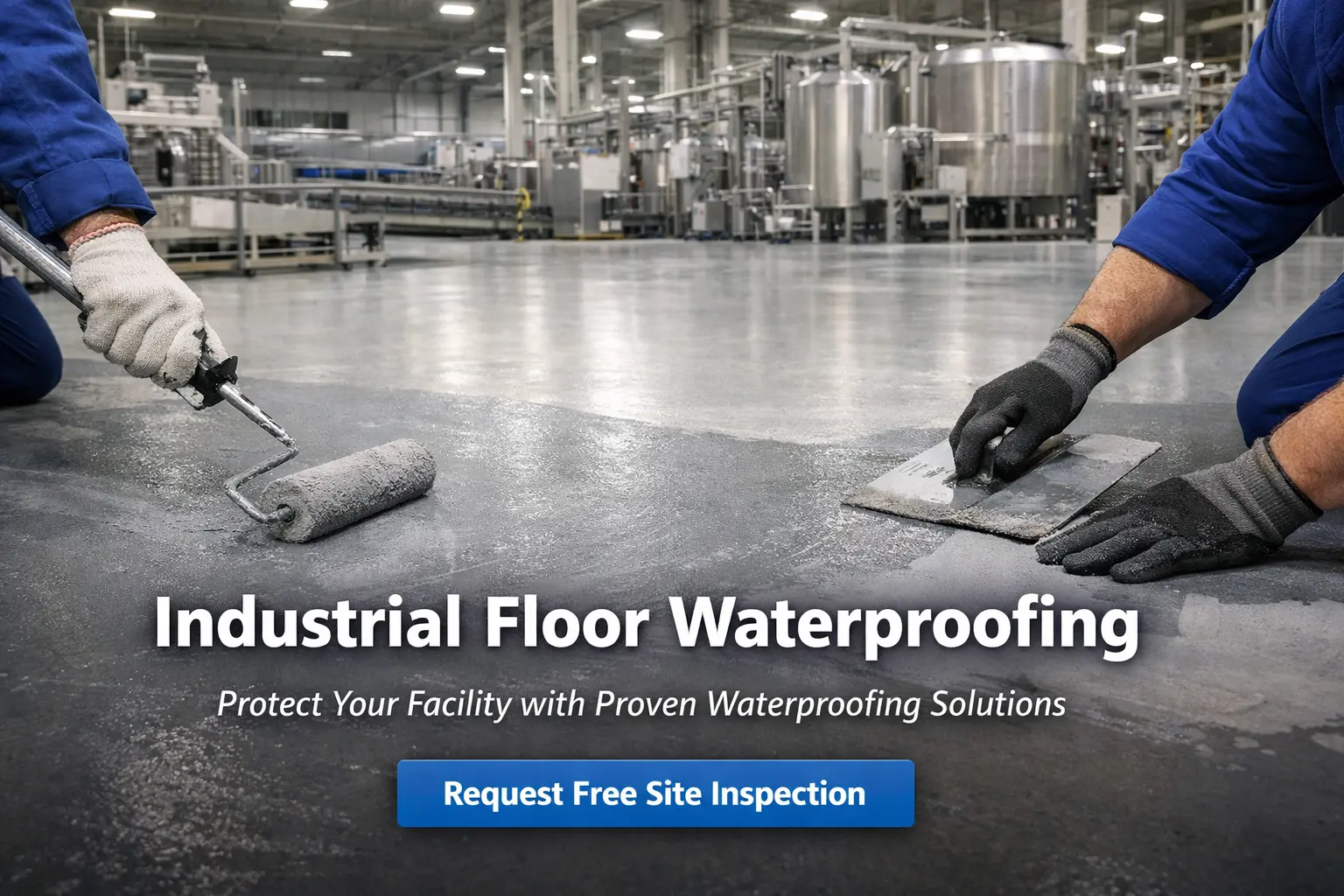
Industrial Floor Waterproofing Services in Bangalore: Protect Your Facility from Leaks & Damages
Imagine your industrial facility, the heart of your operations in bustling Bangalore, suddenly facing an unexpected crisis: a persistent leak silently seeping through your factory floor. It’s not just a minor inconvenience; it’s a direct threat to your machinery, inventory, and crucially, your operational continuity. In a city like Bangalore, known for its heavy monsoons and high groundwater pressure, ignoring these signs is a gamble no Factory Owner, Warehouse & Logistics Manager, or Industrial Real Estate Developer can afford. Protecting your investment with reliable Industrial Floor Waterproofing Services in Bangalore isn’t just a maintenance task; it’s a strategic imperative. This comprehensive guide will walk you through why industrial floors leak, the severe risks of inaction, the best waterproofing techniques, and how to choose a trusted partner like Aqua Blue Waterproofing to safeguard your facility. Stop floor leaks. Protect your facility. Call Aqua Blue: +91 8892026121 Table of Contents Why Do Industrial Floors Leak in Bangalore Facilities? The Risks of Ignoring Industrial Floor Water Leakage Best Industrial Floor Waterproofing Techniques Understanding Industrial Membrane Waterproofing How Slab Waterproofing Protects Heavy-Load Facilities Choosing the Right Waterproofing Company in Bangalore The Aqua Blue Waterproofing Process Cost Factors & Local Regional Challenges Frequently Asked Questions (FAQs) Why Do Industrial Floors Leak in Bangalore Facilities? Industrial floors in Bangalore are under constant stress from heavy machinery, chemical exposure, and the city’s unique climatic conditions. Understanding the root causes of leakage is the first step towards effective floor leak prevention solutions. Capillary Cracks: Microscopic cracks in concrete allow water to be drawn upwards through capillary action, often unnoticed until significant damage occurs. Expansion Joint Failure: These crucial joints allow concrete to expand and contract. If seals fail or wear out, they become direct pathways for water ingress. Chemical Exposure: Acids, alkalis, and solvents used in industrial processes can degrade concrete and existing waterproofing, creating porous surfaces vulnerable to leaks. Improper Slope & Drainage: Inadequate floor slope or clogged drains can lead to water pooling, increasing hydrostatic pressure and forcing water into the slab. Old Concrete Porosity: Over time, concrete naturally becomes more porous. Without adequate industrial leakage repair & waterproofing, older floors are highly susceptible to water penetration. What Are the Risks of Ignoring Industrial Floor Water Leakage? Delaying action on industrial floor water leakage protection services can lead to a cascade of expensive and dangerous problems. The temptation to postpone can be costly in the long run. Machinery Corrosion: Water and moisture lead to rust, degrading valuable equipment, shortening its lifespan, and causing costly breakdowns. Inventory Damage: Stored goods, especially in warehouses in humid environments like Bangalore, are susceptible to moisture, mold, and spoilage, leading to significant financial losses. Slippery Floors & Safety Hazards: Puddles and damp surfaces create dangerous slip-and-fall risks for employees, potentially leading to injuries and legal liabilities. Structural Weakening: Persistent water ingress can compromise the structural integrity of the concrete slab and even the building’s foundation, requiring extensive and costly repairs. Compliance & Insurance Risks: Failure to maintain a safe and compliant facility can lead to regulatory fines and may even void insurance claims for water-related damages. What Are the Best Industrial Floor Waterproofing Techniques Used in Bangalore? Choosing the right method is critical for effective industrial waterproofing solutions. Different industrial environments require specific industrial floor waterproofing techniques to ensure long-term protection. Which Industrial Floor Waterproofing Technique Is Right for Your Facility? The selection depends on the specific demands of your facility, including the type of traffic, chemical exposure, and structural considerations. Polyurethane (PU) Coating Systems: Highly flexible and elastic, PU coatings are excellent for crack bridging and provide seamless, durable surfaces resistant to abrasion and impact. Ideal for areas with heavy foot traffic or moderate machinery. Epoxy Waterproofing Floors: Known for their exceptional chemical resistance, hardness, and aesthetic appeal. Epoxy systems create a tough, impermeable barrier, perfect for chemical processing plants, food & beverage units, and high-traffic warehouses. Crystalline Waterproofing: This technique uses chemicals that penetrate concrete and react with moisture to form insoluble crystals, blocking water pathways from within. Ideal for basements, water tanks, and facilities seeking deep, integral waterproofing that self-heals minor cracks. Cementitious Coatings: A cost-effective and easy-to-apply solution for various industrial settings. These cement-based mixtures provide a rigid or flexible barrier, suitable for general floor protection against moisture. What Is Industrial Membrane Waterproofing and When Is It Required? Industrial membrane waterproofing Bangalore involves applying pre-formed sheets (like APP or SBR modified bituminous membranes) or liquid-applied membranes (like polyurethane or acrylic-based) to create an impermeable layer. Best Use Cases: Membrane systems are highly effective for large industrial basements, loading docks, roofs, and areas subject to significant hydrostatic pressure or structural movement. They are particularly beneficial where a completely monolithic, joint-free seal is required, or in heavy-load zones where slab protection is paramount. Advantages: Excellent elasticity, crack-bridging capabilities, and robust protection against severe water ingress. How Does Industrial Slab Waterproofing Protect Heavy-Load Facilities? For facilities housing heavy machinery, forklifts, and constant movement, robust industrial slab waterproofing services are non-negotiable. Load-Bearing Slab Protection: Proper waterproofing protects the concrete slab itself from weakening, ensuring it can safely bear heavy loads without compromising its integrity. Crack-Bridging Importance: Industrial slabs are prone to movement and minor cracking. Waterproofing systems with crack-bridging properties maintain their integrity even if the underlying concrete shifts slightly. Long-Term Durability: Investing in high-quality slab waterproofing ensures the longevity of your industrial floor, reducing the need for frequent and disruptive repairs. This also supports effective industrial leakage repair & waterproofing. How to Choose the Right Industrial Floor Waterproofing Company in Bangalore? Selecting a vendor is about trust and technical expertise. When looking for the Best industrial waterproofing companies Bangalore, use this checklist: Site Inspection: Do they use moisture meters and thermal imaging? Material Certifications: Do they use industrial-grade polymers? Project History: Have they worked in hubs like Peenya or Hoskote? Warranty: Do they offer a written performance warranty for Industrial Floor Waterproofing Services in Bangalore? Why Aqua Blue Waterproofing Is Trusted for Industrial Projects in Bangalore At Aqua Blue

Advanced Warehouse Waterproofing Services in Bangalore for Long-Term Protection
Owning or managing a warehouse in Bangalore comes with a big challenge: the heavy monsoon rains. With over 900mm of rain hitting the city every year, even a tiny crack in your roof or floor can lead to massive losses. Imagine arriving at work to find lakhs of rupees worth of stock ruined by a ceiling leak or a damp floor. Many people try to fix these issues with “quick fixes” used in homes, but industrial spaces are different. They face heavy truck movements and huge roof areas that need specialized Warehouse Waterproofing Services in Bangalore. This guide will show you how to protect your building and your business for the long term. Protect your warehouse assets today! Contact Aqua Blue Waterproofing: +91-8892026121 Table of Contents Why Warehouse Waterproofing Matters in Bangalore Common Waterproofing Challenges in Industrial Spaces How Modern Systems Protect Your Infrastructure Aqua Blue’s Comprehensive Service Suite Choosing the Right Industrial Contractor Our Step-by-Step Industrial Waterproofing Process Frequently Asked Questions Conclusion: Secure Your Business Continuity Why Warehouse Waterproofing Matters in Bangalore In Bangalore’s industrial corridors from Peenya to Hoskote warehouses are the backbone of the economy. However, the city’s tropical savanna climate brings intense monsoon bursts that put immense pressure on large-span roofs and concrete slabs. Warehouse water damage protection services are not just about stopping a drip; they are about risk management. For a logistics manager, water damage means: Inventory Loss: Moisture ruins electronics, pharmaceutical supplies, and FMCG packaging. Structural Decay: Water causes the reinforcement steel in concrete (rebar) to rust, leading to “spalling” and potential roof collapse. Operational Downtime: Redirecting shipments because of a flooded floor costs more than the repair itself. As Aqua Blue Waterproofing, we have seen that a proactive investment in warehouse leak repair Bangalore saves companies up to 5x the cost of emergency repairs and insurance deductibles. What Are the Common Waterproofing Challenges in Warehouses? Warehouses face unique challenges that residential buildings do not. Understanding these “pain points” is the first step toward a solution. The “Thermal Shock” Effect on Large Roofs Bangalore’s temperature can fluctuate significantly between the afternoon sun and evening rain. This causes metal and concrete roofs to expand and contract. Without best waterproofing practices for warehouses, joints fail, and leaks appear. Hydrostatic Pressure in Low-Lying Industrial Zones Many warehouses in areas like Bommasandra are built on reclaimed land. High groundwater tables exert hydrostatic pressure against the foundation, leading to “rising damp” that ruins floor-stored pallets. Common Consequences of Neglect Mold & Mildew: Creating hazardous working conditions for staff. Slippery Floors: Increasing the risk of forklift accidents and worker injury. Insurance Rejections: Many insurers in Bangalore now deny claims if the facility shows signs of “poor maintenance” or lack of professional waterproofing. How Warehouse Waterproofing Protects Your Infrastructure Moving from awareness to action requires understanding the technology behind industrial waterproofing systems for warehouses. Advanced Liquid Applied Membranes Unlike traditional felt or sheets, liquid applied membranes for warehouse waterproofing create a seamless, rubber-like shield. At Aqua Blue, we often recommend Polyurethane (PU) coatings because they are UV-resistant and can bridge cracks up to 2mm wide. Crystalline Technology for Concrete Floors For storage facility waterproofing in Bangalore, crystalline admixtures are vital. These chemicals react with moisture to grow crystals inside the concrete pores, permanently blocking water paths from the ground up. Quantifiable Benefits Extended Lifespan: Professional sealing can add 15–20 years to the life of a metal roof. Energy Efficiency: White reflective coatings can reduce internal warehouse temperatures by 5°C – 8°C, lowering cooling costs. A Simple Care Guide for Your Warehouse (Season by Season) Don’t wait for the rain to start before you check your roof. In Bangalore, the weather changes a lot. Use this easy calendar to keep your warehouse safe all year round. Month What to Do Why? March – April The Summer Check The hot Bangalore sun can make your roof and walls expand. This causes tiny cracks that need to be filled before the rain arrives. May Clean the Pipes This is the most important step! Clean out all the dry leaves and dust from your gutters and pipes so rainwater can flow away easily. August The Rain Check While it’s raining, look at your roof. If you see water “standing” in puddles instead of flowing away, it means your roof needs leveling or better drainage. November Post-Rain Fix After the heavy rains stop, check for any new damp spots. Fixing small issues now is much cheaper than waiting until next year. Comprehensive Warehouse Waterproofing Services by Aqua Blue At Aqua Blue Waterproofing, we offer a 360-degree approach tailored specifically to the Bangalore industrial climate. Roof & Terrace Waterproofing We specialize in large-scale metal roof lap-joint sealing and RCC roof coating using high-elongation polymers that move with the building. Wall & Basement Sealing Using injection grouting and epoxy-based coatings, we tackle wall dampness and basement seepage in multi-level industrial units. Floor & Storage Area Waterproofing We provide moisture vapor barriers for floors, essential before applying expensive epoxy or PU floor coatings in pharma or electronics warehouses. Read related blog also: Industrial waterproofing services in bangalore Choosing the Right Warehouse Waterproofing Contractor Don’t hire a residential plumber for an industrial job. When searching for warehouse waterproofing contractors Bangalore, look for these specific EEAT markers: Industrial Scale Experience: Ask for a portfolio of projects over 20,000 sq. ft. Localized Knowledge: A contractor should know the soil conditions in Whitefield vs. the rocky terrain of Electronic City. Warranty Transparency: Ensure the warranty covers both “Material” and “Workmanship.” Aqua Blue Waterproofing stands out by providing thermal imaging inspections and detailed moisture mapping before any quote is issued. Step-by-Step Industrial Warehouse Waterproofing Process Our systematic approach ensures that Warehouse Waterproofing Services in Bangalore are executed with zero margin for error. Initial Inspection & Thermal Mapping: We use infrared cameras to detect hidden moisture traps in the roof and walls. Surface Preparation: This is 70% of the job. We use high-pressure water jetting (up to 250 bar) to remove
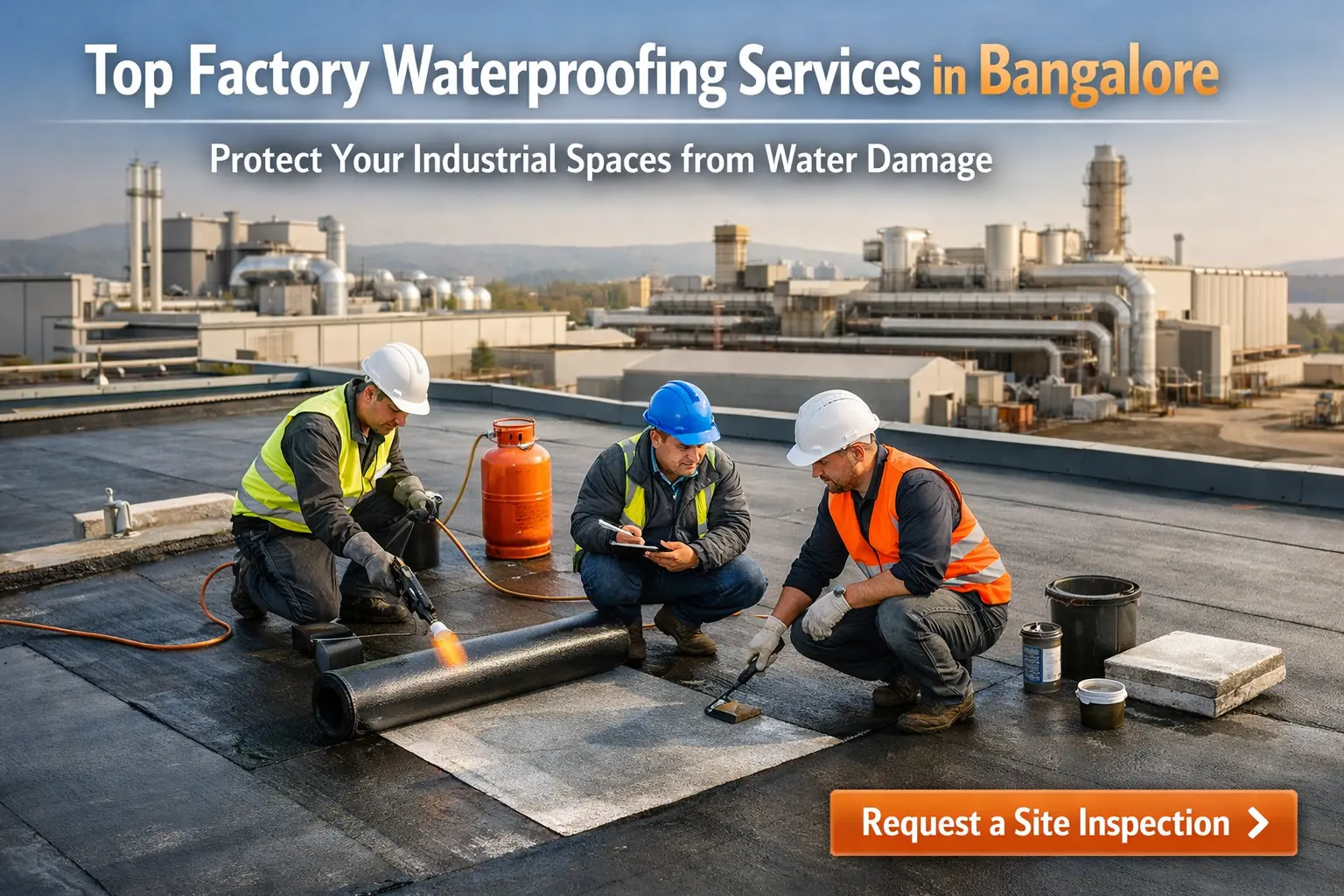
Top Factory Waterproofing Services in Bangalore for Safe Industrial Spaces
Imagine a sudden July downpour in Bangalore. Within hours, water begins to seep through the concrete slab of your production floor, pooling around high-voltage machinery and soaking expensive inventory ready for dispatch. For many industrialists in hubs like Peenya or Jigani, this isn’t a hypothetical—it is a recurring nightmare that leads to expensive downtime, compromised safety, and structural decay. In a city known for its intense monsoon cycles and high humidity, Factory Waterproofing Services in Bangalore are not just a maintenance luxury; they are a fundamental pillar of industrial asset protection. This guide will walk you through the essential systems required to protect your facility, from specialized floor coatings to advanced roof membranes, ensuring your operations remain dry and uninterrupted. Whether you are managing a pharmaceutical plant in Whitefield or a heavy engineering unit in Yelahanka, understanding the “why” and “how” of professional leakproofing is the first step toward a resilient workspace. Protect Your Assets Today! Don’t wait for the next leak to disrupt your production. Call Aqua Blue Waterproofing at +91 91080 00024 for a comprehensive site inspection and a custom quote. Table of Contents What is Industrial Waterproofing? Why Factory Waterproofing is Critical in Bangalore Common Areas and Problems in Factories Our Factory Waterproofing Solutions Why Choose Aqua Blue Waterproofing How We Execute Factory Waterproofing Projects Frequently Asked Questions (FAQs) Conclusion What is Industrial Waterproofing? Industrial waterproofing is the specialized application of barriers and chemical coatings designed to prevent water ingress into large-scale, high-utility structures. Unlike residential work, industrial leakproofing in Bangalore requires heavy-duty materials capable of withstanding aggressive chemical exposure, extreme thermal expansion, and the mechanical stress of heavy machinery and forklift traffic. Types of Protection and Areas Covered A comprehensive system doesn’t just cover the roof. It involves a 360-degree approach to the building envelope: Structural Integrity: Preventing water from reaching the internal steel reinforcement (rebars), which prevents carbonation and “concrete cancer.” Surface Durability: Utilizing the best waterproofing systems for factory floors that remain moisture-impermeable even under high-pressure cleaning or chemical spills. Storage Zones: Ensuring that warehouses maintain a bone-dry environment to prevent mold growth on organic inventory or corrosion on metallic parts. Read related blog also:- Industrial Waterproofing Services in Bangalore Why Factory Waterproofing is Critical in Bangalore Bangalore’s geography and rapid industrialization present unique challenges for factory water damage protection services. With an average annual rainfall of approximately 970mm, often concentrated in heavy bursts, the pressure on industrial infrastructures is immense. The Bangalore Impact The Monsoon Factor: Areas like Yelahanka and Nelamangala often experience heavy runoff. Without a robust external waterproofing system, hydrostatic pressure can force groundwater through basement walls, leading to persistent dampness. The Cost of Neglect: A single day of production stoppage in a medium-sized factory can cost between ₹60,000 to ₹6,00,000, far exceeding the cost of a proactive waterproofing treatment. Localised Stress: Industrial waterproofing near Whitefield often deals with structures exposed to both high heat and sudden cooling during rains. This thermal shock causes micro-cracks in concrete that only professional-grade membranes can bridge effectively. Common Areas and Problems in Factories Factories are complex environments with multiple entry points for moisture. Identifying these early is key to choosing the correct industrial waterproofing in Yelahanka Bangalore. Typical Vulnerable Zones & Problems Industrial Basements: Constant exposure to high water tables makes basement waterproofing for industries a top priority. Common signs of failure include salt efflorescence (white powdery deposits) and peeling paint. Flooring & Cracks: In manufacturing, floor dampness is a safety hazard. We often see seepage through expansion joints or cracks caused by heavy machinery vibration. Rooftops & Gutters: Large-span metal or concrete roofs are prone to leaks at the “lap joints” or where the rainwater down-take pipes meet the roof slab. Our Factory Waterproofing Solutions At Aqua Blue Waterproofing, we utilize high-performance, industry-certified materials tailored to the specific mechanical loads of your facility. Advanced Solutions We Offer Liquid Applied Membranes (LAM): High-elasticity coatings like PU (Polyurethane) that provide a seamless barrier over complex roof geometries. Polyurea Coatings: These are the best waterproofing systems for factory floors in Bangalore due to their rapid curing time (minutes!) and extreme abrasion resistance. Crystalline Systems: Ideal for concrete basements, these chemicals react with moisture to grow crystals inside the concrete pores, sealing them permanently from within. Why Choose Aqua Blue Waterproofing As leading waterproofing contractors for factories in Bangalore, we bring technical precision and a deep portfolio of successfully completed industrial projects. Our Unique Selling Propositions (USPs) Expert Inspection: We use thermal imaging to find leaks that the naked eye misses. Tailored Engineering: Every factory is different. We customize the chemical mix based on your industry (Pharma vs. Textile). Minimal Disruption: We plan our applications in shifts to ensure your production line doesn’t stop. Safety & Compliance: We follow all industrial safety protocols, ensuring a hazard-free work site. Long-Term Warranty: Our Aqua Blue Waterproofing industrial services in Bangalore come with robust service warranties for total peace of mind. How We Execute Factory Waterproofing Projects Our process is designed to be transparent, reducing the friction usually associated with large-scale industrial repairs. Assessment: A thorough audit of the structure to identify primary and secondary leak sources. Surface Preparation: This is 70% of the job. We use grit blasting or mechanical grinding to ensure the substrate is ready. Application: Precision application of membranes, whether it’s torch-on bituminous felt or high-end Polyurea. Quality Check: We conduct “ponding tests” (where applicable) to prove the effectiveness of the barrier before the project is signed off. Frequently Asked Questions (FAQs) Q: What are the common signs my factory needs waterproofing? A: Look for damp patches on ceilings, rusty reinforcement steel appearing in concrete, moldy smells in the basement, or slippery patches on the factory floor. Q: How much does factory waterproofing cost in Bangalore? A: Current market rates for industrial-grade waterproofing range from ₹50 to ₹160 per sq. ft., depending on the complexity and choice of materials like EPDM, PU, or TPO. Q: Can you handle industrial waterproofing near Whitefield for IT/Manufacturing hybrid

End-to-End Waterproofing Services for Industrial Buildings in Bangalore
Industrial Waterproofing Services in Bangalore are essential for factories, plants, and large industrial buildings. These structures face constant stress from heavy rainfall, machine vibrations, and rising groundwater levels. In areas like Peenya, Jigani, and Hoskote, even a small leak can disrupt production and damage expensive equipment. Because of this, industrial waterproofing requires professional, engineering-driven solutions rather than basic patchwork. However, for a 50,000 sq. ft. factory or a high-tech warehouse, a leak in the wrong place can lead to electrical short circuits, mold growth in sensitive inventory, and long-term concrete carbonation. This guide is designed specifically for Plant Managers, Warehouse Operators, and Industrial Facility Owners to provide a roadmap for professional industrial waterproofing services in Bangalore. At Aqua Blue Waterproofing, we believe in engineering-first solutions that protect your assets from the foundation to the rooftop. Stop the Leaks. Protect Your Production. 📞 Call Aqua Blue Waterproofing: +91 8892026121 Table of Contents Common Industrial Waterproofing Problems Industrial vs Residential Waterproofing Industrial Zones We Serve in Bangalore Industrial Waterproofing Solutions Specialized Industrial Basement Waterproofing Why Choose Aqua Blue Waterproofing Our Step-by-Step Professional Process FAQs What Are the Most Common Waterproofing Problems in Industrial Buildings? Industrial buildings are subjected to environmental and mechanical stresses that typical commercial properties never face. If you are noticing damp patches or rust on your ceiling, you likely need urgent industrial building leak repair Bangalore. Why Do Factories Experience Frequent Water Leakage? Machine-Induced Vibration: Heavy machinery creates continuous vibration on the shop floor. Over time, this movement causes micro-cracks in the RCC roof slab. As a result, rainwater easily enters the structure. Expansion Joint Failure: Industrial buildings are built in multiple sections. However, expansion joints lose flexibility due to heat.When this happens, water starts leaking through the joints. Chemical Exposure: In chemical and pharmaceutical units, acidic vapors slowly damage waterproof coatings. As a result, traditional materials become weak. Over time, they fail to protect the building during Bangalore’s heavy rainfall. What Waterproofing Issues Are Common in Warehouses? Warehouses in Bangalore commonly face the following waterproofing problems: Moisture rising through floor slabs due to capillary action Water damage to palletized goods and packaging Overflowing roof gutters during heavy rainfall Leakage at metal sheet overlaps caused by wind-driven rain How Does Industrial Waterproofing Differ from Commercial or Residential Solutions? You cannot use a “one-size-fits-all” approach for a factory. Professional waterproofing contractors for factories Bangalore focus on industrial-grade durability that accounts for the building’s “Life Cycle.” Load-Bearing Strength: Industrial roofs often carry heavy equipment such as chillers and solar panels.Because of this load, the waterproofing system must be strong and safe for regular movement. High Elasticity Needs: RCC slabs expand in hot weather and shrink at night. Therefore, waterproofing membranes must be flexible to prevent cracking. Compliance Standards: Industrial projects must follow strict IS codes. As a result, certified materials and trained applicators are essential. Which Industrial Areas and Facilities Do We Serve Across Bangalore? We have built our reputation by providing localized industrial waterproofing services in Bangalore across every major manufacturing hub. We understand the specific soil conditions and weather patterns of: Peenya Industrial Estate – Aging RCC roof restorations Jigani & Bommasandra – Basement seepage due to high groundwater Hoskote & Nelamangala – Large warehouse roof waterproofing Whitefield & IT Corridors – High-tech industrial facilities What Waterproofing Solutions Are Best for Industrial Buildings in Bangalore? Which Waterproofing Systems Work Best for Factories? PU coatings create a seamless waterproof layer on industrial roofs. Since they are liquid-applied, there are no joints for water to enter.This makes them ideal for factories and large industrial buildings. What Are the Best Waterproofing Methods for Warehouses? For warehouses, Liquid-Applied membranes are reinforced with glass fiber mesh. As a result, they seal metal roof overlaps effectively.They also perform well in Bangalore’s wind-driven rain. How Do We Handle Basement Waterproofing for Industrial Facilities? Basement waterproofing for industries is a technical challenge that requires deep engineering knowledge. In areas like Electronic City, the hydrostatic pressure from the ground can be immense. PU Injection Grouting: We use high-pressure pumps to inject water-reactive resins into concrete cracks. The resin expands on contact with water, sealing the leak instantly from the inside. Crystalline Waterproofing: This is a “reactive” technology. When moisture enters the concrete, the chemicals react to form crystals that plug the pores of the slab, making the concrete itself waterproof. Why Choose Aqua Blue Waterproofing for Industrial Projects in Bangalore? When you hire Aqua Blue Waterproofing industrial services Bangalore, you are hiring a partner committed to your facility’s uptime. Zero-Downtime Execution: We coordinate work around your production schedule. Whether it is night shifts or weekends, this ensures your assembly line never stops. Advanced Diagnostics: We don’t just “guess” where the leak is. We use thermal imaging cameras and moisture scanners to map out the seepage path accurately. Trust & Warranty: As leading waterproofing contractors for factories Bangalore, we provide written warranties of 10 to 15 years, backed by top-tier material manufacturers like Sika, Fosroc, and Zydex. What Is Our Step-by-Step Industrial Waterproofing Process? Site Audit: A comprehensive walk-through to identify structural weak points and vibration-prone areas. Surface Engineering: We use mechanical grinders to remove old, failing membranes and prepare the substrate for a perfect bond. Primer & Base Application: Applying high-penetration primers that “bite” into the concrete. Membrane Execution: Layered application of industrial waterproofing solutions Bangalore with intermediate reinforcement. Quality Testing: 24-hour ponding tests and infrared scans to ensure 100% water-tightness. What Do Bangalore Industrial Clients Ask Before Waterproofing? (FAQs) Q1: Can industrial waterproofing be done during the monsoon? A: Yes. While dry weather is ideal, however, we use specialized quick-cure PU systems and temporary shielding methods. As a result, emergency industrial leak repairs can be carried out even during the rainy season. Q2: Is it better to repair just the leaking area or the whole roof? A: In most cases, a full system is recommended for industrial buildings. This is because patchwork repairs often fail when water travels beneath old membranes. Therefore, a seamless system provides
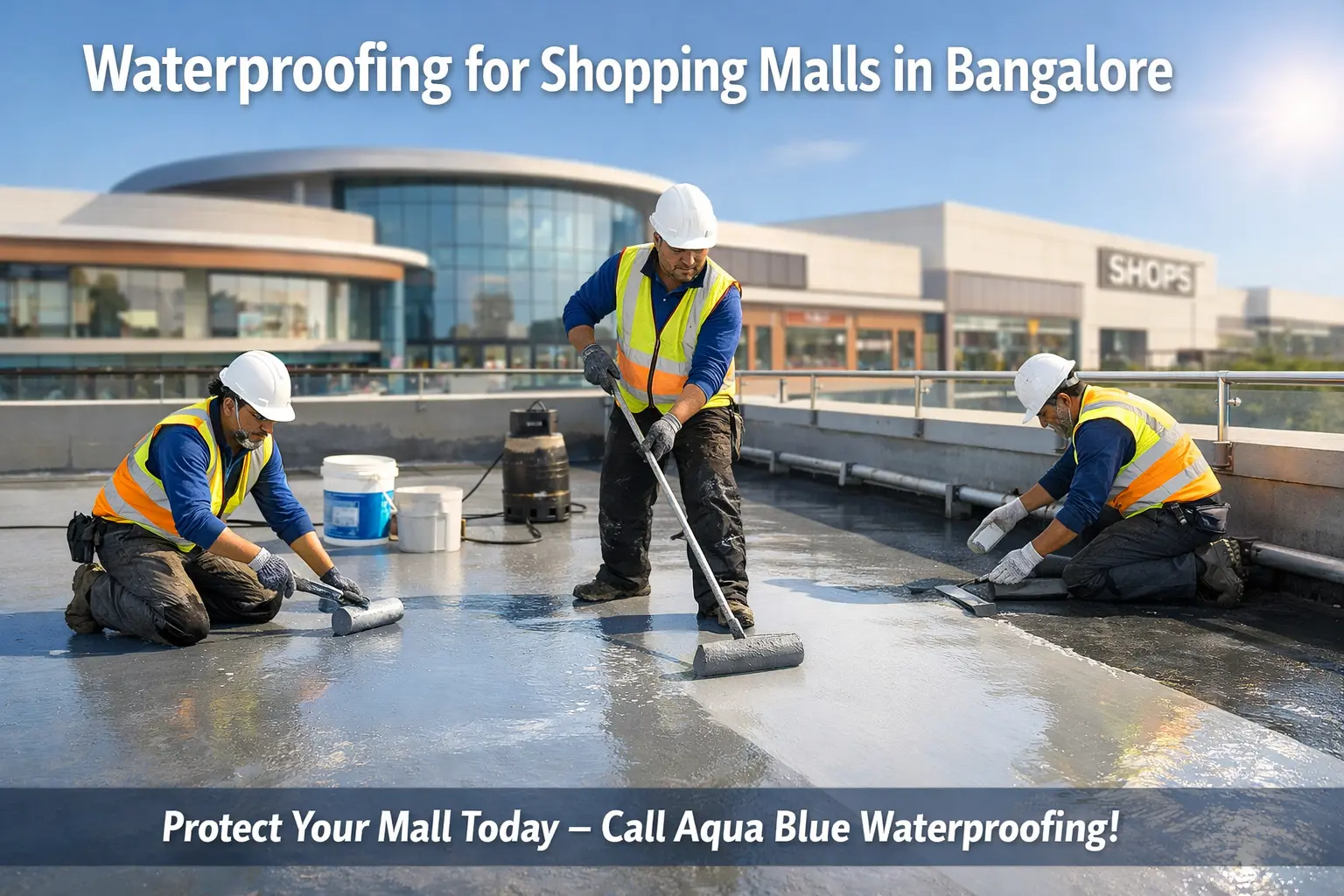
Waterproofing for Shopping Malls in Bangalore: Trusted Expert Solutions
Maintaining a shopping mall in a city like Bangalore is a massive logistical challenge. With the city’s rapid urban expansion and notorious monsoon cycles—often bringing intense, sudden downpours—structural integrity is under constant threat. Many facility managers mistakenly believe that a simple patch-up or basic coat of paint is enough to handle the 900mm+ of annual rainfall Bangalore receives. However, for high-traffic commercial hubs like those in Whitefield, Indiranagar, or Koramangala, a single leak in a food court or a basement parking lot can result in massive revenue loss, slip-and-fall liabilities, and long-term structural decay. This guide is designed specifically for Mall Facility Managers and Property Owners to provide a roadmap for professional waterproofing services in bangalore. Need Urgent Mall Waterproofing Solutions? 📞 Call Aqua Blue Waterproofing: +91 8892026121 Table of Contents • What Is Shopping Mall Waterproofing? • Why Bangalore Malls Face Frequent Leakage • Impact on Infrastructure, Revenue & Safety • Best Waterproofing Solutions for Bangalore Malls • How Facility Managers Choose the Right Method • Why Choose Aqua Blue Waterproofing? • Our Step-by-Step Professional Process • Hyper-Local Expertise: Areas We Serve • FAQs What Is Waterproofing for Shopping Malls in Bangalore & Why Does It Matter? Commercial waterproofing for shopping malls in Bangalore goes far beyond residential standards. It is a specialized engineering process designed to protect vast, flat RCC (Reinforced Cement Concrete) roofs, multi-level basements, and complex expansion joints from water penetration. In a city where real estate value is among the highest in India, the “shell” of your building is your most valuable asset. In Bangalore’s climate, the combination of high humidity and heat followed by heavy rain causes constant expansion and contraction of building materials. Without high-elasticity waterproofing, these structures develop micro-cracks that turn into major seepage points. Understanding how waterproofing protects mall infrastructure is the first step toward avoiding multi-crore structural repair bills. Waterproofing for shopping malls in Bangalore isn’t just about stopping a drip; it’s about life-cycle management of the concrete itself. Why Do Shopping Malls in Bangalore Face Frequent Water Leakage Problems? Bangalore’s unique soil profile, often clay-heavy with high water tables in areas like Bellandur and Electronic City—creates immense hydrostatic pressure against mall foundations. Roof Slab Seepage Most Bangalore malls feature large, flat rooftop areas used for HVAC chillers, solar panels, or parking. Standing water during monsoons is the primary cause of slab seepage. When water “ponds” on a flat roof, it finds the smallest capillary pores in the concrete to enter the building. Expansion Joint Failure Malls are massive structures built in sections. The joints between these sections are “living” cracks that require specialized flexible sealants. If these fail, water enters the vertical structure, often appearing as leaks on multiple floors simultaneously. This is a common reason for shopping mall leak repair Bangalore calls. Service Duct & HVAC Leakage Improperly sealed penetrations for air conditioning pipes and electrical cables often become hidden pathways for water ingress. These leaks are particularly dangerous as they often occur near electrical panels and server rooms. How Does Water Leakage Impact Mall Infrastructure, Revenue & Safety? A leak isn’t just an aesthetic issue; it’s a major business risk. According to industry data from commercial property insights and CREDAI reports, water damage is a leading cause of depreciating asset value in Bangalore’s commercial sector. Revenue Loss: If an anchor tenant like Zara or H&M experiences a ceiling leak, the damage to inventory and the need for store closures directly impact the mall’s rental income and reputation. Electrical Hazards: Water entering false ceilings often comes into contact with complex lighting and POS systems, posing a significant fire risk and potential for localized blackouts. Customer Experience: Musty odors from mold growth and “Buckets on the Floor” during rainy days degrade the premium feel of a mall. Effective waterproofing solutions for malls Bangalore ensure customer satisfaction remains high and safety protocols are met. What Are the Best Waterproofing Solutions for Shopping Malls in Bangalore? Choosing the right waterproofing services in bangalore requires matching the material to the specific architectural zone of the mall. Which Areas Need Waterproofing the Most? Roofs & Terraces: Exposed to direct sunlight and heavy rain; requires UV-resistant coatings. Basement Parking: Requires “negative side” waterproofing to combat groundwater pressure. Podiums & Food Courts: High-traffic areas where kitchen drainage and landscaping irrigation add constant moisture. What Materials Work Best for Commercial Mall Waterproofing? Liquid Applied Membranes for Commercial Waterproofing: These provide a seamless, joint-free layer. High-quality PU (Polyurethane) Coatings are preferred for roofs due to their 400% elongation capacity, allowing them to stretch without cracking. APP Bituminous Membranes: Ideal for heavy-duty basement and podium protection where thick, torch-applied shielding is required. TPO Membranes: Advanced thermoplastic polyolefin for large-scale energy-efficient roofing that also reflects heat, reducing HVAC loads. How Do Mall Facility Managers Choose the Right Waterproofing Method? Selecting a vendor for commercial waterproofing services Bangalore involves more than just looking at the lowest quote. Facility managers must weigh four critical factors: Footfall Impact: Can the work be done without closing entrances? Application Speed: How fast does the material cure? (PU membranes cure faster than traditional cementitious coats). Warranty: Does the provider offer a back-to-back warranty on both material and workmanship? Maintenance Needs: How easy is it to patch the area if future mechanical work (like installing a new AC unit) damages the membrane? Why Choose Aqua Blue Waterproofing for Shopping Malls in Bangalore? At Aqua Blue Waterproofing, we are recognized as mall waterproofing experts in Bangalore with over a decade of hands-on experience in the city’s unique environment. Zero-Disruption Policy: We specialize in “Night Shift” applications to ensure your shoppers never see a brush or a bucket during mall hours. Inspection-First Approach: We use thermal imaging and moisture sensors to find the “invisible” path of a leak before we suggest a solution. Transparent Process: We provide detailed BOQs (Bill of Quantities) and use only top-tier brands like Fosroc, Zydex or Sika to ensure Aqua Blue Waterproofing shopping mall services Bangalore stand the test of time. What
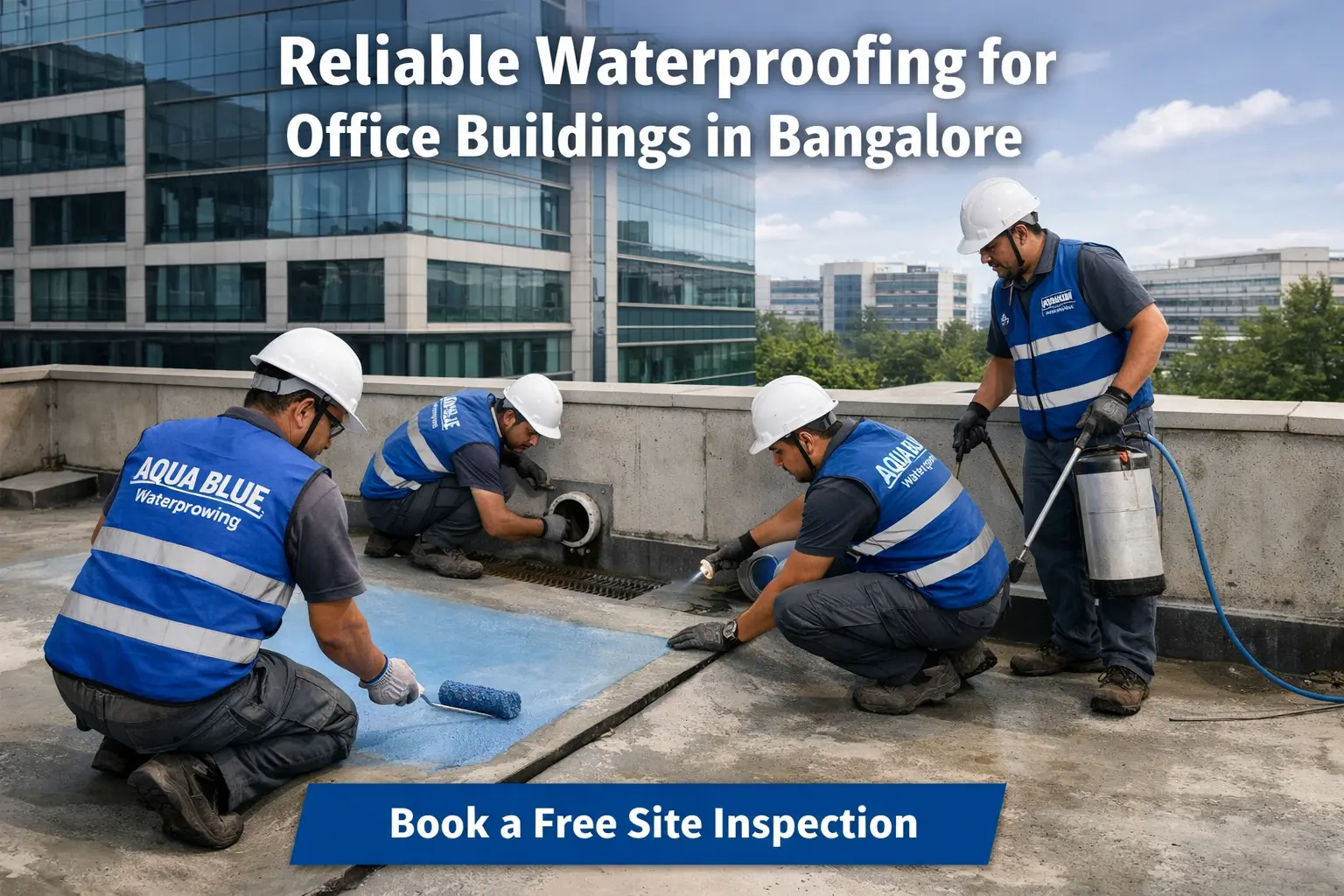
Complete Waterproofing Solutions for Office Buildings in Bangalore
The Bangalore monsoon is a double-edged sword. While the rain brings relief to the city’s heat, it serves as a relentless stress test for commercial real estate. For many Facility Managers & Estate Managers, a single leak isn’t just a maintenance issue—it is a threat to expensive IT infrastructure, server rooms, and employee safety. Many property owners mistakenly believe that patchwork repairs are enough, but in a city with high humidity and heavy rainfall, only a holistic approach works. This guide serves as a roadmap for Property Management Companies and Developers to understand the necessity of Waterproofing for office buildings in Bangalore. We will delve into why standard solutions often fail, the best technical treatments for commercial slabs, and how to protect your asset’s valuation. Need Immediate Expert Assistance? Contact Aqua Blue Waterproofing today for a professional site audit. 📞 Call Us: 88920 26121 Table of Contents • What is “Complete Waterproofing” for Offices? • Why Bangalore Buildings Face Seepage Issues • Common Waterproofing Problems in Offices • Best Waterproofing Solutions for Bangalore Offices • Why Choose Aqua Blue Waterproofing? • Current Market Trends & Costs • How to Choose the Right Contractor • Frequently Asked Questions What Does “Complete Waterproofing for Office Buildings in Bangalore” Actually Mean? Complete waterproofing is not a “bucket and brush” job. In the context of Bangalore’s unique geography—characterized by high-absorption red soil and rapid temperature fluctuations—it refers to an integrated system that protects a building from the foundation to the rooftop. For Waterproofing for office buildings in Bangalore, a complete solution involves identifying the structural vulnerabilities of Grade-A office spaces. Partial fixes often fail because water follows the path of least resistance; if you seal the terrace but ignore the expansion joints, the moisture simply migrates. At Aqua Blue Waterproofing, we emphasize end-to-end barriers that account for Bangalore’s high rainfall zones and the aging RCC (Reinforced Cement Concrete) structures found in hubs like Central Business District (CBD) and Hebbal. Why Do Office Buildings in Bangalore Face Repeated Water Leakage Issues? Bangalore’s commercial landscape has seen a massive boom, but this rapid construction often leads to design gaps. Understanding how to prevent water leakage in office buildings starts with recognizing the local environmental stressors. What Are the Most Common Waterproofing Problems in Office Buildings? Commercial structures face unique pressures that residential buildings don’t. Our diagnostic teams frequently encounter: Expansion Joint Failure: Large office complexes are built in sections; the joints between these sections are often the first to leak. Basement Seepage: With deep multi-level parking common in Whitefield and Electronic City, hydrostatic pressure from the high water table forces moisture through retaining walls. Terrace Slab Cracks: High thermal expansion during Bangalore’s sunny days followed by cool nights causes micro-cracks in concrete. Service Shaft Leaks: Vertical plumbing lines for office restrooms are notorious for office building damp proofing failures. How Does Water Seepage Affect Office Operations & Asset Value? Seepage is a silent killer of property value. Beyond the aesthetic damage of peeling paint, it leads to: Health Hazards: Mold and mildew growth in AC vents (Sick Building Syndrome). Equipment Risk: Water dripping into data centers or UPS rooms can cause millions in hardware loss. Tenant Attrition: Top-tier IT clients will not renew leases in a building with persistent dampness. What Are the Best Waterproofing Solutions for Office Buildings in Bangalore? Finding office waterproofing services near me Bangalore is easy, but finding the right solution requires technical expertise. Commercial waterproofing must be durable enough to handle foot traffic and heavy chillers. Which Waterproofing Methods Work Best for Different Office Areas? Terraces & Roofs: We recommend Polyurethane (PU) Coatings or TPO Membranes. These provide a seamless, UV-resistant shield that handles thermal movement. Basements & Podiums: Crystallization waterproofing or High-Pressure Injection Grouting are the gold standards for stopping active leaks in retaining walls. External Walls: Using Elastomeric coatings ensures the building “breathes” while remaining 100% rain-proof.” How Is Commercial Waterproofing Different From Residential? At Aqua Blue Waterproofing, we simplify these differences into three main areas: 1. No Stopping the Work (Zero-Disruption) In a home, you might be okay with a bit of noise or a strong smell for a day. In an office, work can’t stop. The Simple Difference: We use “Cold-Applied” materials. This means no big fires, no melting tar, and no toxic smells that give employees headaches. We use high-tech coatings that are safe for people to breathe while we work right outside their windows. 2. Built for Heavy Pressure (Load Resistance) A house roof only has to deal with rain. An office roof usually carries massive AC units, water tanks, and heavy machinery that vibrates 24/7. The Simple Difference: Commercial waterproofing is “industrial grade.” It’s designed to be thick and flexible enough to stay waterproof even when heavy machines are shaking it or people are walking on it every day. 3. Working in Stages (Phased Execution) You can’t just block the entrance to an IT park or close the whole parking lot. The Simple Difference: We work like “Ninjas.” We finish one small section (like 25% of the parking lot) and open it back up before moving to the next. This ensures your office keeps running and employees can park their cars without any hassle. Read related blog also:- Commercial Waterproofing in Bangalore Why Choose Aqua Blue Waterproofing for Office Buildings in Bangalore? As office waterproofing experts Bangalore, we don’t believe in guesswork. Our approach is data-driven and tailored to the local climate. What Is Aqua Blue’s Process for Office Waterproofing Projects? Moisture Mapping: Using infrared thermal imagers to find hidden leaks. Surface Preparation: Grinding and cleaning the substrate (the most skipped step by cheap contractors). Multi-Layer Application: Applying primer, reinforcement mesh, and topcoats. Pond Testing: Filling treated areas with water for 48-72 hours to ensure 100% success. Searching for the best waterproofing company for office buildings Bangalore? Look for our portfolio of successfully treated IT parks and commercial hubs across the city. What Do Recent Bangalore Commercial Property Trends Say About Waterproofing? (2026–2027)
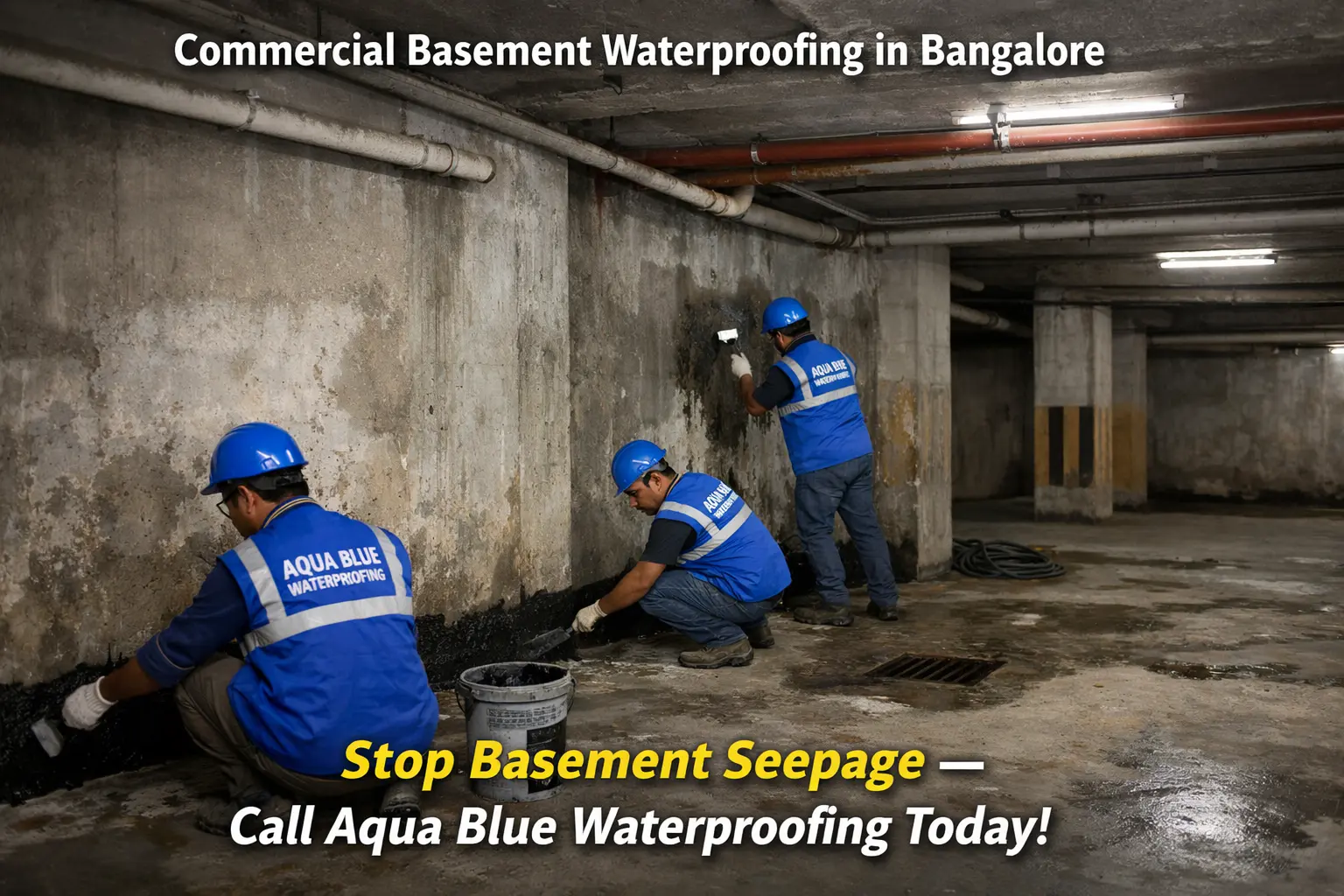
Commercial Basement Waterproofing in Bangalore: Expert Solutions to Stop Seepage & Structural Damage
A damp basement in a Bangalore commercial complex is more than just an eyesore; it is a ticking time bomb for your building’s structural integrity. Many property owners mistakenly believe that a few patches of white efflorescence or minor wall sweating are normal results of Bangalore’s climate. However, with the city’s unique red soil composition and a rapidly rising water table in areas like Sarjapur and Whitefield, minor leaks quickly escalate into major foundation threats. This comprehensive guide is designed for Commercial Property Owners, Facility Managers, and Industrialists who need to understand the technical realities of Commercial Basement Waterproofing in Bangalore. We will explore why local soil conditions demand specialized care, the specific causes of seepage in our tech parks, and the high-performance solutions offered by Aqua Blue Waterproofing to ensure your asset remains dry, safe, and compliant. Need an Expert Inspection Today?📞 Call Aqua Blue Waterproofing: 88920 26121 Protect your investment with Bangalore’s trusted basement specialists. Table of Contents Why Commercial Waterproofing is Critical in Bangalore Root Causes of Basement Seepage in Local Buildings The Impact on Safety, Compliance, and Asset Value Timing Your Waterproofing Projects The Best Solutions for Commercial Parking Structures Modern Solutions: Comparing Chemical Injection vs. Crystalline Healing The Aqua Blue Step-by-Step Foundation Process Why Choose Aqua Blue Waterproofing Fixing Leaks Permanently vs. Temporary Patches Frequently Asked Questions Why Is Commercial Basement Waterproofing in Bangalore a Critical Concern for Property Owners? In a city like Bangalore, the basement is often the “brain” of a commercial building, housing electrical panels, HVAC systems, and high-density parking. Commercial Basement Waterproofing in Bangalore is not a luxury; it is a fundamental engineering requirement. The city’s rapid urbanization has led to significant changes in groundwater flow. When heavy monsoons hit, the hydrostatic pressure against basement walls increases exponentially. Without a professional waterproofing system, water is forced through microscopic pores in the concrete, leading to “weeping walls.” At Aqua Blue Waterproofing, we’ve seen that proactive measures cost significantly less than the structural repairs required once the reinforcement steel begins to corrode. What Causes Basement Seepage in Commercial Buildings in Bangalore? Understanding the “why” is the first step toward a permanent solution. Bangalore’s geography presents unique challenges that differ from other Indian metros. What Are the Most Common Reasons for Basement Water Leakage in Bangalore? High Groundwater Pressure: In areas like Bellandur and Hebbal, the water table is high. Hydrostatic pressure pushes water through the floor-to-wall joints (coves). Poor Construction Joints: Many older commercial buildings lack “water stops” at the junctions where the floor slab meets the retaining wall. Soil Settlement & Cracks: Bangalore’s soil can shift, causing structural cracks in the foundation that act as direct pathways for water. Failed Membranes: Standard bitumen coatings often fail after 5–7 years due to the acidic nature of Bangalore’s groundwater. Why Is Basement Waterproofing Important for Commercial Properties in Bangalore? How Does Basement Seepage Impact Commercial Safety, Compliance, and Asset Value? Neglecting seepage leads to a cascade of failures: Structural Compromise: Constant moisture causes “spalling,” where the concrete breaks away from the rusted iron rods inside. Electrical Hazards: Many Bangalore IT parks house server rooms in lower levels. Seepage near electrical conduits is a severe fire risk. Health & Air Quality: Mold and mildew thrive in damp basements, circulating through the building’s HVAC system and affecting employee health. Property Valuation: A leaky basement is a red flag during audits, significantly lowering the market value of the commercial asset. When Is the Best Time to Waterproof a Commercial Basement in Bangalore? Should Basement Waterproofing Be Done Before or After the Monsoon? While Aqua Blue Waterproofing provides emergency services year-round, the best time to waterproof is during the pre-monsoon months (February to May). This allows for proper surface drying and curing of specialized membranes. However, if you notice active “gushing” leaks during the rains, PU Injection Grouting can be performed from the inside to stop water flow immediately. What Is the Best Waterproofing Solution for Commercial Basement Parking in Bangalore? Parking decks require a system that can handle both water pressure and the vibration of heavy vehicle movement. Which Waterproofing Methods Work Best for Bangalore’s Soil & Climate? PU Injection Grouting: Ideal for fixing active leaks in expansion joints and cracks without excavation. Crystalline Waterproofing: A chemical treatment that becomes part of the concrete structure, sealing pores from the inside out. Thermoplastic Membranes (TPO/PVC): Heavy-duty liners used for external “positive side” waterproofing in new constructions. Epoxy Floor Coatings: Specifically for parking zones to prevent water from seeping through the floor slab. Modern Solutions: Comparing Chemical Injection vs. Crystalline Healing In the Commercial Basement Waterproofing in Bangalore market, these are the two top-tier solutions. One acts as an emergency repair, while the other serves as long-term structural protection. What is PU Injection Grouting? (The Emergency Specialist) If you have an active, gushing leak, PU (Polyurethane) Grouting is the answer. It is a non-invasive “quick surgery” for your walls. How it works: We inject liquid resin into cracks using high-pressure pumps. The Reaction: The resin hits water and expands 20x into a flexible foam, plugging the leak instantly. Best for: Stopping heavy seepage in high-traffic commercial zones where building vibration is common. How Does Crystalline Waterproofing Work? (The Structural Healer) While grouting fixes specific cracks, Crystalline Technology makes the entire concrete structure waterproof from the inside. How it works: A chemical slurry is applied to the interior walls; no external digging is required. The Reaction: Chemicals migrate deep into the concrete to grow millions of crystals that plug every microscopic pore. Self-Healing: If a new hairline crack appears years later, the crystals “wake up” upon contact with water to seal it automatically. This offers permanent defense against seepage pressure. How Is Commercial Foundation Waterproofing Done in Bangalore Buildings? What Is the Step-by-Step Process Aqua Blue Waterproofing Follows? We follow a rigorous, tech-driven approach to ensure 100% dryness: Thermal Imaging & Moisture Mapping: We use sensors to find hidden leak sources without breaking walls. Surface Preparation: Grinding and cleaning

Commercial Roof Waterproofing in Bangalore: Expert Leak-Proof Solutions for Long-Lasting Protection
In a city like Bangalore, where the weather can shift from burning hot days to pouring rain in a single afternoon, a building’s roof is its most important line of defense. For facility managers and warehouse owners, a minor leak isn’t just a nuisance—it can lead to structural damage and expensive repairs.1 With Bangalore’s annual rainfall often exceeding 1,000mm, understanding the technical side of Commercial Roof Waterproofing in Bangalore is essential for long-term property health. This guide provides a clear look at effective roof leak prevention in Bangalore, compares the most durable materials for the local climate, and outlines the standards you should expect from professional services like Aqua Blue Waterproofing to ensure your building remains protected. Protect your assets before the next monsoon. Call Aqua Blue Waterproofing today at +91 88920 26121 for a professional site inspection. Table of Contents The Importance of Commercial Waterproofing Warning Signs Your Roof is Failing Top Waterproofing Materials & Solutions The Professional Waterproofing Process Why Most Waterproofing Fails at the Edges How Smart Waterproofing Saves Your Business Money Maintenance Checklist for Facility Managers Common Pitfalls in Roof Protection FAQs Why Commercial Roof Waterproofing is Crucial in Bangalore Bangalore’s “garden city” climate presents specific challenges for large-scale structures. The city experiences two distinct monsoon seasons—the Southwest and the Northeast—meaning roofs are under constant water pressure for nearly six months of the year. Climate Stress: Rapid temperature shifts between the afternoon sun and cool nights cause concrete to expand and contract, which eventually leads to micro-cracks. Structural Impact: For IT parks in Whitefield or industrial units in Peenya, water ingress can lead to rebar corrosion (rusting of internal steel), which compromises the entire building’s safety. Property Value: Effective Commercial Roof Waterproofing in Bangalore is more than a repair; it is a way to preserve the market value of the asset and prevent internal mold that affects tenant health. Signs Your Commercial Roof Needs Attention Proactive detection is the key to minimizing repair costs. Facility managers should look for these subtle indicators of a failing system: White Powder Stains: White, chalky salt deposits on the underside of the ceiling indicate that water is successfully migrating through the concrete slab. Ponding Water: If water remains on a flat roof 48 hours after a rainstorm, it indicates a failure in the slope or drainage system, often leading to a need for commercial terrace leak repair Bangalore. Interior Blistering: Bubbling paint or peeling wallpaper in top-floor offices are late-stage signs that moisture has already breached the structure. Corner Cracks: Hairline cracks near parapet walls or HVAC mounts are common entry points for water. Top Waterproofing Materials Compared Providing reliable roof waterproofing for office buildings Bangalore requires matching the chemistry to the roof’s usage. A. Polyurethane (PU) Liquid Membranes Often called the “Gold Standard,” PU is a liquid that dries into a seamless, rubber-like skin. Pros: 400% elongation (it stretches without breaking), UV resistant, and seamless. Best For: Complex roofs with many pipes and HVAC units. B. Bituminous (APP) Membranes These are thick, asphalt-based sheets reinforced with polyester. Pros: Extremely tough. It can handle heavy foot traffic and is resistant to punctures. Best For: Industrial warehouses and factories in areas like Peenya. C. TPO (Thermoplastic Polyolefin) A single-ply reflective membrane. Pros: Highly eco-friendly. It reflects sunlight, which can reduce your building’s cooling costs by up to 20%. Best For: Modern “Green” buildings and massive flat-roof warehouses. D. Cementitious Coatings A blend of sand and specialized chemicals. Pros: Breathable and cost-effective. Best For: Underground sumps, lift pits, or as a base layer for balconies. Quick Comparison: Waterproofing Solutions Material Type Best For Key Advantage PU (Polyurethane) Office Buildings High elasticity; moves with building expansion. Bituminous Membranes Industrial Warehouses Durable and resistant to heavy physical impact. Cementitious Coatings Small Commercial Areas Cost-effective and easy to apply for rigid structures. Cool Roof Coatings Tech Parks Reflects heat, reducing AC costs. The Professional Waterproofing Process Quality results depend 20% on the material and 80% on the application process. A standard professional approach should include: Detailed Site Audit: Using moisture meters to find hidden dampness. Surface Engineering: Removing old, weak layers and cleaning the substrate with high-pressure water jets. Mechanical Grinding: Ensuring the concrete is “open” enough to bond with new chemicals. Application: Applying the membrane in cross-directional layers for maximum strength. Quality Validation: Conducting a 24-hour flood test to ensure the system is watertight. Read Also:- Commercial Waterproofing in Bangalore Why Most Waterproofing Fails at the Edges Even the most expensive materials will fail if the “detailing” is ignored. On a large commercial roof in Bangalore, the most dangerous areas aren’t the flat surfaces, but the joints and corners. At Aqua Blue Waterproofing, we pay extra attention to these three critical spots: Parapet Wall Coving (Corner Rounding): Water loves to trap itself in the sharp 90-degree angle where the floor meets the wall. We create a “cove”—a smooth, curved slope at every corner—so water cannot sit there. Expansion Joint Sealing: Large commercial buildings are designed to move and “breathe.” We use high-grade, flexible seals that act like a “rubber bridge,” allowing the building to move without breaking the shield. Pipe and HVAC Penetrations: Every time a pipe goes through your roof, it creates a hole. We use specialized “liquid flashing” to wrap around these pipes like a tight sleeve. How Smart Waterproofing Saves Your Business Money Many facility managers view waterproofing as a “repair cost,” but it is actually a long-term financial asset. For a typical commercial building in Bangalore, investing in professional-grade waterproofing provides a measurable Return on Investment (ROI) in three ways: Energy Savings: Advanced coatings with high SRI (Solar Reflective Index) can reduce your building’s internal temperature by 5–8°C. This leads to a 15-20% reduction in monthly AC electricity bills. Asset Protection: By preventing “concrete cancer” (rebar rusting), you avoid structural repairs that can cost ten times more than the waterproofing itself. Tenant Retention: For commercial landlords, a leak-free building means fewer complaints, lower turnover, and higher rental yields. Maintenance