
waterproofingaquablue@gmail.comPRAVEEN P is the Founder of Aqua Blue Waterproofing and a Waterproofing Technical Specialist with over 16 years of industry experience. Since establishing the company in 2014, he has helped homeowners and businesses across Bangalore solve leakage and seepage issues through reliable, long-lasting waterproofing solutions and expert guidance. waterproofingcontractorsbangalore.com
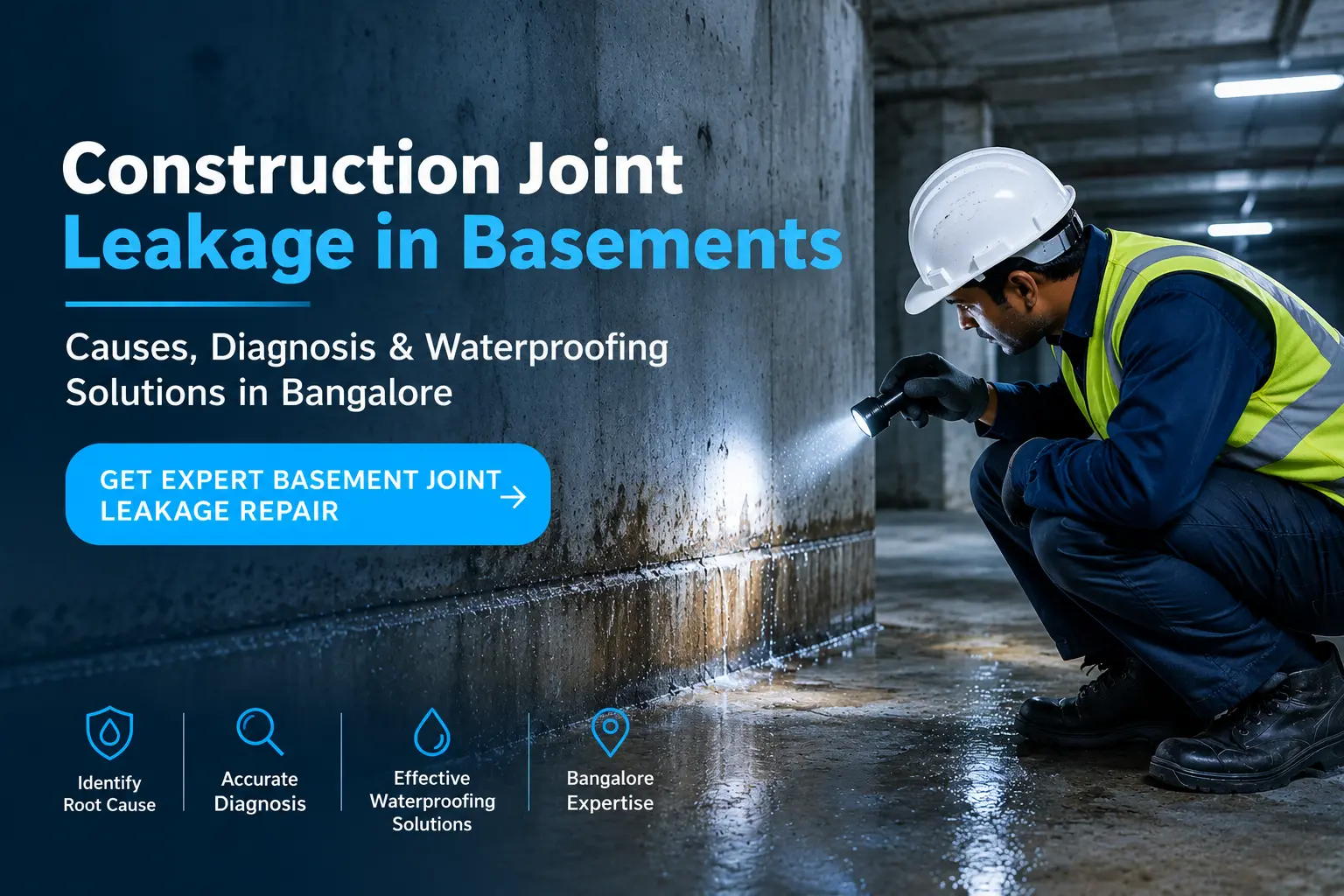
Construction Joint Leakage in Basements: Causes, Diagnosis & Waterproofing Solutions in Bangalore
Persistent water seepage through below-grade construction joints can destabilize structural elements, damage stored goods, and compromise basement utility in commercial and residential developments. In urban hubs like Bangalore, high hydrostatic pressure from seasonal monsoons and perched water tables forces water into microscopic cold joint seams. Resolving this issue permanently requires precise internal pathway diagnosis, appropriate material selection, and site-specific waterproofing execution. At Aqua Blue Waterproofing, we diagnose deep-seated concrete cold joint failures and deploy specialized waterproofing solutions across multi-level residential basements, IT park parking facilities, and commercial complexes in Bangalore. This comprehensive guide covers cold joint vulnerabilities, diagnostic protocols, chemical waterproofing options, and preventive construction standards. Need an urgent site inspection for basement or joint leakage in Bangalore? 📞 Call Aqua Blue Waterproofing Experts: 88920 26121 Table of Contents Why Construction Joints Become Leakage Points in Basements Why Do Construction Joints Leak in Basements? What Causes Basement Construction Joint Leakage? How to Identify Construction Joint Leakage in a Basement Signs of a Leaking Construction Joint in a Basement How to Diagnose the Source of Basement Water Leakage What Is the Best Waterproofing for Basement Construction Joints? How to Seal Basement Construction Joints Construction Joint Leakage Repair Process in Bangalore Why Basement Joint Leakage Can Return After Repair How to Prevent Construction Joint Leakage in New Basements Construction Joint Leakage in Bangalore: Local Conditions to Consider What to Check Before Hiring a Basement Joint Waterproofing Contractor FAQs About Construction Joint Leakage in Basements Construction Joint Leakage Repair in Bangalore Why Construction Joints Become Leakage Points in Basements Water leakage through basement joints is one of the most common issues in underground concrete structures. A construction joint (or cold joint) is an intentional break created when fresh concrete is poured against a previously hardened concrete lift. Because the two concrete lifts do not form a continuous chemical or physical bond, a microscopic interface remains between them. Subterranean water seepage typically occurs along these cold joints due to surrounding soil saturation and groundwater head pressure. Hydrostatic pressure continuously pushes groundwater against below-grade basement retaining walls and raft slabs. Water bypasses solid, dense concrete by finding paths of least resistance, such as cold joints, honeycombed aggregates, and structural micro-fissures. Effective basement waterproofing in Bangalore requires tracing the entry path of water rather than simply applying a surface patch over visible moisture. Surface coatings applied to the interior face often fail under negative hydrostatic pressure if the internal joint cavity remains unsealed. Identifying whether water originates from a cold joint, tie-rod hole, or porous concrete matrix ensures the correct waterproofing treatment is selected for long-term protection. Why Do Construction Joints Leak in Basements? Understanding why construction joints leak requires examining both physical site stresses and concrete placement practices. Hydrostatic Pressure From Groundwater Groundwater surrounding below-grade basement walls exerts continuous lateral and vertical pressure against the structure. As rain saturates the surrounding soil, the water table rises, increasing hydrostatic head pressure. This force drives water through tiny capillary networks within the cold joint interface. Poor Construction Joint Preparation Proper surface preparation is crucial before pouring adjacent concrete lifts. Common jobsite errors include: Concrete Laitance: A weak, milky layer of cement and fine particles that forms on top of a concrete lift, preventing strong bonding with the next pour. Accumulated Dust and Debris: Construction debris, sawdust, or soil left on the joint interface before the second pour creates interconnected pathways for water. Inadequate Surface Roughness: Smooth, un-roughened joint faces lack mechanical interlock, weakening the cold joint boundary. Missing or Damaged Waterstop Systems In subterranean concrete construction, physical barriers called waterstops are placed inside the joint prior to pouring. Joint leakage often traces back to missing or compromised waterstop systems: PVC Waterbars: Can bend, fold, or displace during heavy concrete vibration, leaving unsealed gaps. Hydrophilic Waterstops: Swellable strip sealants that expand on contact with moisture. If exposed to rain before the second concrete pour, they pre-swell and lose their sealing capacity. Injection Hose Systems: Perforated hoses embedded along joints that remain un-grouted or get crushed during concrete placement. Concrete Shrinkage and Joint Deterioration As concrete cures, hydration and thermal cooling cause volume contraction. Drying shrinkage pulls adjacent pours slightly apart, widening the cold joint interface into a micro-fissure capable of passing water under pressure. Movement Between Concrete Sections Differential foundation settlement, soil compaction variations, and thermal expansion create micro-movements between structural wall lifts and raft slabs. Rigid surface repairs crack under this movement, reopening water entry paths. Failed Previous Waterproofing or Joint Repairs Temporary fixes—such as patching joints with standard cement mortar, applying non-flexible surface renders, or smearing topical silicone sealants—fail under negative hydrostatic pressure. Water eventually pushes through or bypasses these surface barriers. What Causes Basement Construction Joint Leakage? Cause How It Can Lead to Leakage Hydrostatic pressure Pushes water toward vulnerable joint areas under sustained subterranean head. Poor joint preparation Creates pathways through the concrete interface due to laitance and debris. Damaged waterstop Allows water to bypass the intended physical barrier within the concrete mass. Joint movement Stresses rigid sealing materials, causing cracking and bond line separation. Concrete honeycombing Creates connected voids and pathways adjacent to the construction joint. Failed sealant Allows water to enter through the joint face due to loss of adhesion or elasticity. Poor drainage Increases water pressure around the structure by trapping groundwater against walls. Aging waterproofing Reduces protection over time as external membranes degrade or shift. How to Identify Construction Joint Leakage in a Basement Identifying the precise leak location prevents unnecessary structural hacking and misdirected repairs. Check Where Water Is Appearing Inspect high-risk structural interfaces across the basement layout: Wall-to-Floor Junctions: The kick-off joint where vertical retaining walls meet horizontal raft slabs. Basement Slab Joints: Sequential pour lines across large basement floor slabs. Retaining Wall Joints: Horizontal lift lines between vertical concrete pours. Vertical Construction Joints: Pour breaks between adjacent retaining wall panels. Concrete Wall Interfaces: Transitions between main structural concrete and brick or block infill. Check Whether Leakage Follows the Joint Line Water originating from a cold
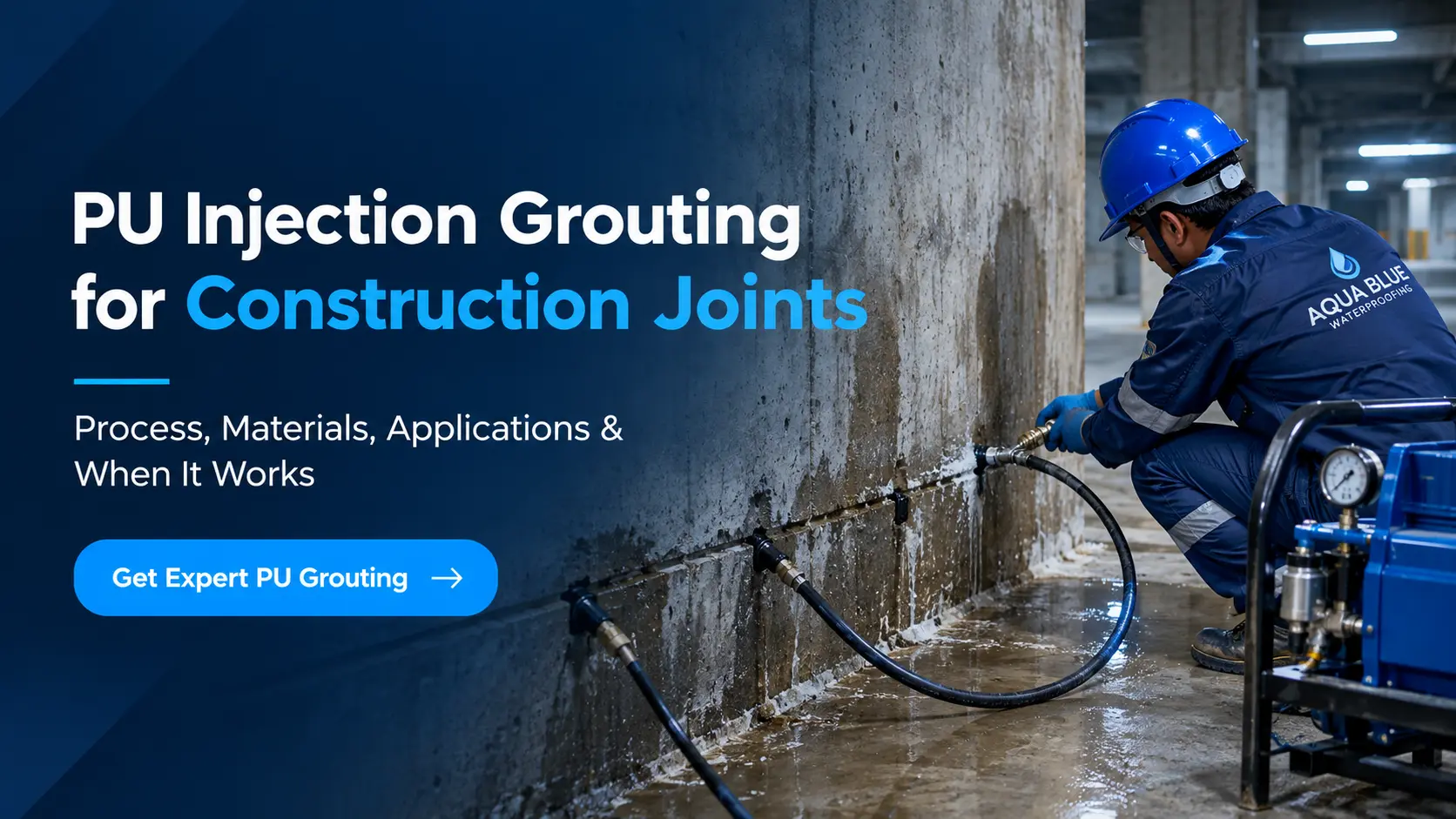
PU Injection Grouting for Construction Joints: Process, Materials, Applications & When It Works
Active water seepage through a basement construction joint or underground raft slab can compromise a building’s functional integrity. In commercial and residential infrastructure, positive-side exterior waterproofing membranes eventually degrade, shift, or fail due to high hydrostatic pressure. When excavating the exterior perimeter is structurally unfeasible, cost-prohibitive, or physically blocked, property managers, civil engineers, and structural consultants turn to PU injection grouting for construction joints as a non-destructive repair solution. At Aqua Blue Waterproofing, we specialize in diagnosing deep structural water pathways and deploying advanced polyurethane injection techniques across residential complexes, IT parks, and commercial basements. This comprehensive guide details the mechanics of PU resin, step-by-step injection procedures, material selection criteria, and realistic expectations for long-term waterproofing performance. Need an urgent site inspection for active basement or joint leakage in Bangalore? 📞 Call Aqua Blue Waterproofing Experts: 88920 26121 Table of Contents Introduction What Is PU Injection Grouting for Construction Joints? What is a construction joint? What is polyurethane injection grouting? Is PU injection grouting a structural repair? When Does a Construction Joint Need PU Injection Grouting? How Does PU Injection Grouting Work? What Materials Are Used for PU Injection Grouting? Hydrophobic vs Hydrophilic PU Injection Grout: What’s the Difference? When Does PU Injection Grouting Work Best? When PU Injection Grouting May Not Be the Right Solution PU Injection Grouting vs Other Construction Joint Waterproofing Methods PU Injection Grouting for Different Construction Joint Applications What Should Be Checked Before PU Injection Grouting? PU Injection Grouting Process in Bangalore: What Changes on Site? How Long Does PU Injection Grouting Last? How to Know If PU Injection Grouting Has Been Done Properly Frequently Asked Questions About PU Injection Grouting Get Construction Joint Leakage Assessed by a Waterproofing Professional Polyurethane (PU) injection grouting for construction joints is a specialized negative-side waterproofing method where low-viscosity liquid polyurethane resin is pumped under controlled high pressure directly into internal cold joints, micro-fissures, and voids in concrete. When the injected resin comes into contact with moisture or active water inside the joint, it reacts chemically to expand into a dense, closed-cell foam or resilient elastomer. This reaction completely seals the internal void network, stopping active water ingress at its source without requiring external wall excavation. This technique is essential when water is actively leaking through a subterranean construction joint and the exterior (positive-side) face is inaccessible due to backfilled soil, surrounding structures, or deep raft foundations. By delivering liquid chemistry deep within the concrete matrix via mechanical packers, PU injection fills intricate capillary networks that surface coatings cannot reach. Crucial Technical Distinction: PU injection grouting is strictly a waterproofing and leak-sealing treatment, not a structural repair. While flexible PU resins stop water travel and accommodate dynamic joint movement, they do not restore original tensile or flexural load-bearing capacity to structurally compromised concrete elements. What Is PU Injection Grouting for Construction Joints? Understanding the physical nature of concrete pours is essential to understanding why joint waterproofing fails. What is a construction joint? A construction joint (or cold joint) is a planned stopping point created when concrete placement occurs in separate sequential stages rather than a single continuous pour. Typical locations include raft-to-wall junctions, floor lifts, and retaining wall segments. Because new concrete does not chemically bond seamlessly to hardened concrete, a microscopic seam is formed. Under sustained hydrostatic pressure, groundwater forces its way into this interface, making construction joints a primary pathway for internal building leakage. What is polyurethane injection grouting? Polyurethane injection grouting is a mechanical process designed to fill internal concrete voids. The operational sequence follows a simple path: Mechanical Injection Port (Packer) $\rightarrow$ Pressurized PU Liquid Resin $\rightarrow$ Internal Leakage Path Intersect $\rightarrow$ Chemical Reaction / Expansion $\rightarrow$ Impermeable Seal Is PU injection grouting a structural repair? AEO Answer Box: Waterproofing vs. Structural Injection No, PU injection grouting is not a structural repair. Polyurethane resins are engineered for volume expansion, hydro-blocking, and elasticity. They lack the high compressive, tensile, and shear strengths required to structurally bind fractured concrete together. Treatment System Main Purpose Suitable Joint Condition Movement Allowance PU Injection Grouting Water stopping & flexible leak sealing Wet, water-bearing, active leaks Accommodates minor dynamic joint movement Epoxy Injection Structural crack bonding & load transfer Dry/non-active structural cracks Rigid; zero movement tolerance Microfine / Cementitious Grout Large void filling & mass stabilization Non-moving, wide cavities or honeycombing Rigid; no movement accommodation Surface Elastomeric Coating Surface water barrier Clean, accessible exterior/interior faces Accommodates surface-level movement When Does a Construction Joint Need PU Injection Grouting? Surface renders and topical mortar patches often fail on leaking construction joints because negative hydrostatic pressure pushes surface films off the concrete face over time. PU injection is indicated when water travels deep within the concrete thickness. Decision Checklist: [x] Active water trickling, seeping, or gushing through the joint line. [x] Continuously damp or water-bearing construction joints. [x] Ingress under high hydrostatic pressure from subterranean water tables. [x] Joint inaccessible from the exterior due to backfill or adjacent structures. [x] Water entering through basement walls, raft slabs, or lift pits. [x] Water bypassing existing surface-applied membranes. Mini-Answer: PU injection grouting for construction joints is considered when water travels through internal concrete paths and surface-applied treatments cannot reliably access or seal the leak path. How Does PU Injection Grouting Work? Executing a durable PU injection repair requires a disciplined, step-by-step process. Pumping resin without systematic preparation leads to material waste and incomplete void sealing. Step 1 — Inspect the Construction Joint Inspect the joint geometry, active water pressure, flow volume, concrete soundness, presence of honeycombing, and accessibility for high-pressure injection equipment. Step 2 — Mark the Leakage Path Trace the structural orientation of the internal joint line. Water rarely travels in a straight line through concrete; identifying the true structural path prevents misdirected drilling. Step 3 — Drill Injection Ports Drill holes along the joint at a 45-degree angle to the surface. Holes are spaced based on wall thickness (typically equal to 1/2 the wall thickness) and staggered on alternate sides

Concrete Cold Joints in Bangalore: Key Considerations for Long-Term Concrete Protection
Water leakage along structural concrete seams is one of the most persistent issues affecting residential apartments, commercial complexes, and industrial sites across Bangalore. During heavy monsoon downpours, water collects on flat roofs, podium decks, and basement walls, quickly finding micro-fractures along concrete cold joints in Bangalore properties. Securing specialized joint treatment is essential for protecting structural integrity, preventing steel rebar corrosion, and eliminating recurring interior dampness. This comprehensive guide details the mechanics of cold joint formation, preventive construction practices, advanced diagnostic techniques, and high-performance repair methodologies. Whether managing an ongoing leakage problem or planning new construction, understanding proper joint treatment ensures long-term protection against water ingress. Need immediate technical help or a site inspection for leaking building joints in Bangalore? Contact our senior specialists at Aqua Blue Waterproofing by calling +91-88920 26121. Table of Contents What Are Concrete Cold Joints? What Happens When Concrete Pouring Is Interrupted? Where Do Cold Joints Occur in Buildings? How to Identify a Cold Joint in Concrete Can Concrete Cold Joints Cause Water Leakage? How Can Cold Joints Be Prevented During Concrete Construction? What to Do When Water Leaks Through a Concrete Cold Joint? Concrete Cold Joint Repair: What Does the Process Involve? Cold Joint Waterproofing in Bangalore: Choosing the Right Treatment Concrete Cold Joint Repair in Bangalore: When Should You Seek Professional Help? Why Cold Joint Treatment Can Fail Frequently Asked Questions About Concrete Cold Joints Conclusion: Protecting Concrete Cold Joints for Long-Term Performance What Are Concrete Cold Joints? A concrete cold joint is an unplanned boundary formed when fresh concrete is placed against a previous pour that has already started setting. This delay prevents mechanical interlocking and chemical bonding, creating a structural seam vulnerable to water ingress. Identifying and treating these interfaces is essential for long-term structural protection when managing concrete cold joints in Bangalore. In concrete construction, a cold joint represents a plane of weakness where two successive placements of concrete meet without forming a unified monolithic mass. When fresh concrete comes into contact with concrete that has already passed its initial setting phase, the two batches cannot mix or bond together seamlessly at the interface. Bonding at this interface becomes a significant concern because the shear strength and tensile capacity across the seam are reduced compared to continuous concrete. However, a cold joint is not automatically equivalent to a structural failure. With proper engineering evaluation, mechanical bonding agents, and surface preparation, cold joints can be managed without compromising the safety of the structure. Cold Joint vs Planned Construction Joint Feature Cold Joint Planned Construction Joint Origin Results unexpectedly from an unplanned pour delay Intentionally designed and scheduled in structural drawings Location Occurs randomly wherever the pour was halted Predetermined at points of minimum shear stress Bonding Interface Weak bond due to setting without joint preparation Prepared with keyways, bonding slurry, or water stops Sequence Role Corrective measure required post-placement Formally incorporated into the construction sequence What Happens When Concrete Pouring Is Interrupted? When concrete placement is halted mid-pour, a distinct timeline of material state changes occurs: Concrete Placement → Unplanned Interruption → Initial Setting of First Pour → Subsequent Concrete Placement → Cold Joint Interface Formation As the first batch of concrete sits undisturbed, hydration begins and the cement paste hardens. When subsequent concrete is poured over or against it, the new mix cannot consolidate with the stiffened surface below, forming a distinct cold-joint boundary. Why Concrete Setting Time Matters The time window before a cold joint forms depends entirely on ambient site conditions and concrete mix characteristics: Site Delays and Transit Interruptions: Ready-mix concrete trucks stuck in urban traffic or pump breakdowns on-site cause unexpected delays that allow concrete to reach initial set. Weather and Temperature Shifts: High temperatures and low humidity accelerate hydration, shortening the available window for continuous placement. Admixtures and Mix Design: Retarders extend workable times, whereas accelerators speed up setting times. Coordinated Concrete Pouring: Maintaining synchronized batching, transportation, and vibration schedules ensures fresh layers integrate before the underlying concrete sets. Where Do Cold Joints Occur in Buildings? Unplanned cold joints develop across various structural elements during construction: Cold Joints in RCC Slabs Large slab casts frequently experience cold joints when concrete pumping pauses between mixer truck deliveries, creating horizontal weakness planes across floor decks. Cold Joints in Beams and Columns Vertical cold joints form when column lifts are poured in stages or when high beam-column junctions experience placement delays during congested rebar pours. Cold Joints in Foundations and Raft Slabs Massive concrete pours for raft foundations are susceptible to cold joints if pour rates lag behind setting times across large surface areas. Cold Joints in Basement Walls Pouring retaining and basement walls in lifts creates horizontal cold joints that are continually exposed to external soil moisture and groundwater. Cold Joints in Water-Retaining Structures Cold joints in sumps, overhead water tanks, and swimming pools disrupt continuous concrete density, opening direct paths for stored water to escape. How to Identify a Cold Joint in Concrete A visible line on a concrete surface does not automatically confirm an active cold joint. Proper diagnosis distinguishes superficial surface marks from structural discontinuities. Common Signs to Look For Visible Interface Lines: A distinct, dark, or uneven seam line running across the concrete face. Surface Discontinuity: Rough texture differences, slight offsets, or lack of aggregate continuation across the boundary. Cracks Along the Interface: Micro-fractures following the exact line of the concrete pour seam. Dampness and Seepage: Dark wet patches or active water droplets along the seam line during rain. Efflorescence: White powder or mineral deposits left behind as moisture evaporates through the joint. Localized Concrete Deterioration: Scaling, flaking, or spalling concrete along the seam. What Is Checked During a Professional Inspection? Joint Location and Orientation: Mapping whether the joint lies in a high-shear or high-bending zone. Concrete Surface Cohesion: Testing sound transmission and surface hardness along the joint using hammer tapping or ultrasonic pulse velocity. Extent of Ingress and Voids: Checking for honeycombing, internal air pockets, or continuous leakage pathways. When
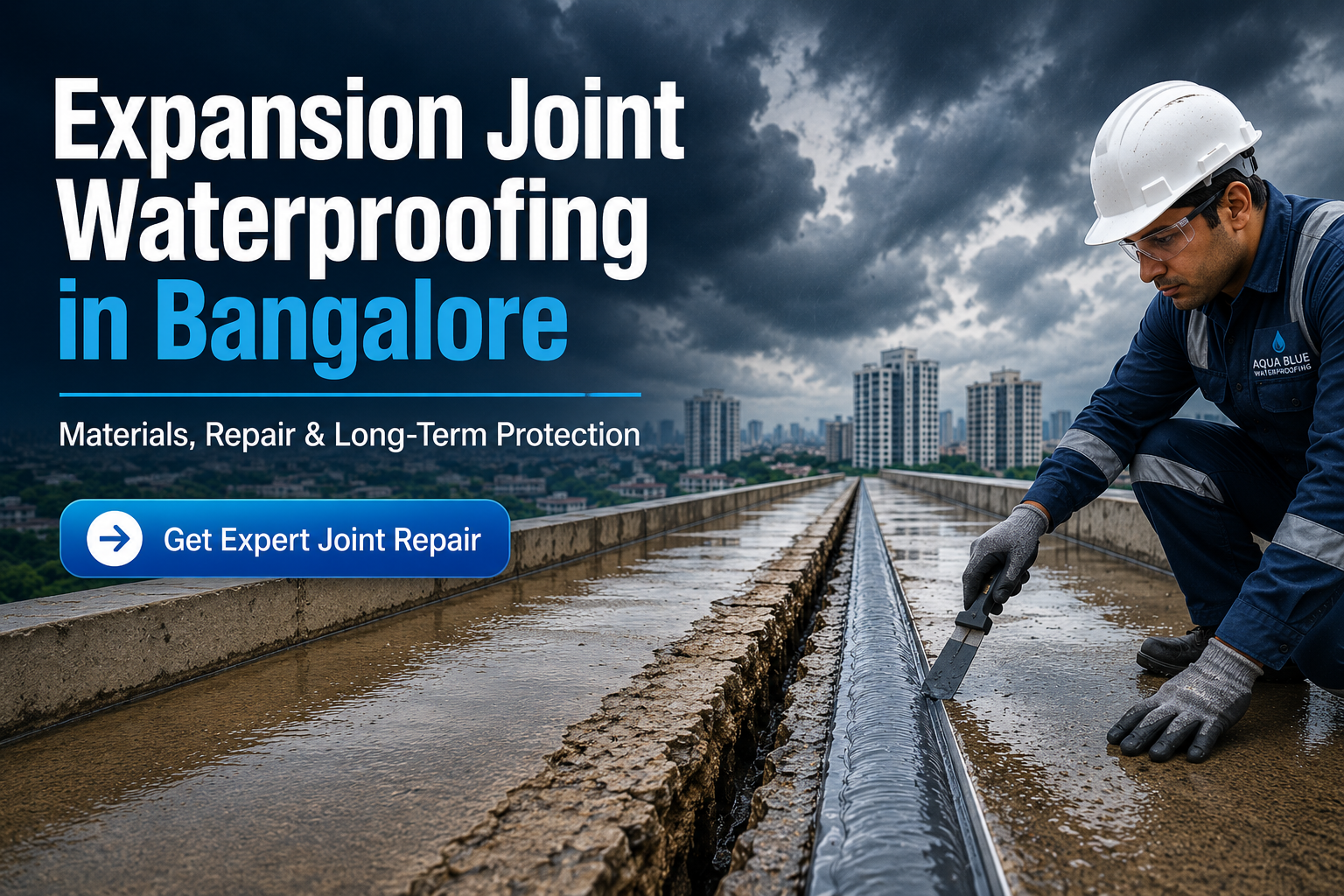
Expansion Joint Waterproofing in Bangalore: Best Materials, Repair & Long-Term Protection
waterproofingaquablue@gmail.comPRAVEEN P is the Founder of Aqua Blue Waterproofing and a Waterproofing Technical Specialist with over 16 years of industry experience. Since establishing the company in 2014, he has helped homeowners and businesses across Bangalore solve leakage and seepage issues through reliable, long-lasting waterproofing solutions and expert guidance. waterproofingcontractorsbangalore.com
Joint Waterproofing in Bangalore: Types of Building Joints, Leakage Causes & Permanent Repair Solutions
waterproofingaquablue@gmail.comPRAVEEN P is the Founder of Aqua Blue Waterproofing and a Waterproofing Technical Specialist with over 16 years of industry experience. Since establishing the company in 2014, he has helped homeowners and businesses across Bangalore solve leakage and seepage issues through reliable, long-lasting waterproofing solutions and expert guidance. waterproofingcontractorsbangalore.com
How to Choose a Waterproofing Method Based on the Source of Water Leakage
waterproofingaquablue@gmail.comPRAVEEN P is the Founder of Aqua Blue Waterproofing and a Waterproofing Technical Specialist with over 16 years of industry experience. Since establishing the company in 2014, he has helped homeowners and businesses across Bangalore solve leakage and seepage issues through reliable, long-lasting waterproofing solutions and expert guidance. waterproofingcontractorsbangalore.com
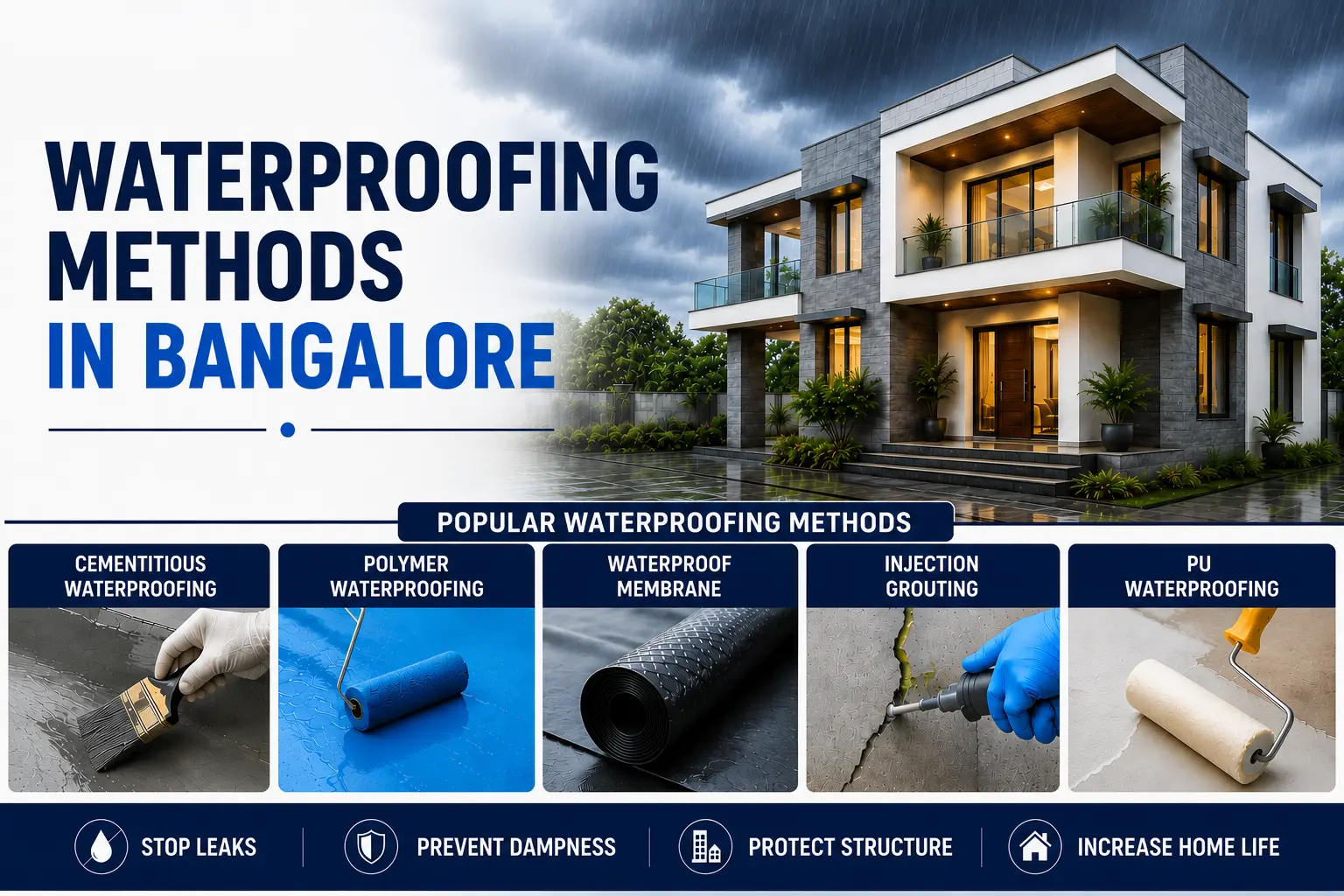
Waterproofing Methods in Bangalore: Which One Actually Works for Your Home?
Bangalore homes face unique structural stress due to sudden weather shifts, heavy monsoons, and thermal expansion. Applying generic coatings without identifying the core issue leads to recurring dampness and wall damage. This guide breaks down the most effective waterproofing methods in Bangalore, comparing polymer, cementitious, membrane, bituminous, and grouting systems so you can choose the long-lasting solution your home needs. Dealing with recurring damp patches or peeling paint on your walls is frustrating, especially in a city like Bangalore where sudden climate shifts and heavy monsoon rains expose hidden structural flaws. Many homeowners spend thousands on quick surface coats only to see water seepage return within months. Choosing the right waterproofing methods in Bangalore requires matching the repair technology to your specific structural issue rather than applying a one-size-fits-all patch. This comprehensive guide breaks down the most reliable waterproofing solutions in Bangalore, helping you protect your property value permanently. For immediate structural inspection and expert guidance, call Aqua Blue Waterproofing at +91 8892026121. Table of Contents Main Types of Waterproofing Methods Used in Bangalore Difference Between Waterproofing Methods Best Waterproofing Method for Specific Water Leakage Problems Which Waterproofing Solutions Last the Longest? How Waterproofing Experts Choose the Right Method Why Waterproofing Fails Even After Repairs Decision Guide: How to Choose the Right Method When Should You Call Waterproofing Experts in Bangalore? Frequently Asked Questions Conclusion Main Types of Waterproofing Methods Used in Bangalore Understanding the primary types of waterproofing methods available allows you to make informed decisions for your home. Cementitious Waterproofing This is a rigid or semi-flexible coating created by mixing Portland cement with synthetic waterproofing agents. Best Use Case: Wet areas like bathroom slabs, water tanks, and balconies before tiling. Durability: High durability in unexposed internal areas. Limitations: Lacks elasticity; it cannot stretch if concrete expands or develops structural movement cracks. Polymer Waterproofing Utilizing advanced synthetic resins like acrylics or polyurethanes, polymer waterproofing in Bangalore creates a seamless, flexible rubber-like protective layer over masonry. Best Use Case: Exposed terraces, exterior walls, and roof slabs subjected to temperature swings. Durability: Excellent resistance to weather and UV exposure. Limitations: Requires precise surface preparation to achieve optimal adhesion. Waterproof Membrane Systems Pre-formed bituminous or synthetic TPO/PVC sheets heat-welded or bonded over concrete decks. Best Use Case: Large commercial rooftops, podiums, and terrace gardens with high traffic. Durability: Exceptional long-term performance when properly protected. Limitations: Improper seam welding can create weak points where water trickles through. Bituminous Waterproofing Asphalt-based liquid coatings or torch-on rolls designed to form a dark, impermeable barrier. Best Use Case: Underground foundations, retaining walls, and basement exteriors. Durability: High against subterranean ground moisture. Limitations: Softens under direct sunlight and degrades without UV protection. Injection Grouting A low-viscosity polyurethane or epoxy resin injected directly under pressure into core structural cracks and hollow voids. Best Use Case: Active water gushing through concrete expansion joints or structural cracks. Durability: Permanent structural fill. Limitations: Serves as a target repair rather than a complete surface coat. Difference Between Waterproofing Methods Understanding the fundamental difference between waterproofing methods helps prevent misapplication. Feature Polymer Waterproofing Cementitious Coating Membrane Sheets Injection Grouting Flexibility High (stretches with cracks) Rigid / Low elasticity Very High Non-applicable (fill) UV Resistance Excellent Moderate (requires cover) Variable by material N/A (Internal core) Crack Bridging Up to 2mm Minimal High Seals core void Maintenance Low Low Moderate Zero Bangalore Fit Ideal for roofs & walls Wet interior slabs Large terraces Structural cracks Best Waterproofing Method for Specific Water Leakage Problems Matching the remedy to your concrete issue is critical when evaluating waterproofing methods for water leakage problems: Terrace Leakage: Liquid elastomeric polymer coatings work best because they expand and contract with summer heat without splitting. Wall Seepage: Breathable polymer waterproof coats combined with acrylic crack sealants protect exterior surfaces while letting internal vapor escape. Bathroom Leakage: Polymer-modified cementitious slurry applied under floor tiles creates a permanent barrier above structural slabs. Basement Moisture: High-density bituminous coatings or crystalline waterproofing withstand heavy hydrostatic water pressure. Crack-Related Leakage: High-pressure polyurethane injection grouting seals deep internal voids instantly. Which Waterproofing Solutions Last the Longest? Selecting long-lasting waterproofing methods in Bangalore depends heavily on building structure type: Independent Homes & Villas: Seamless liquid polymer membranes overlaid with heat-reflective coatings handle direct UV exposure efficiently. Apartments & High-Rises: Combination systems—polyurethane injection for slab voids and elastomeric coats for exterior walls—provide maximum durability. Older Buildings: Flexible, breathable polymer systems are mandatory because aged masonry shifts and settled walls crack easily. Overall, engineered waterproofing solutions for Bangalore homes that combine crack-filling with elastic surface membranes yield the highest lifespan. How Waterproofing Experts Choose the Right Method True waterproofing professionals do not guess; they follow a systematic diagnostic approach: Moisture Inspection: Digital pinless meters measure trapped water density behind plaster. Thermal Leak Detection: Infrared thermography cameras map hidden fluid paths inside walls without destructive drilling. Crack Assessment: Categorizing surface hairline cracks versus deep structural fissures. Surface Evaluation: Assessing substrate concrete strength, dust contamination, and old paint adhesion. This precise diagnostic process is why property owners trust Aqua Blue Waterproofing Bangalore for guaranteed results. Why Waterproofing Fails Even After Repairs Waterproofing projects fail due to poor execution rather than product quality: Selecting rigid cement coats for flexible terrace surfaces. Applying new waterproof coatings over loose, uncleaned dust or peeling paint. Ignoring active internal cracks before painting. Skipping proper moisture testing prior to application. Avoid These Mistakes Checklist: Always clean substrates down to bare masonry. Seal all visible cracks with polymer sealant first. Ensure full curing time between multi-layer coats. Decision Guide: How to Choose the Right Method Ask these questions to select the appropriate waterproofing methods in Bangalore: Is the leakage on an open terrace exposed to sun? Choose Polymer Elastomeric Coating. Is the moisture rising near ground level up to 3 feet? Choose Chemical DPC Injection & Salt-Resistant Plaster. Are there structural cracks dripping water? Choose Polyurethane Pressure Grouting. Is it a wet interior area before tiling? Choose Flexible Cementitious Coating. When Should You Call Waterproofing Experts in
Damp Patches on Walls in Bangalore: Causes, Warning Signs & the Right Waterproofing Solution
Why You Should Never Ignore Damp Patches on Walls? When the heavy monsoon rains clear out, many property owners notice small, unsightly spots darkening their plaster. A common mistake is assuming that these damp patches on walls are just temporary cosmetic flaws that can be painted over. For homeowners looking to protect their properties, understanding the root cause of this wetness is crucial. This guide will show you how to spot the early warning signs of internal dampness, distinguish between different types of leaks, and choose the correct repair methods. By understanding the true source of the problem, you can prevent minor water issues from turning into massive restoration bills. Need Expert Help? Don’t wait until damp patches become structural damage. Our experts identify the source and provide long-lasting waterproofing solutions. Call Now For Site Inspection One – Minute Summary Many homeowners notice damp patches after the monsoon and assume a fresh coat of paint will solve the problem. In reality, these patches often indicate hidden issues like water seepage, plumbing leaks, or failed waterproofing. Ignoring them can lead to peeling paint, mould growth, structural damage, and costly repairs. This guide explains how to identify damp patches early, understand their causes, and choose the right waterproofing solution for a long-lasting fix. Common Causes Early Warning Signs Permanent Waterproofing Solutions When to Book an Inspection TABLE OF CONTENT What Are Damp Patches? Causes of Damp Patches How to Identify Damp Patches Warning Signs Damp Patches on Ceiling and Walls What Happens If Ignored? Permanent Solutions Best Waterproofing Solution Book an Inspection Frequently Asked Questions What Are Damp Patches on Walls? A damp patch is a visible area of moisture that forms within your masonry or concrete. It is important to know the difference between temporary surface wetness and a serious structural issue. Surface dampness might happen after a hot shower or during an incredibly humid day, and it usually dries up quickly on its own once ventilation improves. On the other hand, recurring spots or deep moisture in walls mean that water is continuously forcing its way into your home. These dark patches should never be ignored, as they indicate that your primary building materials are actively absorbing and holding water. What Causes Damp Patches on Walls? It is important to understand that a damp patch is not the actual problemm it is a visible warning sign of a hidden moisture issue. Understanding what causes damp patches on walls is the first step toward choosing the right waterproofing solution and preventing long-term structural damage. Rainwater Seepage Through Exterior Walls When external walls are not properly sealed, structural concrete faces continuous exposure to heavy storms. Rainwater beats against the building, aks through fine exterior cracks, and travels inward until it emerges as a visible patch on your interior room walls. Hidden Plumbing Leaks Even a tiny pinhole leak in an internal water supply pipe or a compromised drainage line hidden inside the brickwork will release water constantly. This creates a focused, ever-growing circle of dampness on the surrounding plaster. Roof or Terrace Leakage If your terrace waterproofing wears out, rainwater will pool on the concrete roof structure. The water slowly tracks downward through microscopic cracks, creating unsightly damp patches on ceiling and walls. Condensation Due to Poor Ventilation When warm, humid air hits cold, unventilated wall surfaces in kitchens or bathrooms, it turns back into liquid water. Over time, this repeated surface wetness creates deep, localized wall dampness. Rising Ground Moisture In ground-floor rooms, groundwater can climb upward from the earth through porous bricks via capillary action. If you want to know more about this specific ground-level issue, read our detailed guide on managing rising damp in Bangalore homes. How to Identify Damp Patches on Walls Before They Become Serious Knowing how to identify damp patches on walls before the underlying damage spreads can save you a significant amount of time and money. Look out for these common warning signs: Paint Bubbling or Peeling As moisture accumulates behind your internal finishes, it destroys the adhesive bond. You will notice your decorative layers blistering, flaking, or turning into peeling paint that easily flakes off when touched. White Salt Deposits (Efflorescence) When subterranean water moves through brickwork and evaporates into your room, it leaves natural mineral salts behind. This appears on your plaster as a white, fluffy, or powdery substance that ruins the appearance of your wall. Musty Smell If a room has a hidden moisture problem, it will start to smell musty, stale, and earthy. This bad smell stays trapped inside the room, even if you leave the windows open to let fresh air in. Damp Walls That Feel Cold If you place your palm flat against a suspected area, a wall holding internal moisture will feel significantly colder and damper than the unaffected walls in the same room. Mould Growth If a wall stays wet for too long, wall fungus will grow quickly. You will see ugly black, green, or grey spots spreading across the wall. This ruins your paint and makes your home unhealthy to live in. Are Damp Patches a Sign of Water Seepage? The short answer: Sometimes yes-but not always.. While many people automatically assume that every wet spot is a sign of direct wall seepage, the issue can stem from multiple different structural faults. A spot could be caused by an internal plumbing leak, an unsealed window frame, or simply poor air circulation in a tightly enclosed room. Because the visual symptoms look identical to the untrained eye, arranging a professional waterproofing inspection Bangalore is the safest way to confirm exactly where the water is coming from before spending money on repairs. Damp Patches on Ceiling and Walls — What Do They Usually Indicate? The physical location of the dampness provides a major clue about the real issue causing the damage: Location of Dampness Most Likely Cause Primary Source Upper ceiling patches Roof or terrace leakage Rainwater pooling on top concrete slabs High wall patches near ceilings
Rising Damp in Bangalore: Which Treatment Actually Works for Your Home?
It is a frustrating cycle for many local homeowners: you notice the paint near your floor slowly bubbling and peeling, so you scrape it off and apply a fresh coat. But as soon as the heavy rains return, those damp patches come right back. Many homeowners assume every wet wall is “rising damp,” but not all moisture issues have the same cause. Understanding exactly what is happening inside your brick masonry is the only way to stop the damage for good. In this guide, we will explain how to identify rising damp in Bangalore, why temporary fixes fail, and which professional waterproofing solutions actually work to protect your property. Need an expert moisture inspection today? Call Aqua Blue Waterproofing at 8892026121 to secure your home. One-Minute Summary If the paint near your floorboards is peeling and damp patches keep growing, your home might be suffering from rising damp. This structural issue occurs when ground moisture travels upward through your walls. Simply repainting or using waterproof paint will not fix the root cause. A professional moisture inspection by Aqua Blue Waterproofing is required to accurately diagnose the source and apply the right treatment whether that involves polymer waterproofing systems, crack repair, or foundation treatments to protect your Bangalore home permanently. Table of Contents What Is Rising Damp and What Causes It in Bangalore Homes? How to Identify Rising Damp Before It Becomes a Bigger Problem Is Rising Damp Dangerous for Your Home? Why Repainting or Waterproof Paint Doesn’t Solve Rising Damp Why Professional Moisture Inspection Is the First Step Which Waterproofing Solution Works Best for Rising Damp? How to Fix Rising Damp in Bangalore Homes the Right Way When Should You Call a Waterproofing Expert? Why Bangalore Homes Are More Vulnerable to Rising Damp Frequently Asked Questions Conclusion What Is Rising Damp and What Causes It in Bangalore Homes? To fix the problem, you first need to understand what causes rising damp. In simple terms, it is the result of capillary action. Just like a sponge soaking up water from a spill, your building foundation and porous brick masonry absorb ground moisture. This moisture slowly travels upward through the walls against gravity. Older buildings are particularly affected because their original physical moisture barriers may have broken down over time. When the heavy Bangalore monsoon hits, the groundwater levels rise, creating intense pressure that pushes even more water into your home’s structure. How to Identify Rising Damp Before It Becomes a Bigger Problem What Are the Early Signs of Rising Damp? Catching the problem early saves your walls. If you want to know how to identify rising damp, look for these specific warning signs: Damp walls near floor level: The moisture rarely travels higher than one meter up the wall. Damp patches: Dark, cold spots on the plaster. Paint peeling: Blistering paint or peeling wallpaper just above the skirting boards. White salt deposits: Also known as efflorescence, this white powder is left behind when moisture evaporates. Musty smell: A damp, stale odor lingering in the room. Rising Damp vs Wall Seepage — What’s the Difference? Feature Rising Damp Wall Seepage Location Starts near the floor Can appear anywhere on walls or ceilings Source Ground moisture Rainwater, plumbing, or roof leakage Appearance Gradual upward spread Seasonal or sudden spreading patches Solution Requires foundation/base treatment Requires crack repair or exterior sealing Read more: Waterproofing vs Damp Proofing in Bangalore Is Rising Damp Dangerous for Your Home? If you are wondering, is rising damp dangerous, the short answer is yes. Ignoring ground moisture does not just ruin your paint; it causes severe long-term issues: Structural Damage: Constant dampness weakens mortar joints and brickwork. Weak plaster: Wall finishes will continuously crumble and fall away. Mold growth: Damp environments are perfect for toxic black mold. Indoor air quality issues: Spores from mold can trigger respiratory problems. Damage to flooring: Moisture spreading from the walls can rot wooden floors and lift tiles. Why Repainting or Waterproof Paint Doesn’t Solve Rising Damp A common and costly mistake is relying on surface-level fixes. Painting over damp walls or applying standard waterproof coating directly onto the wet plaster is only a temporary band-aid. These paints trap the moisture inside the wall. Because you are ignoring the moisture source, the water will simply build up behind the paint layer until the hydrostatic pressure causes the new paint failure to bubble, crack, and peel all over again. Why Professional Moisture Inspection Is the First Step At Aqua Blue Waterproofing, we do not guess. Before we recommend any treatment, our professionals conduct a rigorous site inspection. Using advanced tools like a moisture meter, we perform a complete root cause analysis to trace exactly where the water is entering. We check your exterior wall condition, inspect the foundation for faults, look for hidden plumbing leaks, and assess basement moisture levels. This thorough wall inspection ensures you never pay for the wrong treatment. Which Waterproofing Solution Works Best for Rising Damp? Homeowners constantly ask for the best treatment for rising damp in Bangalore. The truth is, there is no single, one-size-fits-all product. The right waterproofing method depends entirely on the source of the moisture, the severity of the damage, and your specific wall construction. Based on our inspection, possible solutions include: Polymer waterproofing systems applied to masonry. Exterior wall waterproofing to block driving rain at the base. Foundation waterproofing to stop groundwater at the source. Crack repair using heavy-duty injection methods. Protective waterproof coatings and waterproof membranes where structurally appropriate. How to Fix Rising Damp in Bangalore Homes the Right Way If you want to know how to fix rising damp in Bangalore homes permanently, it requires a strict, professional process: Professional Inspection: Mapping the exact moisture levels. Identify the Root Cause: Confirming it is ground moisture and not a hidden pipe leak. Repair Cracks or Leak Sources: Sealing any structural gaps allowing water ingress. Apply the Right Waterproofing System: Using targeted chemical barriers or polymer coatings. Restore Wall Finish: Re-plastering using salt-retardant mixes