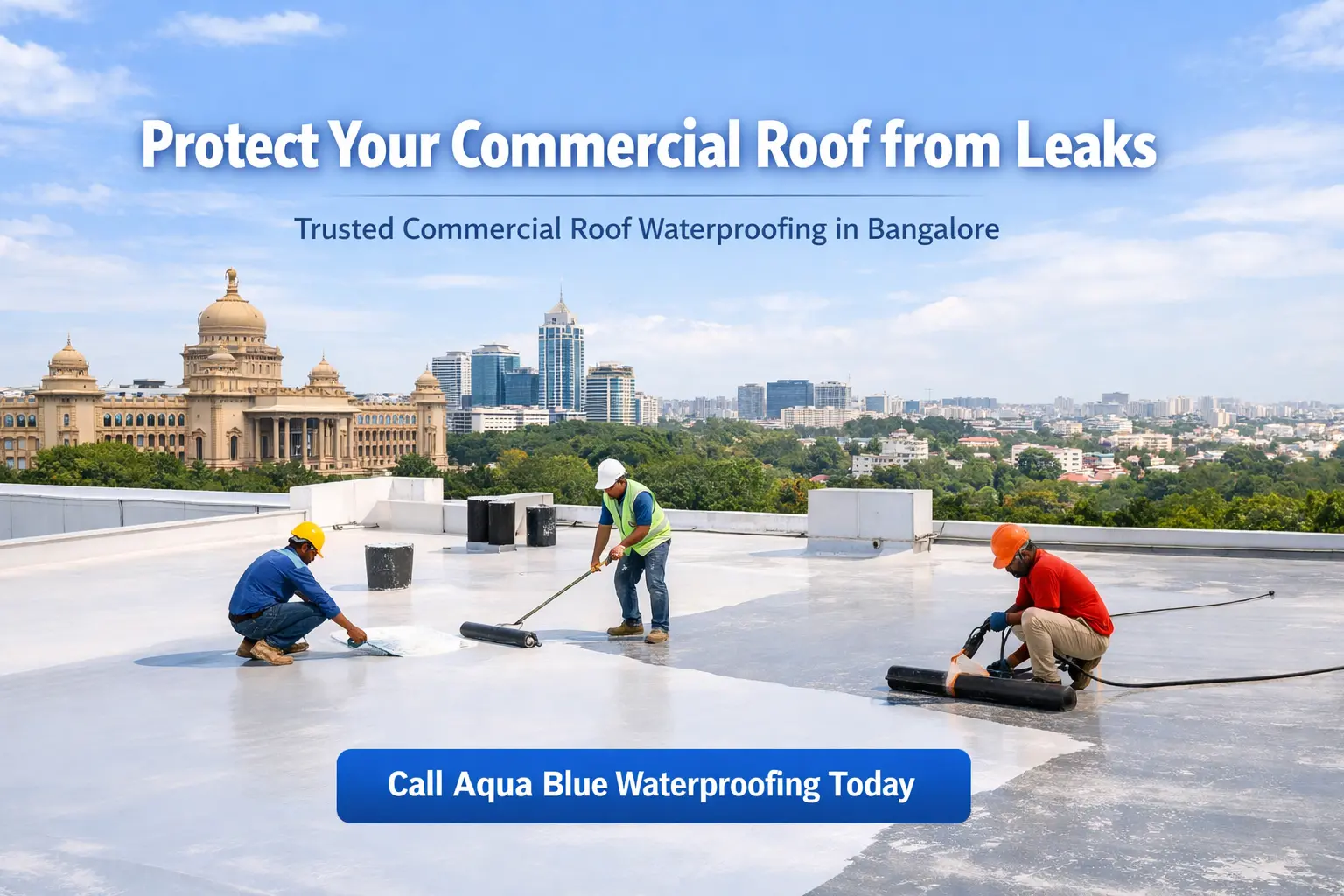
In a city like Bangalore, where the weather can shift from burning hot days to pouring rain in a single afternoon, a building’s roof is its most important line of defense. For facility managers and warehouse owners, a minor leak isn’t just a nuisance—it can lead to structural damage and expensive repairs.1 With Bangalore’s annual rainfall often exceeding 1,000mm, understanding the technical side of Commercial Roof Waterproofing in Bangalore is essential for long-term property health.
This guide provides a clear look at effective roof leak prevention in Bangalore, compares the most durable materials for the local climate, and outlines the standards you should expect from professional services like Aqua Blue Waterproofing to ensure your building remains protected.
Protect your assets before the next monsoon. Call Aqua Blue Waterproofing today at +91 88920 26121 for a professional site inspection.
Table of Contents
The Importance of Commercial Waterproofing
Warning Signs Your Roof is Failing
Top Waterproofing Materials & Solutions
The Professional Waterproofing Process
Why Most Waterproofing Fails at the Edges
How Smart Waterproofing Saves Your Business Money
Maintenance Checklist for Facility Managers
Common Pitfalls in Roof Protection
FAQs
Why Commercial Roof Waterproofing is Crucial in Bangalore
Bangalore’s “garden city” climate presents specific challenges for large-scale structures. The city experiences two distinct monsoon seasons—the Southwest and the Northeast—meaning roofs are under constant water pressure for nearly six months of the year.
Climate Stress: Rapid temperature shifts between the afternoon sun and cool nights cause concrete to expand and contract, which eventually leads to micro-cracks.
Structural Impact: For IT parks in Whitefield or industrial units in Peenya, water ingress can lead to rebar corrosion (rusting of internal steel), which compromises the entire building’s safety.
Property Value: Effective Commercial Roof Waterproofing in Bangalore is more than a repair; it is a way to preserve the market value of the asset and prevent internal mold that affects tenant health.
Signs Your Commercial Roof Needs AttentionProactive detection is the key to minimizing repair costs. Facility managers should look for these subtle indicators of a failing system:
White Powder Stains: White, chalky salt deposits on the underside of the ceiling indicate that water is successfully migrating through the concrete slab.
Ponding Water: If water remains on a flat roof 48 hours after a rainstorm, it indicates a failure in the slope or drainage system, often leading to a need for commercial terrace leak repair Bangalore.
Interior Blistering: Bubbling paint or peeling wallpaper in top-floor offices are late-stage signs that moisture has already breached the structure.
Corner Cracks: Hairline cracks near parapet walls or HVAC mounts are common entry points for water.
Top Waterproofing Materials Compared
Providing reliable roof waterproofing for office buildings Bangalore requires matching the chemistry to the roof’s usage.
A. Polyurethane (PU) Liquid Membranes
Often called the “Gold Standard,” PU is a liquid that dries into a seamless, rubber-like skin.
Pros: 400% elongation (it stretches without breaking), UV resistant, and seamless.
Best For: Complex roofs with many pipes and HVAC units.
B. Bituminous (APP) Membranes
These are thick, asphalt-based sheets reinforced with polyester.
Pros: Extremely tough. It can handle heavy foot traffic and is resistant to punctures.
Best For: Industrial warehouses and factories in areas like Peenya.
C. TPO (Thermoplastic Polyolefin)
A single-ply reflective membrane.
Pros: Highly eco-friendly. It reflects sunlight, which can reduce your building’s cooling costs by up to 20%.
Best For: Modern “Green” buildings and massive flat-roof warehouses.
D. Cementitious Coatings
A blend of sand and specialized chemicals.
Pros: Breathable and cost-effective.
Best For: Underground sumps, lift pits, or as a base layer for balconies.
Quick Comparison: Waterproofing Solutions
Material Type Best For Key Advantage PU (Polyurethane) Office Buildings High elasticity; moves with building expansion. Bituminous Membranes Industrial Warehouses Durable and resistant to heavy physical impact. Cementitious Coatings Small Commercial Areas Cost-effective and easy to apply for rigid structures. Cool Roof Coatings Tech Parks Reflects heat, reducing AC costs. The Professional Waterproofing Process
Quality results depend 20% on the material and 80% on the application process. A standard professional approach should include:
Detailed Site Audit: Using moisture meters to find hidden dampness.
Surface Engineering: Removing old, weak layers and cleaning the substrate with high-pressure water jets.
Mechanical Grinding: Ensuring the concrete is “open” enough to bond with new chemicals.
Application: Applying the membrane in cross-directional layers for maximum strength.
Quality Validation: Conducting a 24-hour flood test to ensure the system is watertight.
Read Also:- Commercial Waterproofing in BangaloreWhy Most Waterproofing Fails at the Edges
Even the most expensive materials will fail if the “detailing” is ignored. On a large commercial roof in Bangalore, the most dangerous areas aren’t the flat surfaces, but the joints and corners. At Aqua Blue Waterproofing, we pay extra attention to these three critical spots:
Parapet Wall Coving (Corner Rounding): Water loves to trap itself in the sharp 90-degree angle where the floor meets the wall. We create a “cove”—a smooth, curved slope at every corner—so water cannot sit there.
Expansion Joint Sealing: Large commercial buildings are designed to move and “breathe.” We use high-grade, flexible seals that act like a “rubber bridge,” allowing the building to move without breaking the shield.
Pipe and HVAC Penetrations: Every time a pipe goes through your roof, it creates a hole. We use specialized “liquid flashing” to wrap around these pipes like a tight sleeve.
How Smart Waterproofing Saves Your Business MoneyMany facility managers view waterproofing as a “repair cost,” but it is actually a long-term financial asset. For a typical commercial building in Bangalore, investing in professional-grade waterproofing provides a measurable Return on Investment (ROI) in three ways:
Energy Savings: Advanced coatings with high SRI (Solar Reflective Index) can reduce your building’s internal temperature by 5–8°C. This leads to a 15-20% reduction in monthly AC electricity bills.
Asset Protection: By preventing “concrete cancer” (rebar rusting), you avoid structural repairs that can cost ten times more than the waterproofing itself.
Tenant Retention: For commercial landlords, a leak-free building means fewer complaints, lower turnover, and higher rental yields.
Maintenance Checklist for Facility Managers
To ensure commercial roof maintenance Bangalore stays within budget, a routine checklist is vital:
Clear the Drains: Monthly checks to ensure plastic waste or leaves aren’t blocking rainwater pipes.
Sealant Checks: Inspecting expansion joints every 12 months, as sealants dry out faster in Bangalore’s high UV sun.
After-Rain Walkthroughs: Checking for debris that may have blown onto the roof during high winds.
Common Pitfalls in Roof Protection
Many property owners make the mistake of choosing “low-cost” domestic painters for commercial jobs. Commercial roofs have different thermal loads and traffic needs. Common mistakes include:
Ignoring the Slope: Water must flow, not sit.
Skipping the Primer Coat: This leads to the membrane peeling off within two seasons.
Hiring Non-Specialists: Industrial roofs require industrial-grade chemical knowledge.
FAQs
1. How long does commercial waterproofing typically last?
A: When installed by a specialist like Aqua Blue Waterproofing, a high-grade PU system can last 10 to 15 years with basic maintenance.
2. Can repairs be done during the monsoon?
A: Major applications should be done in dry weather, but emergency roof leak prevention can be handled using specialized “wet-surface” sealants.
3. Which type of waterproofing is best for a roof?
A: For a commercial roof in Bangalore, Polyurethane (PU) Liquid Membrane is the best all-around solution. If you have an industrial warehouse, Bituminous Membranes are better for heavy-duty protection.
4. Does waterproofing help with heat?
A: Yes, modern liquid membranes often come with high SRI (Solar Reflective Index) values, which can lower top-floor temperatures significantly.
Conclusion
Maintaining a commercial property in Bangalore requires a balance of local weather knowledge and technical expertise. By focusing on high-quality materials and regular inspections, you can avoid the high costs of structural repair.
Does your current maintenance plan include a pre-monsoon roof audit? Share your thoughts or ask a question in the comments below!
Visit our Google My Business listing
Contact our Commercial Waterproofing Specialists Now: 88920 26121
PRAVEEN P is the Founder of Aqua Blue Waterproofing and a Waterproofing Technical Specialist with over 16 years of industry experience. Since establishing the company in 2014, he has helped homeowners and businesses across Bangalore solve leakage and seepage issues through reliable, long-lasting waterproofing solutions and expert guidance.