
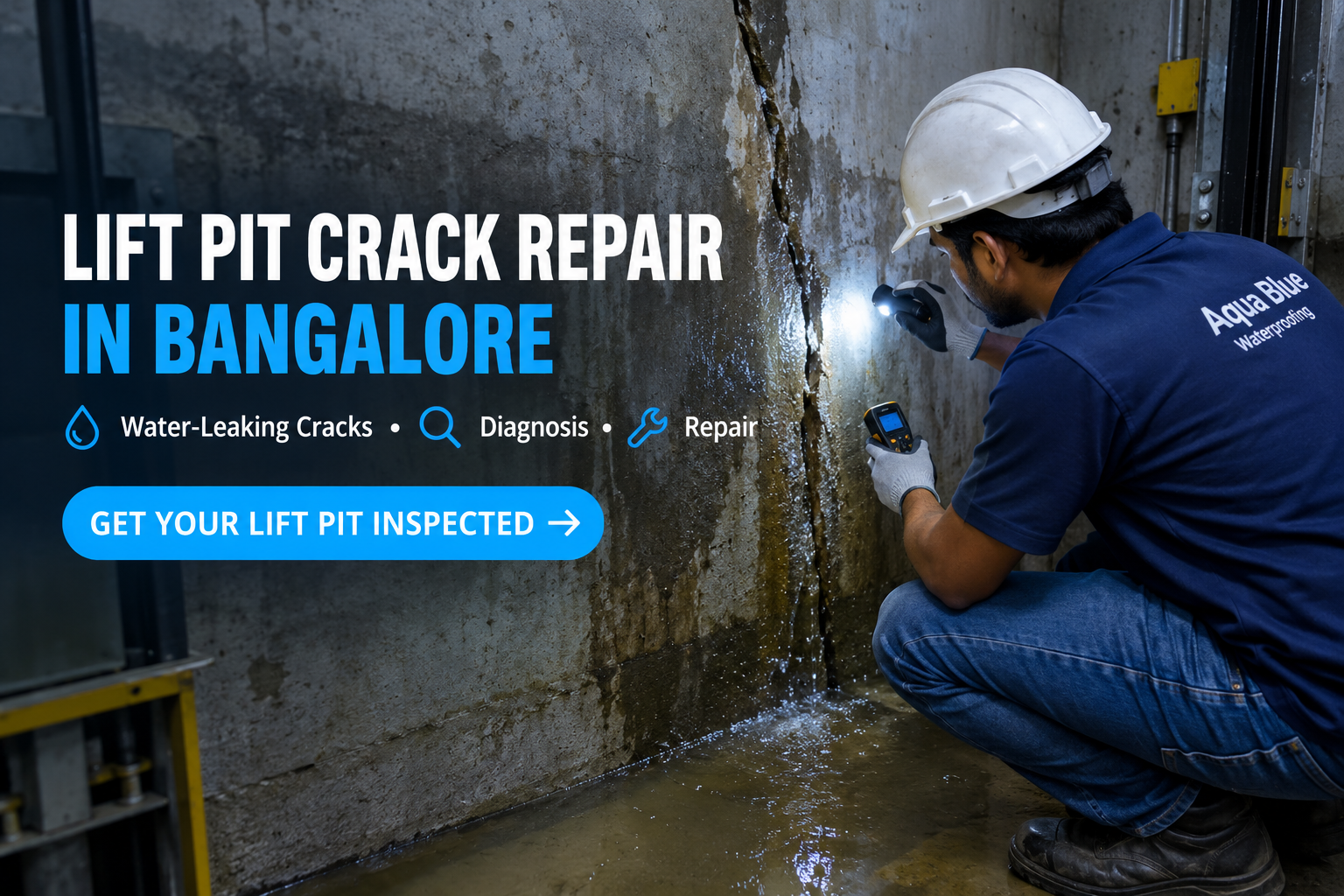
An elevator pit sits at the absolute lowest point of a building's sub-structure, placing it in constant contact with surrounding soil moisture and subterranean hydrostatic water pressure. When cracks develop in the reinforced cement concrete (RCC) raft slab or retaining walls, water actively penetrates the pit. This leads to standing water, unpleasant odors, and significant corrosion risks to elevator mechanical components.
Yes, cracks in a lift pit can directly cause water leakage. However, successfully fixing a leaking pit requires an accurate diagnostic evaluation before choosing a treatment. Repairing a non-structural hairline surface crack differs significantly from sealing an active, water-bearing construction joint under pressure.
At Aqua Blue Waterproofing, we provide specialized diagnostic assessments and targeted repair systems for residential, commercial, and industrial facilities throughout Bangalore. This guide covers crack identification, diagnostic steps, repair methodologies, local structural factors, and how to select an experienced contractor for long-term protection.
Need an immediate inspection or leak diagnosis for your elevator pit?
📞 Call Aqua Blue Waterproofing Specialists: 08892026121
💬 Discuss Your Lift Pit Leakage: Book a Free Site Diagnostic Inspection
Table of Contents
- Can Lift Pit Cracks Cause Water Leakage?
- What Causes Cracks in a Lift Pit?
- What Types of Cracks Can Occur in an Elevator Pit?
- How to Identify a Water-Leaking Crack in a Lift Pit
- When Should Lift Pit Cracks Be Repaired?
- How to Fix Cracks in a Lift Pit
- Lift Pit Crack Treatment: Which Repair Method Is Suitable?
- Can PU Injection Be Used for Lift Pit Cracks?
- Lift Pit Waterproofing Repair vs Crack Repair: What's the Difference?
- Lift Pit Water Leakage Repair in Bangalore
- Lift Pit Crack Repair for Apartments and Commercial Buildings
- How to Choose a Lift Pit Crack Repair Contractor in Bangalore
- Lift Pit Crack Repair Services in Bangalore
- Frequently Asked Questions About Lift Pit Crack Repair
- Get Your Lift Pit Crack Inspected
Can Lift Pit Cracks Cause Water Leakage?
Concrete is inherently porous and susceptible to micro-cracking during curing, structural settlement, or environmental shifting. When subterranean hydrostatic pressure mounts around an elevator shaft, these cracks become direct conduits for groundwater ingress.
       SUBTERRANEAN HYDROSTATIC WATER PRESSURE
       ---------------------------------------
                          │
                          ▼
        [ RCC Pit Wall / Retaining Structure ]
                          │
  === ( Active Crack / Internal Void Network ) ===
                          │
                          ▼
       [ Water Ingress into Lift Pit Floor ]
How Water Enters Through a Lift Pit Crack
- Groundwater Pressure: As water accumulates around sub-grade foundation walls, hydrostatic pressure forces moisture into any path of least resistance.
- Cracks Through Concrete: Fissures extending through the full depth of an RCC wall allow liquid water to flow directly into the pit interior.
- Connected Internal Voids: Incompletely vibrated concrete creates honeycombing—an interconnected matrix of internal air pockets that feeds water directly into surface cracks.
- Water Traveling Through Concrete: Water frequently enters the outer face of a wall at one point, travels horizontally through internal voids, and emerges through a visible crack several feet away.
- Visible Dampness vs. Actual Entry Point: Dampness on the interior face does not always mark the exact point of exterior failure due to lateral fluid migration inside the slab.
Why Lift Pit Cracks Are More Likely to Become Leakage Paths
Elevator pits sit lower than adjacent basement floors or footings, putting them in proximity to groundwater tables. Because pit walls act as retaining structures against surrounding soil, any breach in the concrete matrix faces continuous fluid pressure, making leaks more likely here than in above-grade structures.
Can Every Lift Pit Crack Cause Leakage?
Not every crack in a concrete pit actively leaks:
- Dry / Non-Leaking Cracks: Surface-level shrinkage cracks that do not penetrate the entire slab thickness and are not exposed to active groundwater pressure.
- Damp Cracks: Cracks exhibiting slow capillary action or atmospheric condensation, appearing wet without active water accumulation.
- Actively Leaking Cracks: Full-depth cracks through which groundwater is actively trickling, weeping, or jetting under pressure.
- Joint & Defective Concrete Cracks: Cracks originating along cold construction seams or honeycombed concrete that worsen during monsoon seasons.
What Causes Cracks in a Lift Pit?
Understanding the cause of a crack ensures the repair targets the underlying issue rather than simply covering up a symptom.
Concrete Shrinkage and Curing-Related Cracks
During the early curing phase of RCC construction, volumetric contraction (drying shrinkage) can generate fine tensile cracks across pit floors and retaining walls if curing compound applications or hydration control measures were insufficient.
Construction Defects and Poor Concrete Compaction
Improper compaction using needle vibrators during concrete pouring leaves air pockets and honeycombing within the structure, creating weak zones where cracks form easily under subterranean pressure.
Cracks at Wall-to-Floor Junctions
The connection between the vertical pit wall and the horizontal bottom raft slab is a primary stress location. Differential movement between separate pours often causes cracking along this perimeter seam.
Construction or Cold Joints
When concrete pouring is interrupted and resumed later, a cold joint forms. Without proper surface preparation or waterbar installation, these cold seams separate over time, forming linear cracks.
Structural Movement or Settlement
Differential foundation settlement, soil compaction variations, or dynamic loads from elevator machinery can produce structural cracks that require mechanical load-restoration methods alongside waterproofing.
Hydrostatic Pressure and Water Ingress
Continuous groundwater pressure forces water through micro-cracks, gradually eroding concrete binder materials, widening the fissures, and increasing total water flow over time.
Aging Concrete and Previous Repair Failure
Over time, concrete undergoes carbonation and chemical degradation. Rigid surface patches, cement-slurry coatings, or improper topical fills frequently fail under dynamic building movement, causing cracks to re-emerge.
What Types of Cracks Can Occur in an Elevator Pit?
Different types of cracks in an elevator pit require distinct repair strategies:
+-------------------------------------------------------------------------+
|                  ELEVATOR PIT CRACK CLASSIFICATION                      |
+-------------------------------------------------------------------------+
|  Crack Type               | Typical Location   | Structural Risk Level  |
+---------------------------+--------------------+------------------------+
|  Hairline / Fine Cracks   | Pit Walls / Base   | Low (Capillary damp)   |
|  Wider / Recurrent Cracks | Mid-Wall / Slab    | Moderate to High       |
|  Wall-to-Floor Junction   | Perimeter Seam     | High Leakage Risk      |
|  Construction Seams       | Pour Interfaces    | High Leakage Risk      |
|  Active Water-Bearing     | Any Breached Area  | Immediate Attention    |
+-------------------------------------------------------------------------+
- Hairline and Fine Concrete Cracks: Narrow surface fissures (less than 0.5 mm wide) typically caused by shrinkage; they often cause dampness through capillary action rather than active flow.
- Wider or Recurrent Cracks: Fissures wider than 1 mm that expand and contract due to thermal changes or building settlement.
- Wall Cracks: Vertical or diagonal cracks running across retaining walls, often caused by lateral soil pressure or structural curing strains.
- Floor Cracks: Horizontal cracks across the raft slab, typically resulting from hydrostatic uplift pressure from underneath the foundation.
- Wall-to-Floor Cracks: Perimeter cracks at the wall-base junction, representing one of the most common water entry routes in subterranean structures.
- Cracks Associated With Construction Joints: Linear seams where separate concrete pours meet without adequate waterstop integration.
- Cracks With Active Water Flow: Fissures actively emitting running water, requiring rapid-setting hydraulic plug materials or chemical injection to arrest flow before surface sealing.
How to Identify a Water-Leaking Crack in a Lift Pit
Accurate diagnosis requires distinguishing active groundwater ingress from surface condensation or machinery oil spills.
Signs of Active Water Leakage
- Visible Water: Standing water pooled at the base of the elevator pit floor.
- Damp Crack Lines: Dark, wet lines tracing specific paths along RCC walls or floor slabs.
- Recurring Wet Patches: Moisture patterns that expand after rainfall or during high water table seasons.
- Mineral Deposits (Efflorescence): White, crystalline salt deposits along crack lines, left behind as migrating water evaporates.
- Repeated Surface Patch Failure: Blistered paint, spalling mortar, or pop-outs over previously patched cracks.
Why the Visible Crack May Not Be the Actual Water Entry Point
Water follows the path of least resistance through interconnected internal voids, cold joints, and capillary channels inside the RCC matrix. As a result, groundwater entering the exterior face of a foundation wall may travel several meters horizontally before exiting through a visible interior crack. Sealing only the visible outlet without treating the internal pathway often redirects water to a new exit point nearby.
What Should Be Checked Before Crack Repair?
Before applying repair materials, conduct a systematic checklist:
- Crack Location & Geometry: Note depth, width, orientation, and whether the crack extends through the entire slab.
- Moisture Condition: Determine if the crack is dry, damp, weeping, or under active hydrostatic pressure.
- Surrounding Concrete Soundness: Tap the area with a hammer to detect hollow, spalling, or honeycombed concrete.
- Joint Proximity: Check if the crack aligns with cold joints, form-tie holes, or wall-to-floor junctions.
- Penetrations & Utilities: Inspect nearby electrical conduits, sump pump discharge pipes, or anchor bolts.
- Drainage Status: Verify whether external perimeter drains or interior sumps are operating correctly.
When Should Lift Pit Cracks Be Repaired?
Prompt repair prevents minor moisture issues from escalating into major structural concrete degradation or machinery failure.
When the Crack Is Allowing Water In
Immediate repair is necessary whenever liquid water passes through a crack, as standing water damages elevator cables, hydraulic buffers, and electronic sensors housed in the pit.
When Dampness Keeps Returning After Surface Repairs
If previous paint coats or cement mortars fail repeatedly, groundwater is actively migrating under pressure. This indicates that deeper injection or structural crack sealing is required rather than surface-level patching.
When the Crack Is Widening or Reappearing
Cracks that expand over time point to ongoing building movement or settlement. These dynamic cracks must be treated with flexible polyurethane sealants or resins rather than rigid cementitious fills.
When Cracks Occur Along Joints or Weak Concrete
Cracks along cold construction joints or honeycombed RCC degrade over time under continuous moisture exposure. Early intervention restores density and prevents widespread matrix softening.
When There Are Signs of Concrete Deterioration
If efflorescence, concrete spalling, or exposed rebar rust are present, immediate repair is necessary to stop water ingress and slow carbonation-induced rebar corrosion.
When the Crack May Have Structural Significance
If a crack extends across major structural elements, displays structural shearing, or exceeds 2 mm in width, order a structural engineering assessment before applying waterproofing materials. Rigid structural epoxies may be required to restore structural integrity alongside waterproofing seals.
How to Fix Cracks in a Lift Pit
Repairing a leaking lift pit crack requires a structured, multi-step process:
Step 1: Inspect & Map Crack Geometry
  │
  ▼
Step 2: Determine Active vs. Passive Water Conditions
  │
  ▼
Step 3: V-Groove & Clean Concrete Substrate
  │
  ▼
Step 4: Select Repair Method (Injection / Mortar / Sealant)
  │
  ▼
Step 5: Apply Crack Treatment (High-Pressure PU / Epoxy / Plug)
  │
  ▼
Step 6: Treat Cold Joints & Surrounding Honeycombing
  │
  ▼
Step 7: Perform Water Retaining / Pressure Monitoring Test
  │
  ▼
Step 8: Apply Secondary Protective Crystalline Slurry Coat
- Step 1 — Inspect and Identify the Crack: Map out all visible cracks, measure their widths, and mark hollow or honeycombed concrete zones around them.
- Step 2 — Determine Whether Water Is Active: Check whether water is actively flowing under pressure or if the surface is merely damp.
- Step 3 — Prepare the Crack and Surrounding Concrete: Chisel out a "V" or "U" shaped groove (15–20 mm deep) along non-active cracks using a mechanical router or breaker. Clean out debris, loose dust, and oil with high-pressure air or water streams.
- Step 4 — Select the Appropriate Crack Repair Method: Match the crack type to the correct material—use flexible polyurethane injection for active water-bearing cracks, structural epoxy for dry structural cracks, or polymer repair mortars for static surface cracks.
- Step 5 — Seal, Inject, or Repair the Crack: Install mechanical injection packers for pressurized resin injection, or pack polymer-modified repair mortars firmly into prepared chases for static cracks.
- Step 6 — Treat Associated Joints or Concrete Defects: Rebuild honeycombed concrete around the crack using non-shrink structural micro-concretes or fiber-reinforced repair mortars.
- Step 7 — Check the Repaired Area for Further Leakage: Monitor the treated crack for 24–48 hours under natural groundwater pressure to confirm that active leakage has stopped.
- Step 8 — Apply Additional Waterproofing Where Required: Coat the surrounding wall and floor surfaces with a crystalline coating or flexible polymer slurry to protect against future micro-cracks. For comprehensive resin details, review our companion guide on PU Injection for Lift Pit Leakage: When Is It the Right Solution?
Lift Pit Crack Treatment: Which Repair Method Is Suitable?
Selecting the correct repair method requires evaluating crack dynamics, moisture levels, and structural requirements:
| Crack / Site Condition | Primary Repair Direction | Typical Materials Used |
|---|---|---|
| Fine, Non-Leaking Crack (< 0.5 mm) | Surface chase sealing & crystalline coating | Polymer-modified slurry / Elastomeric sealant |
| Active Water-Bearing Crack | High-pressure injection grouting | Hydrophobic / Hydrophilic Polyurethane (PU) resin |
| Cold Construction Joint Crack | Joint routing & elastomeric sealing / Injection | Polymer-modified repair mortar & flexible sealant |
| Damaged / Honeycombed Concrete | Concrete rebuilding + surface tanking | Non-shrink micro-concrete & polymer mortar |
| Dynamic / Moving Crack | Flexible sealant routing or flexible resin | Polyurethane elastomeric sealant |
| Dry Structural Crack | Structural epoxy pressure injection | Low-viscosity structural epoxy resin |
| Plumbing / External Drainage Water | Source utility repair prior to pit treatment | Pipe sealing / Exterior drain diversion |
Can PU Injection Be Used for Lift Pit Cracks?
Polyurethane (PU) injection grouting is a primary method for sealing active, water-bearing cracks from the negative (interior) side of a lift pit.
When PU Injection May Be Suitable
- Active Water-Bearing Cracks: Liquid PU reacts with water to form an expanding, closed-cell elastomeric foam that blocks active fluid streams.
- Localized Leakage Paths: Provides targeted treatment along defined crack lines without requiring full-scale surface excavation.
- Inaccessible Exterior Walls: Ideal when soil excavation around the outside of the elevator shaft is impossible.
When PU Injection May Not Be Enough
- Structurally Damaged Concrete: PU resin seals water paths but does not restore load-bearing structural strength to severely cracked or load-impaired concrete.
- Plumbing Leakage: Utility pipe leaks must be fixed at their source rather than sealed with subterranean injection.
- Uniform Surface Dampness: Generalized dampness across porous concrete without defined crack paths requires surface crystalline coatings rather than packer injection.
Lift Pit Waterproofing Repair vs. Crack Repair: What's the Difference?
Understanding the distinction between targeted crack repairs and full-pit waterproofing helps avoid partial fixes that leave other areas vulnerable.
+-----------------------------------------------------------------------+
|  TARGETED CRACK REPAIR vs. COMPREHENSIVE LIFT PIT WATERPROOFING        |
+-----------------------------------------------------------------------+
| Scope      | Crack Repair                | Lift Pit Waterproofing     |
+------------+-----------------------------+----------------------------+
| Focus      | Localized entry paths       | Entire below-grade pit     |
| Methods    | PU Injection, Chasing       | Crystalline, Membranes     |
| Objective  | Stop active flowing leaks   | Full subterranean tanking  |
| Durability | Protects treated seam       | Protects full RCC matrix   |
+-----------------------------------------------------------------------+
- When Crack Repair May Be Enough: Suitable when the concrete structure is sound, surrounded by an intact external membrane, and experiencing leakage through a single isolated shrinkage crack or cold joint.
- When Broader Lift Pit Waterproofing Is Required: Necessary when multiple cracks appear across floor slabs and retaining walls, pointing to general concrete porosity or widespread failure of the exterior waterproofing membrane.
- When Concrete Repair Is Required: Essential when concrete exhibits hollow pockets, exposed rusted rebar, or structural spalling. Defective concrete must be cut back and rebuilt with structural repair mortars before waterproofing.
- When Drainage or Dewatering Is Required: Needed when extreme groundwater pressure threatens the foundation slab. Sump pump installation or perimeter drainage may be necessary alongside internal crack repairs.
Lift Pit Water Leakage Repair in Bangalore
Subterranean repairs in Bangalore require accounting for local soil characteristics, building designs, and seasonal weather patterns.
Common Water-Leaking Crack Locations in Bangalore Lift Pits
- Perimeter Wall-Floor Junctions: High hydrostatic pressure during monsoons targets the cold joint between the pit base slab and vertical retaining walls.
- Raft Slab Cracks: Floor cracks caused by upward hydrostatic pressure during heavy rainfall periods.
- Anchor Bolt & Pit Buffer Penetrations: Water migrating along mechanical fixings secured into the base concrete.
Why Bangalore Lift Pit Leakage Needs Site-Specific Diagnosis
- Seasonal Rainfall & Water Table Shifts: Monsoon heavy downpours drastically increase subterranean hydrostatic pressure across low-lying areas like HSR Layout, Koramangala, and Bellandur.
- Variable Subterranean Strata: Soil types in Bangalore vary from soft clay to hard granitic rock fracture zones, creating unpredictable underground water movement around basements.
- Building Age & Construction Standards: Older structures may lack external PVC waterstops at construction joints, while newer developments may experience cracking from early settlement.
Lift Pit Crack Repair for Apartments and Commercial Buildings
Operating requirements vary depending on the facility type:
Lift Pit Crack Repair in Apartment Buildings
- Resident Welfare Association (RWA) Coordination: Repairs require scheduling around lift downtime to minimize disruption to residents.
- Safety & Electrical Protection: Pits must be cleared of standing water and isolated electrically to protect service technicians.
- Low-Odor Materials: Odorless or low-VOC polyurethane and crystalline products are preferred to avoid chemical smells in residential lobbies.
Lift Pit Crack Repair in Commercial Buildings & Offices
- Continuous Lift Operations: Commercial facilities require fast-curing injection resins (such as rapid-reacting hydrophobic PU) to complete repairs during off-peak night shifts.
- High Vibrational Loads: High-speed commercial elevators generate continuous vibration, requiring flexible, high-elongation sealants along all joints and cracks.
How to Choose a Lift Pit Crack Repair Contractor in Bangalore
Selecting a qualified specialist ensures long-term repairs and prevents repeated product failures.
- Require Proper Diagnostic Inspections: Choose contractors who use moisture meters, concrete testing, and visual mapping rather than offering over-the-phone quotes without seeing the site.
- Verify Concrete Soundness Testing: Confirm the contractor tests surrounding concrete for hollow zones or honeycombing before sealing surface cracks.
- Check Material Selection Criteria: Ensure they match specific materials (such as hydrophobic PU, hydrophilic gel, or crystalline slurry) to site conditions rather than using a single product for all applications.
- Review Scope and Post-Repair Testing: Confirm the written scope includes surface preparation, packer installation, crack routing, port patching, and post-injection water testing.
- Verify Subterranean Experience: Choose contractors with documented experience in negative-side subterranean waterproofing and structural crack injection.
- Pricing Transparency: In Bangalore, standard surface crack chase filling generally ranges from ₹45 to ₹120 per linear foot, high-pressure PU packer injection ranges from ₹1,200 to ₹2,500 per nozzle/packer point, and complete crystalline pit renders range between ₹60 to ₹120 per sq. ft. depending on site access and leak severity.
Lift Pit Crack Repair Services in Bangalore
At Aqua Blue Waterproofing, our repair process addresses both visible surface cracks and deep internal water entry paths:
- Initial Diagnostic Inspection: Thermal and moisture mapping to trace original water entry points.
- Substrate Preparation: Mechanical routing of cracks, cleaning, and removing loose concrete.
- High-Pressure Injection Grouting: Installing mechanical packers and injecting specialized PU resins to shut off active water flow.
- Concrete Structural Repair: Rebuilding damaged matrix zones with polymer-modified repair mortars.
- Surface Protective Render: Applying crystalline waterproofing slurries to form an integrated barrier against subterranean moisture.
- Quality Assurance Testing: Post-repair inspection under natural hydrostatic pressure conditions.
FAQs About Lift Pit Crack Repair
Can lift pit cracks cause water leakage?
Yes. Subterranean groundwater pressure forces moisture through concrete cracks, creating standing water, dampness, and potential mechanical corrosion in elevator pits.
How do you fix cracks in a lift pit?
Fixing cracks requires routing out the fissure, sealing static cracks with polymer repair mortars, or injecting active water-bearing cracks with high-pressure polyurethane (PU) resin, followed by a crystalline surface coating.
When should lift pit cracks be repaired?
Cracks should be repaired immediately if liquid water enters the pit, if dampness recurs after surface painting, or if signs of concrete spalling and rust appear.
What is the best treatment for lift pit cracks?
The ideal treatment depends on crack conditions: active leaks require high-pressure PU injection, dry structural cracks require epoxy injection, and non-moving surface cracks respond best to polymer-modified chases and crystalline renders.
Can PU injection repair lift pit cracks?
Yes. PU injection is an effective negative-side repair method for sealing active groundwater leaks through concrete cracks and cold joints without requiring exterior excavation.
Can lift pit cracks be repaired from the inside?
Yes. Negative-side waterproofing methods—such as pressure injection grouting, polymer mortars, and crystalline slurry systems—are specifically designed to stop leaks from inside the pit.
Is crack repair enough to stop lift pit leakage?
If water ingress is limited to an isolated crack, targeted repair may be sufficient. However, if the concrete is porous or multiple leaks exist, full-pit surface waterproofing is required.
How do I choose a lift pit crack repair contractor in Bangalore?
Look for contractors who perform detailed site diagnostics, offer dynamic material options (PU, epoxies, crystalline slurries), supply clear scopes of work, and have documented experience in subterranean waterproofing.
Get Your Lift Pit Crack Inspected
Visible cracks and active water leakage in your elevator pit require professional diagnostic evaluation before minor seepage leads to major structural or mechanical damage.
📞 Call Our Engineering Team: 08892026121
💬 Discuss Your Site Conditions: Book an On-Site Diagnostic Evaluation
Summary & Final Takeaways
Repairing water-leaking cracks in an elevator pit requires matching the repair method to the specific crack type, concrete condition, and water pressure levels. While high-pressure PU injection effectively seals active leaks, lasting protection often combines targeted injection with structural concrete repairs and crystalline surface slurries.
Is your building experiencing recurring elevator pit seepage or active crack leaks? Share your questions or site observations in the comments below, or contact our engineering team to arrange a diagnostic inspection!

PRAVEEN P is the Founder of Aqua Blue Waterproofing and a Waterproofing Technical Specialist with over 16 years of industry experience. Since establishing the company in 2014, he has helped homeowners and businesses across Bangalore solve leakage and seepage issues through reliable, long-lasting waterproofing solutions and expert guidance.