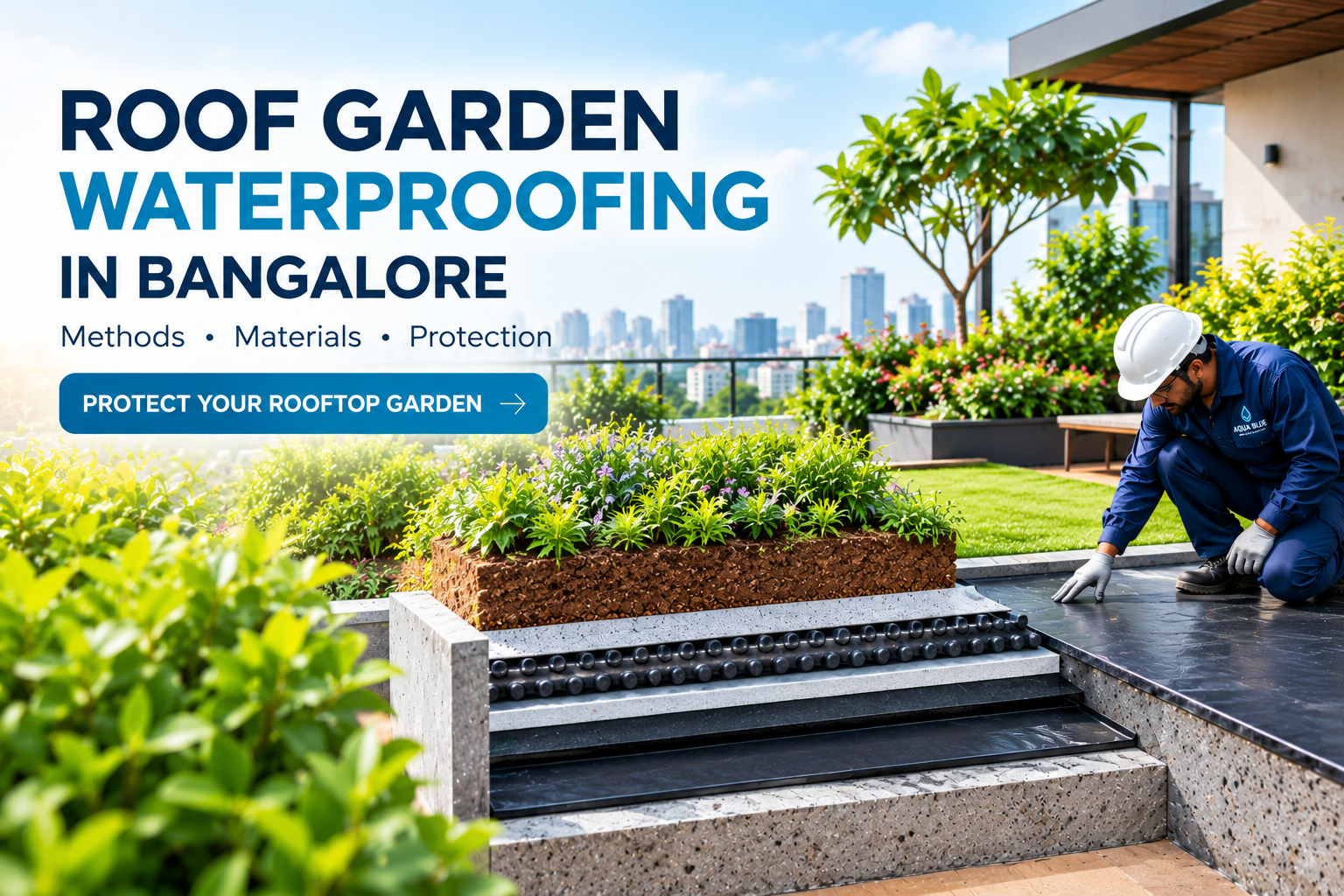
A roof garden waterproofing system protects the underlying RCC roof slab from moisture entering through landscaped areas. Depending on the design, it combines a durable waterproofing membrane with root protection, drainage, filtration, and protective courses. Because soil moisture, continuous irrigation, and monsoon downpours exert constant hydrostatic load, choosing compatible materials and specialized installation methods before planting is essential.
At Aqua Blue Waterproofing, we engineer specialized multi-layer green roof systems for residential terraces, commercial podiums, and rooftop gardens across Bangalore. This guide covers essential assembly layers, material selection, installation workflows, and preventative protection.
Need an immediate site inspection for your roof garden?
📞 Call Aqua Blue Waterproofing Specialists: +91 88920 26121
💬 Schedule Your On-Site Assessment: Book a Free Site Diagnostic Inspection
Table of Contents
- What Is Roof Garden Waterproofing?
- Why Is Roof Garden Waterproofing Important in Bangalore?
- What Are the Essential Layers of a Roof Garden Waterproofing System?
- Which Roof Garden Waterproofing Methods Are Commonly Used?
- What Materials Are Used for Roof Garden Waterproofing?
- How Is the Roof Garden Waterproofing Process Carried Out?
- What Are the Best Roof Garden Waterproofing Solutions for Different Conditions?
- How Can Roof Garden Water Leakage Be Prevented?
- What Are the Common Roof Garden Waterproofing Mistakes?
- How Long Does Roof Garden Waterproofing Last?
- When Should You Schedule a Roof Garden Waterproofing Inspection?
- How to Choose Roof Garden Waterproofing Contractors in Bangalore
- Roof Garden Waterproofing Services in Bangalore by Aqua Blue Waterproofing
- Frequently Asked Questions About Roof Garden Waterproofing
- Protect Your Roof Garden With Aqua Blue Waterproofing
What Is Roof Garden Waterproofing?
Roof garden waterproofing involves installing an engineered barrier assembly beneath soil and vegetation to prevent irrigation water, rainwater, and organic acids from penetrating the structural concrete slab.
⚙️How Does Roof Garden Waterproofing Work?
Unlike exposed terraces where water runs off immediately, a green roof holds wet soil against the roof slab for extended periods. A complete system relies on continuous protective layers working together:
📊How Is Roof Garden Waterproofing Different From Regular Terrace Waterproofing?
| Feature / Aspect | Regular Exposed Terrace Waterproofing | Roof Garden Waterproofing System |
|---|---|---|
| Water Exposure | Intermittent (rainwater runs off to drains) | Continuous (wet soil retains moisture 24/7) |
| Biological Load | Minimal (dust and atmospheric soot) | High (organic fertilizers, soil microbes, plant roots) |
| Root Resistance | Not required | Essential (prevents roots from piercing membranes) |
| Mechanical Stress | Light foot traffic | High dead loads (soil, plants, planters, pavers) |
| Repair Accessibility | High (membrane is directly visible) | Low (requires excavating soil layers) |
Why Is Roof Garden Waterproofing Important in Bangalore?
Bangalore’s seasonal monsoons and urban climate make rooftop gardening popular, but subterranean planting assemblies demand specialized waterproofing planning.
🌧️Rainfall and Water Exposure
Bangalore experiences heavy monsoon downpours followed by humid spells. Rainwater saturates the growing medium, adding hydraulic weight and keeping the slab wet for days.
💧Continuous Moisture Around Roof Garden Layers
Automated irrigation systems keep soil moisture high even during dry months. This continuous water contact drives capillary absorption through any unsealed micro-fissure in the slab.
🌱Root Growth and Waterproofing Protection
Plant roots naturally migrate toward moisture. Without a specialized root barrier membrane, fine root tips wedge into membrane seams, expand over time, and create leaks.
🏗️Protecting RCC Roof Slabs From Water Ingress
Water entering an RCC roof slab corrodes steel reinforcement, causes concrete spalling, and risks structural safety over time.
🚰Why Drainage Planning Matters for Bangalore Roof Gardens
Heavy downpours can flood planters if drainage outlets are undersized or blocked by silt, creating standing water that breaks down waterproofing layers.
What Are the Essential Layers of a Roof Garden Waterproofing System?
A complete system uses distinct functional layers working together to protect the structure:
- RCC Roof Slab and Surface Preparation: The structural base, repaired to a clean, smooth slope toward drainage outlets.
- Waterproofing Membrane: The primary elastomeric barrier (liquid polyurethane, EPDM, or APP bitumen) that blocks liquid water.
- Root Barrier Layer: A specialized chemical or physical sheet (such as anti-root PVC, TPO, or copper-treated bitumen) that repels root penetration.
- Roof Garden Protection Layer: High-density rubber mats or protection boards that cushion the membrane from sharp gravel and heavy tools during planting.
- Roof Garden Drainage Layer: Dimpled plastic boards or composite cores that create an open flow space for excess water to drain away freely.
- Geotextile Filter Fabric: A non-woven fabric that lets water pass into the drainage channels while keeping soil particles out.
- Growing Medium and Vegetation: Engineered lightweight soil mixes and plant selections suited for rooftop environments.
Which Roof Garden Waterproofing Methods Are Commonly Used?
Selecting the right waterproofing method depends on load limits, planter depth, budget, and accessibility.
📋Roof Garden Waterproofing Method Comparison
| System Type | Key Advantages | Critical Considerations |
|---|---|---|
| Polyurethane (PU) | Seamless, highly flexible | Needs root-resistant coat |
| EPDM Rubber Sheet | High elasticity, durable seams | Needs skilled jointing |
| APP/SBS Bitumen | High puncture resistance | Requires anti-root additives |
| Crystalline Slurry | Seals concrete capillary pores | Must pair with membrane |
🖌️Liquid-Applied Waterproofing Membranes
Polyurethane or hybrid polymer liquids dry into a seamless, elastic skin around complex planters, pipe sleeves, and parapets.
📜Sheet Membrane Waterproofing Systems
Prefabricated sheets like EPDM, TPO, or PVC offer uniform thickness and high tensile strength across large, flat podium decks.
🔥Bituminous Waterproofing Membranes
Torch-applied or self-adhesive SBS/APP modified bituminous sheets with chemical root inhibitors provide thick puncture protection under heavy soil beds.
🧪Polyurethane Waterproofing Systems
Pure elastomeric polyurethane resins flex with thermal movement and resist standing water under buried soil layers.
🧱Cementitious Waterproofing Systems
Polymer-modified cementitious coatings work well for rigid concrete planter boxes, though they need flexible membrane toppings to handle structural movement.
What Materials Are Used for Roof Garden Waterproofing?
Using compatible materials ensures long-term performance under buried conditions:
- Waterproofing Membranes: Elastic barriers that seal the roof slab against continuous water pressure.
- Root-Resistant Waterproofing Membranes: Membranes infused with root-repelling additives (like capsaicin or ester compounds) that stop root intrusion.
- Root Barrier Membranes: Separate high-density polyethylene (HDPE) or PVC sheets installed over standard membranes to block aggressive roots.
- Protection Boards and Protection Mats: Semi-flexible asphaltic boards or recycled rubber sheets that prevent mechanical damage during soil placement.
- Drainage Boards and Drainage Composites: Molded HDPE dimple boards that store small amounts of water for plants while channeling excess run-off to drains.
- Geotextile Filter Fabrics: Needle-punched polypropylene fabrics that prevent soil fines from clogging the drainage matrix.
- Sealants and Joint-Detailing Materials: High-elongation polyurethane joint sealants for parapet flashings, expansion joints, and pipe penetrations.
How Is the Roof Garden Waterproofing Process Carried Out?
Installing a green roof waterproofing system requires a systematic, multi-step process:
- Step 1 — Structural Assessment: Verify the slab's structural load capacity for wet soil, plants, and drainage materials.
- Step 2 — Surface Preparation: Clean the slab, grind down sharp edges, repair cracks with polymer mortars, and form smooth fillets at parapet junctions.
- Step 3 — Waterproofing System Design: Plan membrane details, root barriers, drainage paths, and overflow drains around parapets.
- Step 4 — Membrane Installation: Apply the primary membrane (liquid or sheet) up parapet walls at least 300 mm above the intended soil line.
- Step 5 — Root Barrier & Protection Course: Lay out the root barrier and protective boards with overlapped seams to protect the membrane.
- Step 6 — Drainage & Filter Fabric Setup: Place dimpled drainage composites and cover them with overlapped geotextile filter fabric.
- Step 7 — Flood Testing & Verification: Fill the area with water for 24 to 48 hours to confirm watertightness before adding soil.
- Step 8 — Landscaping & Backfilling: Carefully place growing media and plants without damaging the underlying layers.
What Are the Best Roof Garden Waterproofing Solutions for Different Conditions?
| Roof Garden Condition | Recommended Waterproofing Focus |
|---|---|
| New Roof Garden Construction | Complete multi-layer system with integrated root-barrier sheets and dimpled drainage |
| Existing Landscaped Roof Retrofit | Full soil excavation, slab inspection, crack injection, and seamless PU membrane application |
| Planters with Drainage Problems | Clearing blocked drains, replacing clogged filter fabric, and adding composite drainage boards |
| Active Ceiling Leakage Below Garden | Localized soil removal, thermal leak tracing, joint repair, and high-pressure PU resin injection |
| Intensive (Deep Soil) Green Roofs | Heavy-duty protection boards, double-layer root barriers, and high-strength EPDM/PVC membranes |
How Can Roof Garden Water Leakage Be Prevented?
Preventing leaks under landscaped roofs requires careful planning and quality materials:
- Select a waterproofing membrane certified for continuous root resistance.
- Install a dedicated HDPE root barrier over standard waterproofing layers.
- Cushion membranes with protection boards during landscaping to prevent tool punctures.
- Design primary and overflow drainage outlets to handle heavy monsoon downpours.
- Extend waterproofing membranes at least 300 mm above the final soil height along all parapets and walls.
- Perform a 48-hour standing water test before backfilling with soil.
- Clean drain outlets periodically to keep soil and fallen leaves from causing water backups.
What Are the Common Roof Garden Waterproofing Mistakes?
- Using Standard Terrace Coatings: Applying basic acrylic coatings that break down under standing water or lack root resistance.
- Skipping Membrane Protection: Dump-trucking gravel or using shovels directly over exposed membranes without protection boards.
- Undersized Drainage Outlets: Installing standard floor drains that quickly clog with silt and overflow planters.
- Low Parapet Flashing: Ending the membrane below the soil line, allowing water to bypass behind the barrier.
- Skipping Water Tests: Covering membranes with soil before flood-testing, making future leak detection difficult and costly.
- Mixing Incompatible Materials: Combining solvent-based primers with plasticized sheet membranes, causing material breakdown.
How Long Does Roof Garden Waterproofing Last?
A well-designed roof garden waterproofing system can last 15 to 25+ years, depending on material quality, root barrier performance, and installation details.
⏳Factors Influencing Durability:
- Material Quality: Premium EPDM, TPO, or pure liquid PU membranes outlast thin bitumen coatings.
- Substrate Preparation: Proper concrete cleaning and crack repair prevent early membrane peeling.
- Drainage Efficiency: Quick water runoff reduces hydrostatic pressure against membrane seams.
- Protection Layers: Quality protection boards shield membranes from mechanical damage during gardening activities.
When Should You Schedule a Roof Garden Waterproofing Inspection?
- Before Installing a New Garden: Verify that the bare concrete slab is sound, correctly sloped, and leak-free.
- Before Adding Soil: Inspect installed membranes, root barriers, and drainage layers before covering them.
- Dampness Below the Garden: Address discolored ceilings or peeling paint in rooms directly underneath planters immediately.
- Water Pooling Around Drains: Inspect filter fabrics if water stays on the soil surface after rain.
- Before Major Renovations: Evaluate aging membranes before planting new trees or adding heavy hardscaping.
How to Choose Roof Garden Waterproofing Contractors in Bangalore
Working with an experienced contractor ensures your green roof remains watertight over time:
- Look for Green Roof Experience: Choose specialists who understand buried membrane assemblies, root growth patterns, and soil drainage dynamics.
- Require Comprehensive Proposals: Confirm the quote covers all necessary layers—membranes, root barriers, protection mats, drainage boards, and filter fabrics.
- Demand Watertightness Testing: Ensure the contractor includes a mandatory 24- to 48-hour flood test before soil placement.
- Check Material Specifications: Verify that all products carry manufacturer certifications for buried, root-exposed applications.
- Transparent Pricing in Bangalore: High-grade liquid PU or EPDM systems with root barriers and drainage composites typically range from ₹120 to ₹220 per sq. ft., depending on site conditions and structural complexity.
Roof Garden Waterproofing Services in Bangalore by Aqua Blue Waterproofing
At Aqua Blue Waterproofing, we deliver end-to-end green roof waterproofing solutions tailored for Bangalore's climate:
- Slab Assessment & Load Analysis: Evaluating structural condition, slope profiles, and drainage layouts.
- System Specification: Selecting compatible membranes, root barriers, and drainage composites for your plant choices.
- Multi-Layer Installation: Professional application of primers, elastomeric membranes, root barriers, and protection boards.
- Drainage Integration: Installing HDPE dimpled drainage sheets and non-woven geotextile filter layers.
- Quality Verification: Conducting thorough 48-hour standing water tests to ensure complete watertightness.
Frequently Asked Questions About Roof Garden Waterproofing
💬What is roof garden waterproofing?
It is a multi-layer system applied beneath soil and plants to protect the structural roof slab from irrigation water, rainfall, and root intrusion.
💬Which waterproofing method is best for a roof garden?
Seamless liquid polyurethane or heavy-duty EPDM/PVC sheet membranes paired with dedicated HDPE root barriers offer the best combination of flexibility, seam strength, and root resistance.
💬Is a root barrier necessary for every roof garden?
Yes. Plant roots naturally search out moisture and can penetrate standard waterproofing membranes over time, making a dedicated root barrier essential.
💬Can an existing roof garden be waterproofed if it leaks?
Yes, but it requires excavating the soil and plants in the leaking area to expose the slab, repair structural defects, and install a new waterproofing assembly.
💬How long does a roof garden waterproofing system last?
A professionally installed system using high-grade materials and root barriers typically lasts between 15 and 25+ years.
Protect Your Roof Garden With Aqua Blue Waterproofing
A successful roof garden requires balancing healthy plant growth with reliable structural protection beneath the soil. Choosing quality materials, installing dedicated root barriers, and incorporating efficient drainage layers ensures your building stays leak-free for years to come.
🛡️Are you planning a new rooftop garden or fixing an existing terrace leak?
Contact our engineering team today to arrange a site diagnostic evaluation!
📞 Call Us Today: +91 88920 26121
💬 Schedule Your On-Site Diagnostic Evaluation: Book an Assessment with Aqua Blue Waterproofing

PRAVEEN P is the Founder of Aqua Blue Waterproofing and a Waterproofing Technical Specialist with over 16 years of industry experience. Since establishing the company in 2014, he has helped homeowners and businesses across Bangalore solve leakage and seepage issues through reliable, long-lasting waterproofing solutions and expert guidance.