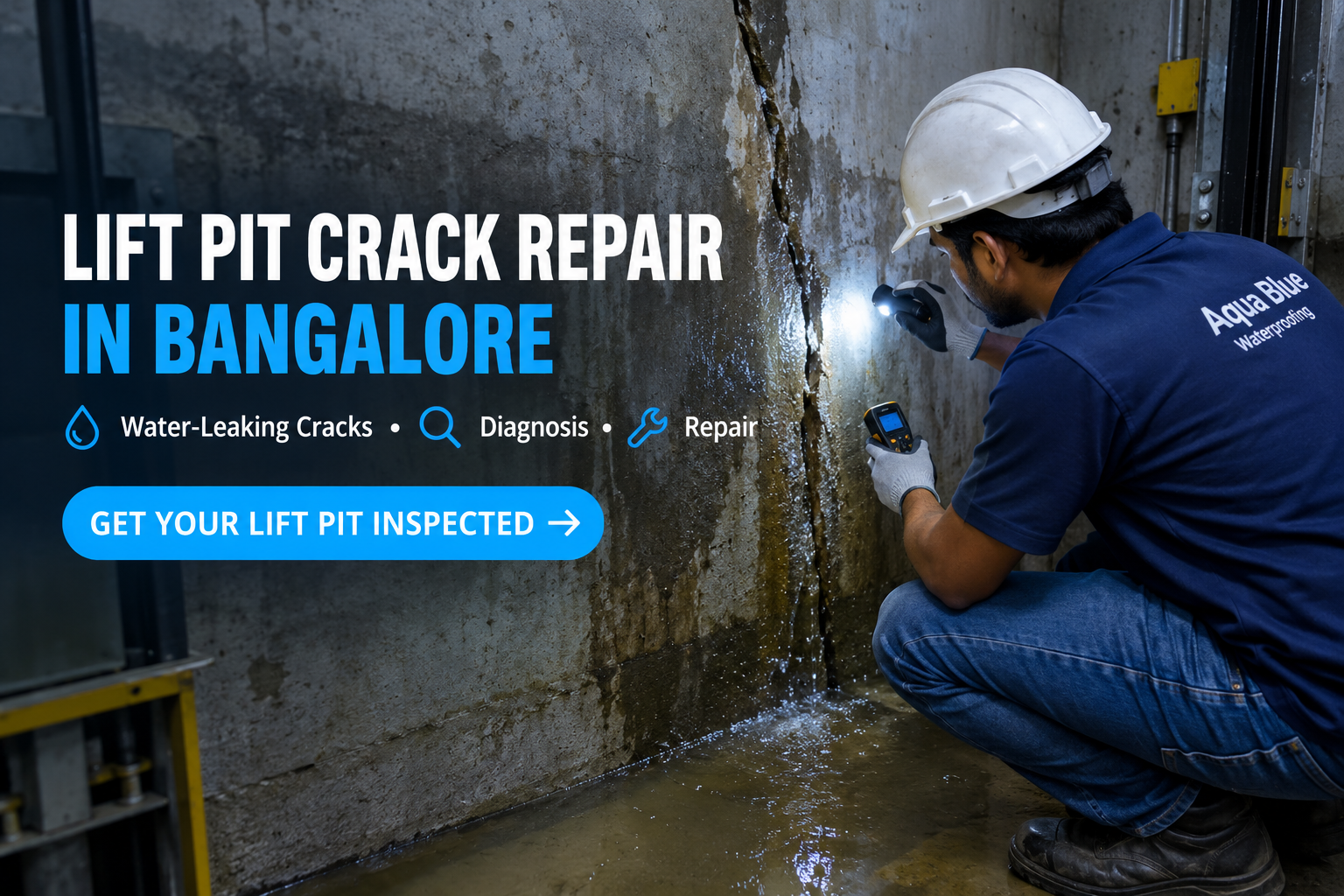
Lift pit water seepage occurs when groundwater or moisture enters an elevator pit through concrete defects, construction joints, wall-floor junctions, or service penetrations. Because the lift pit sits at the lowest point of a concrete structure, surrounding water pressures naturally force moisture inward. Correctly resolving this issue relies entirely on identifying the exact water-entry path rather than applying a temporary surface coating.
Understanding lift pit water seepage in Bangalore requires evaluating the surrounding soil conditions, seasonal rainfall patterns, and the physical state of the RCC concrete walls. Early identification prevents long-term concrete carbonation, rebar corrosion, and costly elevator machinery breakdowns. A thorough professional diagnosis must always precede any repair selection.
Table of Contents
-
What Is Lift Pit Water Seepage?
-
How Does Water Enter an Elevator Pit?
-
What Is the Difference Between Water Seepage and Active Leakage?
-
-
What Are the Main Causes of Lift Pit Water Seepage?
-
Groundwater Seepage in Lift Pits
-
Water Penetration Through RCC Concrete Walls
-
Seepage Through Construction Joints
-
Water Entry at Wall-to-Floor Junctions
-
Concrete Honeycombing and Poor Compaction
-
Cracks in Lift Pit Walls and Floor Slabs
-
Failed Waterproofing and Unsealed Service Penetrations
-
-
What Are the Early Warning Signs of Water Seepage in a Lift Pit?
-
How to Identify Water Seepage in a Lift Pit
-
How to Detect Hidden Water Seepage in Lift Pits
-
Can Water Seep Into a Lift Pit Without Visible Cracks?
-
How Can Moisture Mapping Help Identify Hidden Seepage?
-
Why Does Water Sometimes Appear Away From the Actual Entry Point?
-
When Is Professional Seepage Diagnosis Required?
-
-
Why Does Water Seepage Keep Returning in Lift Pits?
-
How to Stop Water Seepage in a Lift Pit
-
Which Lift Pit Water Seepage Treatment Is Suitable?
-
When Is PU Injection Considered for Lift Pit Seepage?
-
When Is Concrete Repair Necessary?
-
When Is Additional Lift Pit Waterproofing Required?
-
-
Lift Pit Water Seepage in Bangalore: What Should Building Owners Know?
-
When Should You Schedule a Lift Pit Leakage Inspection in Bangalore?
-
Lift Pit Seepage Repair in Bangalore: How to Choose the Right Contractor
-
Frequently Asked Questions About Lift Pit Water Seepage
-
Get Your Lift Pit Water Seepage Inspected in Bangalore
What Is Lift Pit Water Seepage?
Water seepage in a lift pit refers to the slow, continuous migration of moisture or liquid water through the concrete foundation walls, cold joints, floor slabs, or service entries of an elevator shaft. Because elevator pits are constructed below ground level, they are constantly exposed to subsurface soil moisture and external pressures.
How Does Water Enter an Elevator Pit?
-
Moving Through Cracks and Concrete Defects: Micro-fissures and unsealed voids allow moisture to travel through the full thickness of the concrete.
-
Entering Through Construction Joints: The interface seam between two separate concrete pours often lacks a continuous bond, creating a natural path for water.
-
Entering Through Wall-Floor Junctions: The cold joint where the horizontal raft slab meets the vertical retaining wall experiences dynamic stresses, making it a primary entry point.
-
Groundwater Pressure Around Below-Ground Structures: Saturation in the surrounding backfill soil exerts hydrostatic pressure, forcing groundwater through permeable paths in the elevator pit matrix.
What Is the Difference Between Water Seepage and Active Leakage?
Understanding the rate and pressure of fluid ingress helps dictate the required remediation approach:
-
Elevator pit water seepage: Characterized by damp patches, slow capillary moisture penetration, dark concrete discoloration, water droplets, and mineral deposits forming over time.
-
Active lift pit water ingress: Involves visible flowing or trickling water, bubbling seams, and rapid standing water accumulation at the base of the pit.
What Are the Main Causes of Lift Pit Water Seepage?
Identifying the underlying lift pit seepage causes ensures the chosen remediation addresses the structural defect rather than just masking the symptoms.
Groundwater Seepage in Lift Pits
When heavy rains or local hydrological factors raise the subterranean water table, continuous hydrostatic pressure pushes against the exterior face of the pit. Water actively seeks out capillary pores or physical breaches within the submerged sub-structure.
Water Penetration Through RCC Concrete Walls
Plain or RCC concrete is naturally porous if not formulated with crystalline additives or dense mix designs. Poorly graded aggregates, excessive water-cement ratios, or uncompacted concrete leave connected capillary pathways that allow water to migrate through the walls.
Seepage Through Construction Joints
Large concrete placements are completed in stages. The seam created between an existing cured pour and a fresh pour forms a construction joint. Without proper mechanical joint preparation or swellable waterstops, these interfaces become weak links for moisture intrusion.
Water Entry at Wall-to-Floor Junctions
The wall-floor junction experiences shear forces and differential settling. Because the floor raft slab and vertical pit walls are poured at different times, this perimeter cold seam is exceptionally vulnerable to subsurface fluid migration.
Concrete Honeycombing and Poor Compaction
Inadequate mechanical vibration during concrete casting leaves pockets of coarse aggregate devoid of mortar matrix. This concrete honeycombing acts like a sponge, allowing groundwater to flow freely through interconnected voids.
Cracks in Lift Pit Walls and Floor Slabs
Thermal contraction, concrete curing shrinkage, or minor structural settling cause fissures across the RCC structure. Even narrow cracks provide a direct channel for pressurized groundwater. For a comprehensive look at diagnosing and fixing crack-specific issues, read our detailed guide on Lift Pit Crack Repair in Bangalore: How to Fix Water-Leaking Cracks.
Failed Waterproofing and Unsealed Service Penetrations
-
Deteriorated Waterproofing: External (positive-side) tanking membranes degrade, tear, or lose adhesion over time due to ground movement or aggressive soil chemicals.
-
Defective Penetration Sealing: Electrical conduits, drainage sleeves, and anchor bolt penetrations drilled through the concrete provide unsealed gaps for fluid entry.
-
Inadequate Previous Repairs: Topical cement patches or superficial sealants applied over active seepage paths often fail because they leave the internal water channel open behind the patch.
What Are the Early Warning Signs of Water Seepage in a Lift Pit?
Early detection prevents moisture from reaching electrical travelling cables, mechanical buffers, or car guide rails.
| Warning Sign | What It May Indicate |
| Persistent damp concrete wall | Slow capillary moisture penetration through porous concrete or micro-cracks |
| Water droplets along a joint | Moisture migration along a cold construction joint or cold seam |
| White mineral deposits (efflorescence) | Historical or ongoing water movement dissolving calcium salts within the concrete |
| Recurring wet areas on floor | Unresolved subterranean water-entry source beneath the raft slab |
| Peeling coatings or surface patches | Underlying hydrostatic pressure or incompatibility of previous topical repairs |
How to Identify Water Seepage in a Lift Pit
Locating the origin of water ingress requires a structured diagnostic process:
-
Check Lift Pit Walls for Dampness and Moisture Marks: Trace dark patches or salt lines back to their highest point on the vertical RCC walls.
-
Inspect Wall-to-Floor Junctions and Construction Joints: Examine perimeter seams for standing droplets, dark outlines, or soft, degraded joint fillers.
-
Look for Water Trails and Recurring Wet Patches: Map out how water travels down the wall face to confirm whether it originates from a single point or a wide porous band.
-
Observe Whether Seepage Changes After Rainfall: Monitor flow rates during monsoon downpours to determine if the ingress is driven by seasonal surface runoff or a permanent water table.
-
Review Previous Waterproofing and Repair Locations: Inspect old epoxy patches, cementitious renders, or injected ports for signs of debonding or bypass leakage.
SAFETY WARNING: Elevator pits contain severe mechanical and electrical hazards, including high-voltage wiring, counterweights, and moving machinery. Entry into any lift pit must be performed exclusively by authorized facility personnel or certified waterproofing specialists following formal elevator safety and lockout/tagout protocols.
How to Detect Hidden Water Seepage in Lift Pits
Tracing subterranean moisture is often difficult because the point where water appears inside the pit rarely aligns with where it breached the exterior wall.
EXTERIOR GROUNDWATER / SOIL
           │
           ▼  (Water enters exterior wall breach)
┌──────────────────────────┐
│  RCC CONCRETE WALL MATRIX│
│  └───► [Internal Voids]  │  (Lateral fluid movement through voids)
│               └───► [Seam]│
└──────────────────────────┘
           │
           ▼  (Water emerges 2 meters away)
INTERIOR LIFT PIT WALL
Can Water Seep Into a Lift Pit Without Visible Cracks?
Yes. Water can penetrate an elevator pit through unsealed construction joints, micro-porous concrete, honeycombing, unsealed electrical sleeves, or concealed structural interfaces without any visible surface cracking.
How Can Moisture Mapping Help Identify Hidden Seepage?
Specialists use non-destructive moisture meters and thermal imaging tools to scan concrete surfaces. By measuring relative moisture levels across a grid, technicians map hidden moisture gradients beneath dry-looking surface renders.
Why Does Water Sometimes Appear Away From the Actual Entry Point?
Concrete contains an internal network of capillary pores, cold seams, and honeycombed aggregate voids. Pressurized water entering the exterior wall moves laterally through these concealed concrete defects, following the path of least resistance before emerging into the pit meters away from the original entry location.
When Is Professional Seepage Diagnosis Required?
-
When dampness persists despite multiple surface patching attempts.
-
When the exact water-entry pathway cannot be visually identified.
-
When seepage affects multiple walls or wall-floor interfaces simultaneously.
-
When moisture levels fluctuate unpredictably without clear ties to weather events.
Why Does Water Seepage Keep Returning in Lift Pits?
Facility managers often report that a lift pit appears completely dry immediately after a repair, only for dampness to return months later. This recurring cycle happens because:
-
The Original Entry Source Was Missed: The repair sealed the interior exit point rather than stopping water from entering the deep concrete matrix.
-
Superficial Surface Patching Was Used: Troweling standard mortar over a damp seam leaves internal channels filled with water. Over time, hydrostatic head pressure pops the rigid patch off the wall.
-
Adjacent Construction Joints Were Left Untreated: Sealing one section of a cold joint redirects pressurized water sideways along the same seam until it finds an untreated exit.
-
Groundwater Pressure Persists: Subsurface hydrostatic conditions remain active year-round, constantly testing weak points along the structure.
-
Unresolved Concrete Defects: Internal honeycombing or soil drainage failures surrounding the foundation continue to accumulate water around the outer wall faces.
How to Stop Water Seepage in a Lift Pit
Stopping lift pit water seepage requires a systematic, diagnostic approach rather than applying a single material to every site:
-
Step 1 — Identify the Source of Water Ingress: Determine whether the water stems from an elevated water table, surface runoff, or utility line failures.
-
Step 2 — Assess the Concrete, Cracks, and Construction Joints: Inspect the physical strength of the concrete matrix and locate cold seams, voids, or fissures.
-
Step 3 — Address Active Water Entry Where Necessary: Stop active, pressurized streams using fast-setting hydraulic compounds or chemical grouts before applying surface treatments.
-
Step 4 — Select a Suitable Seepage Treatment: Match the repair system (e.g., pressure grouting, crystalline slurry, flexible sealants) to the specific joint dynamics and water pressure.
-
Step 5 — Repair Associated Concrete or Joint Defects: Cut back honeycombed zones, route out defective joint lines, and restore structural profiles with non-shrink polymer mortars.
-
Step 6 — Verify the Repair and Monitor for Recurring Moisture: Inspect the treated pit over an extended period under active groundwater conditions to confirm complete dryness.
Which Lift Pit Water Seepage Treatment Is Suitable?
Treatment selection must be tailored to the specific defect and moisture level identified during diagnosis:
| Seepage Condition | Treatment Consideration |
| Localized water-bearing crack | High-pressure chemical injection grouting to fill deep internal voids |
| Seepage through a construction joint | Mechanical joint chasing followed by elastomeric sealing or specialized injection |
| Honeycombed concrete | Removal of defective concrete, structural mortar reinstatement, and crystalline tanking |
| Widespread wall dampness | Substrate preparation and application of deep-penetrating crystalline waterproofing systems |
| Water entering through a penetration | Mechanical rubber sleeve sealing or flexible elastomeric sealant packing around conduits |
| Drainage-related water accumulation | External perimeter drain correction or internal sump system installation |
When Is PU Injection Considered for Lift Pit Seepage?
Polyurethane (PU) injection is considered when water actively flows or weeps through defined structural cracks, cold seams, or internal void networks that cannot be accessed from the exterior. Injected under high pressure, liquid PU resin reacts with moisture to expand into a dense, closed-cell foam that seals internal pathways. To evaluate whether this method fits your site, read our specialized analysis on PU Injection for Lift Pit Leakage: When Is It the Right Solution?.
When Is Concrete Repair Necessary?
If the pit concrete exhibits honeycombing, hollow sounds, soft cement paste, or spalling rebar, structural concrete restoration must precede waterproofing. Defective material must be chipped back to sound RCC and rebuilt with polymer-modified repair mortars or non-shrink micro-concretes.
When Is Additional Lift Pit Waterproofing Required?
When water migrates through multiple porous zones rather than a single crack, localized patching is insufficient. In these cases, the entire pit requires comprehensive negative-side tanking using crystalline slurries or elastomeric polymer coatings. For a full breakdown of complete pit encapsulation, consult our main pillar guide on Lift Pit Waterproofing in Bangalore: The Hidden Water Problem Below Your Building.
Lift Pit Water Seepage in Bangalore: What Should Building Owners Know?
Subterranean structures in Bangalore present unique challenges due to local construction practices and geological conditions:
Why Can Below-Ground Lift Pits Experience Seepage During Rainy Periods?
Heavy monsoon downpours saturate the surrounding red clay and fractured granitic soils common across Bangalore. This sudden influx raises local groundwater levels, creating intense hydrostatic head pressure against deep foundation walls.
What Should Apartment Associations Check?
-
Repeated Resident Complaints: Monitor reports of musty odors or elevator operational delays in basement lobbies.
-
Maintenance Logs: Review elevator service reports for notes on rusted pit ladders, water on car buffers, or electrical trips.
-
History of Previous Repairs: Keep records of legacy waterproofing attempts to help contractors understand past failure locations.
-
Access Protocols: Coordinate site inspections with RWA facility teams and elevator service vendors to ensure safe pit access.
What Should Commercial Facility Managers Check?
-
Inspection Coordination: Schedule diagnostic checks during low-traffic hours or planned elevator maintenance windows.
-
Equipment Risk Audits: Evaluate proximity of sensitive electronic sensors, travelling cables, and tension pulleys to damp walls.
-
Clear Documentation: Ensure repair contractors provide detailed scopes of work specifying material technical datasheets and preparation steps.
Why Is Site-Specific Seepage Diagnosis Important in Bangalore?
Soil retention rates vary dramatically between areas like Whitefield, Koramangala, and Electronic City. A repair strategy that works for a shallow basement pit in one locality may fail in a deep multi-level basement elsewhere. Treatment selection must always account for site-specific water table dynamics and concrete quality.
When Should You Schedule a Lift Pit Leakage Inspection in Bangalore?
Prompt inspection prevents minor wall dampness from escalating into major operational failures.
Key Triggers for an Inspection:
-
Dampness or discolored patches return shortly after applying surface coats.
-
Moisture droplets continually form along cold construction joints or wall-floor junctions.
-
The exact entry path of standing pit water cannot be determined visually.
-
Water accumulation increases significantly following heavy rainfall.
-
Elevator service technicians issue safety notices regarding pit moisture or corrosion.
What a Professional Inspection Covers:
-
Moisture Mapping: Non-destructive measurements to trace hidden moisture paths through concrete.
-
Concrete Soundness Assessment: Hammer sounding to locate internal honeycombing or delaminated layers.
-
Joint & Penetration Audits: Detailed checks of wall-floor seams, construction joints, and utility pipe sleeves.
-
Historical Treatment Review: Evaluation of legacy membranes or injection points to identify bypass channels.
-
Source Path Mapping: Clear identification of likely water entry points and recommended technical solutions.
Lift Pit Seepage Repair in Bangalore: How to Choose the Right Contractor
Selecting a qualified specialist ensures an engineering-led repair rather than a temporary cover-up.
-
Does the Contractor Identify the Leakage Source Before Repair? Ensure they conduct thorough diagnostic mapping rather than offering quick quotes over the phone.
-
Do They Inspect Concrete Defects and Construction Joints? Verify that their scope includes checking concrete density, honeycombing, and cold seams before applying materials.
-
Can They Explain Why a Particular Treatment Is Recommended? A reputable contractor should clearly explain why a specific system (PU injection, crystalline slurry, or polymer mortar) fits your site conditions.
-
Will They Clarify Whether Localized Repair or Broader Waterproofing Is Required? They should distinguish between sealing a single crack and waterproofing the entire pit matrix.
-
Do They Explain the Repair Scope and Post-Treatment Checks? Look for detailed proposals outlining surface preparation, mechanical routing, injection parameters, and post-repair inspection protocols.
Aqua Blue Waterproofing provides diagnostic evaluations and technical seepage repairs across residential apartments, commercial complexes, and industrial facilities in Bangalore. Our engineering-first approach focuses on tracing water entry paths, evaluating concrete soundness, and executing durable repairs backed by clear communication.
Frequently Asked Questions About Lift Pit Water Seepage
What Causes Water Seepage in a Lift Pit?
Seepage is caused by groundwater pressure forcing moisture through porous concrete, cold construction joints, wall-floor seams, honeycombing, cracks, or unsealed utility penetrations.
How Can I Identify Water Seepage in an Elevator Pit?
Look for dark discolored concrete, white powdery salt deposits (efflorescence), peeling paint, persistent moisture along seams, or small puddles forming on the floor.
Can Lift Pit Water Seepage Occur Without Visible Cracks?
Yes. Water easily penetrates sound-looking concrete through microscopic capillary pores, unsealed construction seams, internal honeycombing voids, or unsealed pipe penetrations.
How Can Hidden Water Seepage Be Detected?
Professionals use non-destructive moisture meters, thermal imaging tools, and concrete soundness testing to map moisture paths hidden inside the RCC matrix.
Does Groundwater Cause Lift Pit Water Seepage?
Yes. Rainwater or elevated underground water tables generate hydrostatic pressure against subterranean walls, pushing fluid inward through any available breach.
Why Does Water Seepage Return After Waterproofing?
Seepage returns if the repair only sealed the interior surface exit point without treating the internal water entry path, or if underlying hydrostatic pressure bypasses the patch along untreated construction joints.
How Can Water Seepage in a Lift Pit Be Stopped?
Stopping seepage requires identifying the water path, addressing active flow, repairing honeycombed or defective concrete, and applying compatible injection grouting or crystalline waterproofing systems.
When Should I Arrange a Lift Pit Leakage Inspection in Bangalore?
Schedule an inspection as soon as dampness persists, water appears along construction joints, or elevator maintenance teams report rust or water accumulation in the pit.
Get Your Lift Pit Water Seepage Inspected in Bangalore
Damp concrete walls, recurring floor puddles, and mineral deposits indicate underlying water pressure that should be evaluated before choosing a repair method. Aqua Blue Waterproofing offers site assessments across Bangalore to trace water entry pathways and recommend diagnostic-led solutions.
Contact our technical team today to schedule an on-site diagnostic evaluation for your building.

PRAVEEN P is the Founder of Aqua Blue Waterproofing and a Waterproofing Technical Specialist with over 16 years of industry experience. Since establishing the company in 2014, he has helped homeowners and businesses across Bangalore solve leakage and seepage issues through reliable, long-lasting waterproofing solutions and expert guidance.