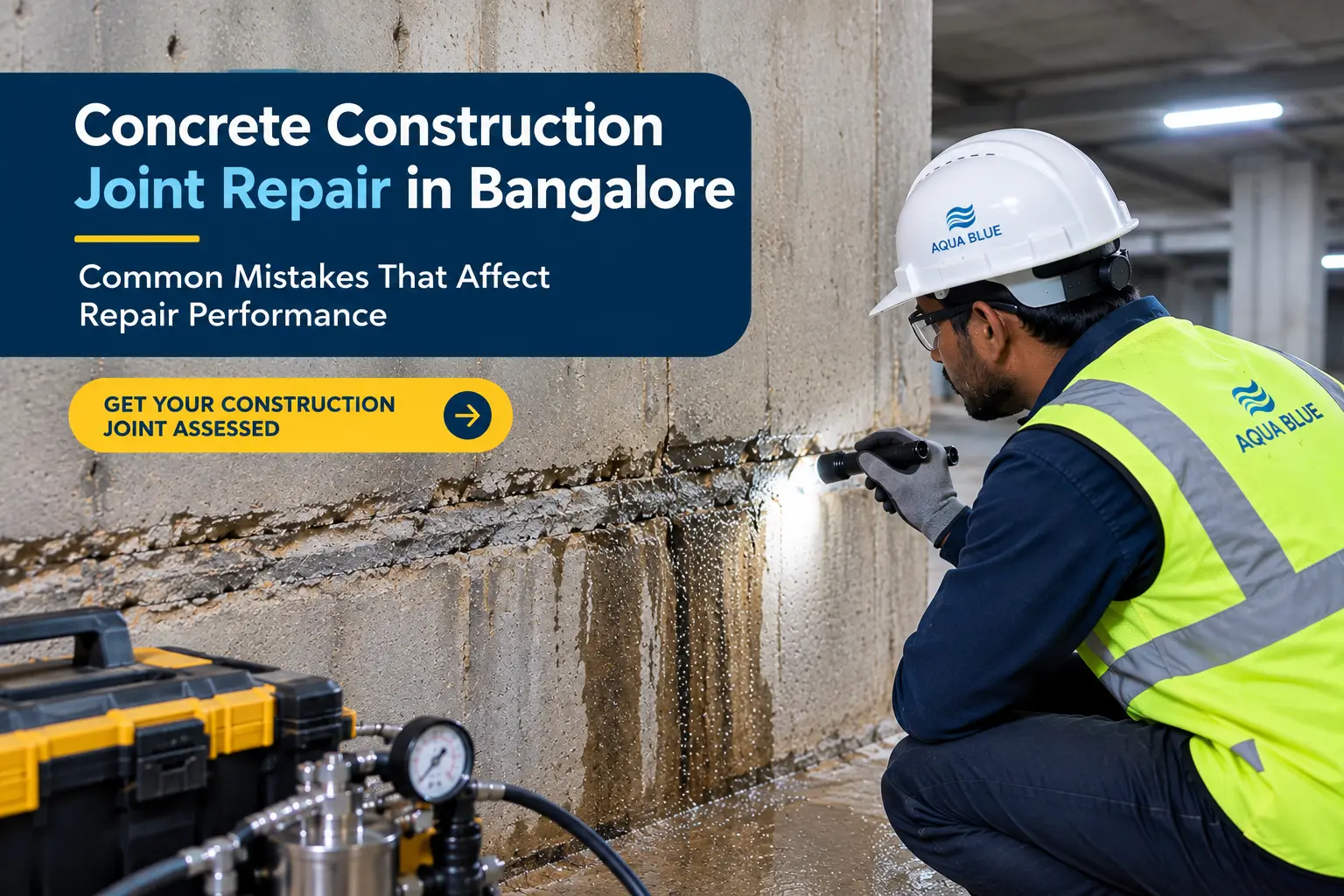
Concrete construction joint repairs often fail not because the repair material is necessarily wrong, but because the joint is misdiagnosed, poorly prepared, exposed to conditions the repair system cannot handle, or repaired without addressing the actual water path or joint movement. When executing professional concrete construction joint repair in Bangalore, understanding local soil mechanics, subterranean water tables, and concrete movement dynamics is essential to achieving long-term performance.
In Bangalore’s rapidly expanding urban footprint from commercial developments in IT corridors like Whitefield and Outer Ring Road to multi-level residential basements in Indiranagar and JP Nagar construction joints are frequently exposed to dynamic hydrostatic head pressure. Heavy monsoon water ingress forces groundwater through weak concrete interfaces, leading to persistent subterranean seepage. At Aqua Blue Waterproofing, we specialize in diagnosing these subterranean failures to ensure structural longevity across apartments, commercial buildings, retaining walls, and underground lift pits.
Need an urgent site inspection for basement or joint leakage in Bangalore?
📞 Call Aqua Blue Waterproofing Experts: 88920 26121
Table of Contents
- What Is a Concrete Construction Joint?
- What Causes Construction Joint Failure?
- 9 Common Mistakes That Affect Concrete Construction Joint Repair Performance
- How to Stop Water Leakage Through Concrete Joints
- What Is the Best Method for Concrete Construction Joint Repair?
- Concrete Construction Joint Repair Procedure
- Construction Joint Repair Methods: Which Approach Fits the Problem?
- When Does a Construction Joint Need More Than Waterproofing?
- Commercial Building Joint Repair in Bangalore
- How to Choose a Concrete Joint Repair Contractor in Bangalore
- How to Prevent Construction Joint Repair From Failing Again
- Frequently Asked Questions About Concrete Construction Joint Repair
- Get Concrete Construction Joint Repair in Bangalore
What Is a Concrete Construction Joint?
How a Construction Joint Forms Between Concrete Pours
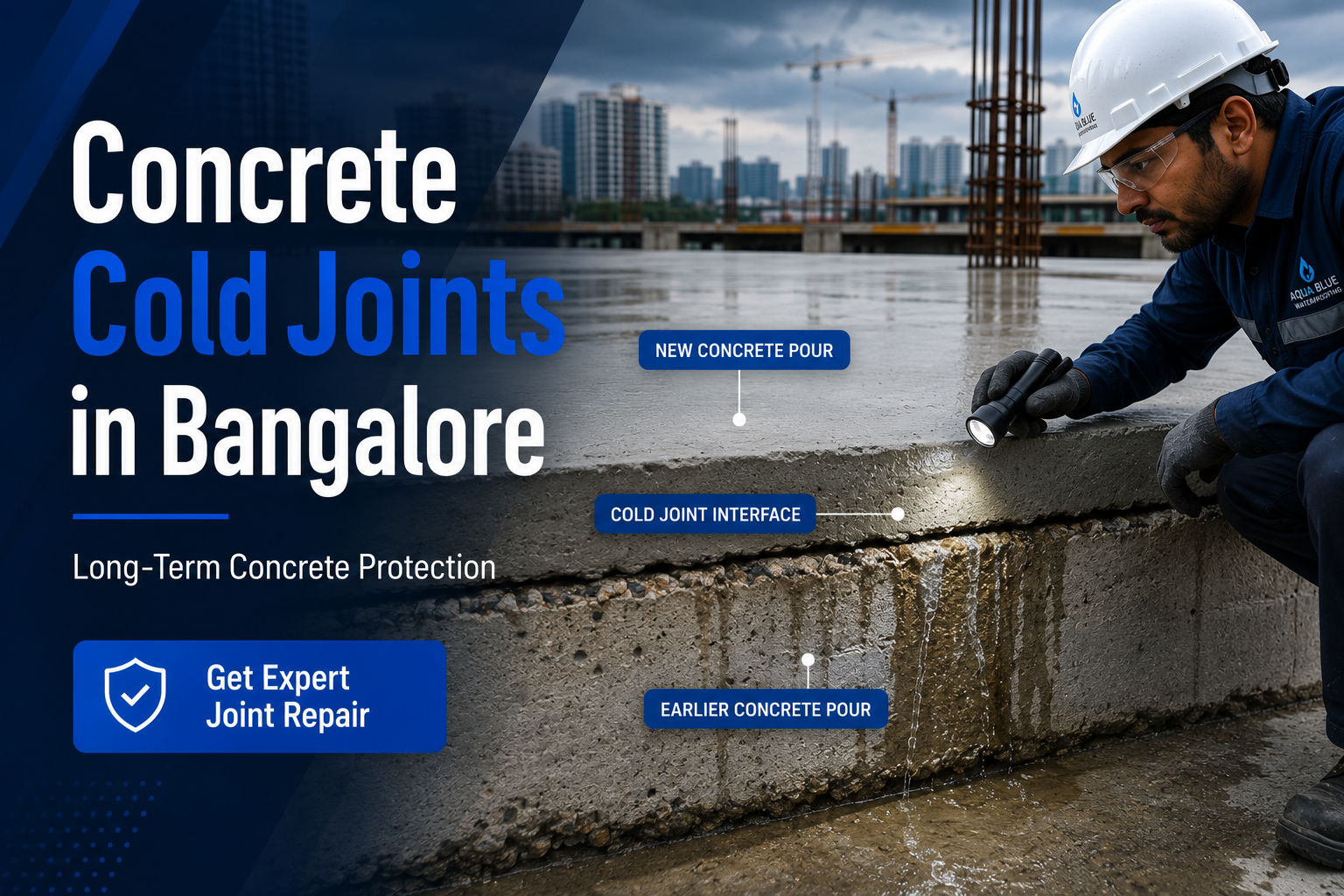
A concrete construction joint is a planned stopping point created during sequential concrete placement. Because large structural elements cannot be cast in a single continuous pour, concrete is placed in lifts or panels, creating an interface where fresh concrete bonds against hardened concrete. These seams are standard in wall-to-slab junctions, raft-to-retaining-wall connections, and lift-pit structures.
Why the Concrete Interface Can Become a Water Ingress Path
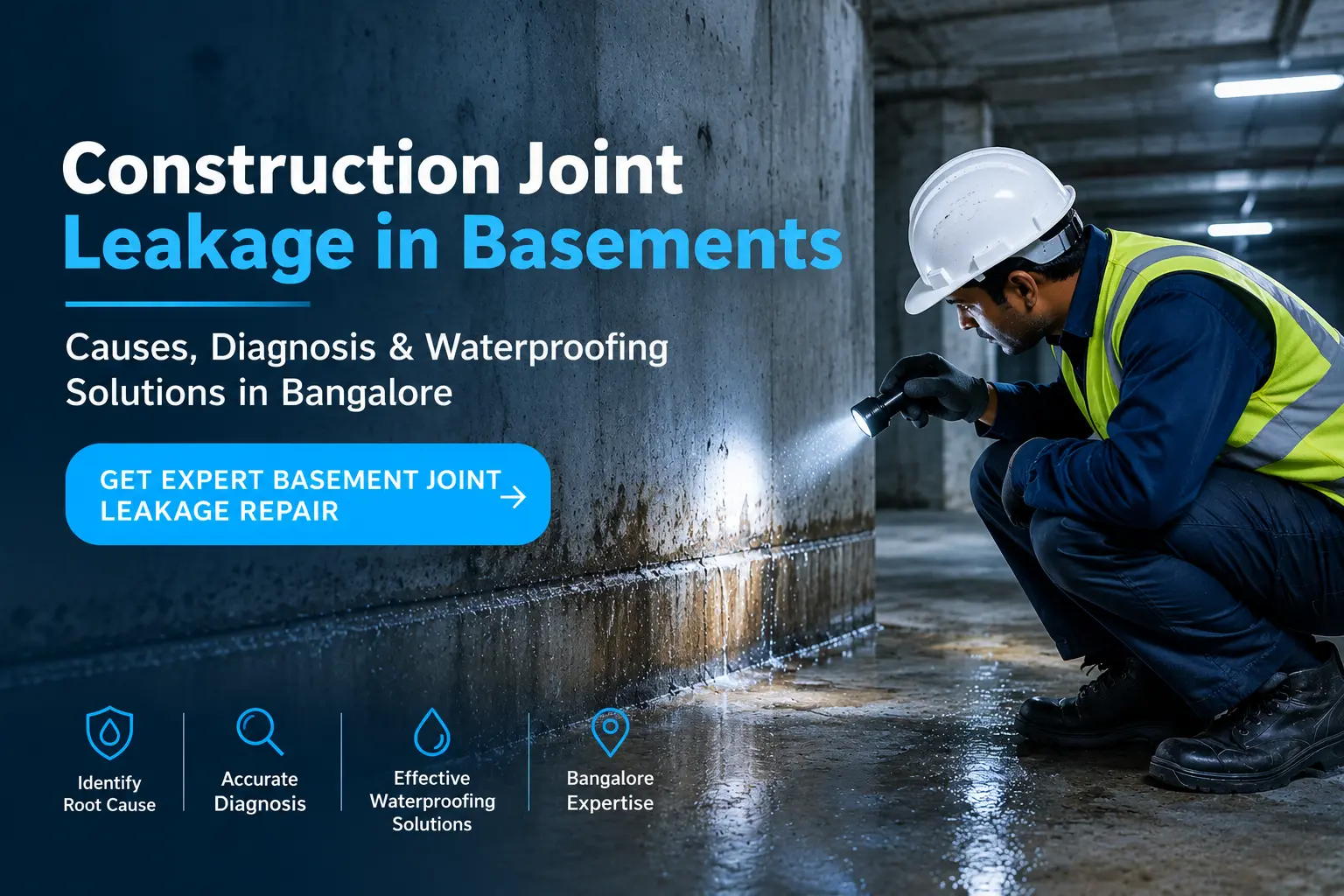
What is a concrete construction joint from a waterproofing perspective? It is a micro-fissure interface. Without proper surface preparation, laitance removal, or waterstop installation, interface irregularities and honeycombing form connected voids. Hydrostatic pressure drives groundwater through these weak zones, resulting in active subterranean leakage.
What Causes Construction Joint Failure?
Understanding construction joint leakage causes requires identifying structural defects before applying repair systems:
- Poor Concrete-to-Concrete Bond at the Joint Interface: Formed when laitance or dust isolates the sequential concrete lifts.
- Inadequate Surface Preparation Before the Next Pour: Lack of mechanical roughening reduces interlock along the concrete interface.
- Honeycombing, Voids and Weak Concrete Around the Joint: Inadequate consolidation leaves porous paths for water ingress.
- Water Pressure Behind or Through the Joint: Rising seasonal groundwater tables create high hydrostatic pressure against below-grade elements.
- Joint Movement That the Repair Material Cannot Accommodate: Thermal expansion or structural settlement cracks rigid repair mortars.
- Incorrect or Missing Waterstop / Joint-Sealing Detail: Misaligned or pre-swollen waterstops fail to block fluid passage across the seam.
- Previous Failed Repairs Blocking the Actual Leakage Path: Topical surface patches conceal the internal cavity, deflecting water sideways.
- Repairing the Visible Leak Instead of the Actual Water Path: Water often enters meters away from where it surfaces inside the building.
9 Common Mistakes That Affect Concrete Construction Joint Repair Performance
Mistake 1 — Treating Every Construction Joint Leak the Same Way
A damp joint, an active flowing leak, a dynamic moving joint, and a structurally deteriorated joint require distinct engineering solutions. Treating all joint defects with a single standard coating guarantees premature failure.
Mistake 2 — Applying Surface Mortar Without Finding the Leakage Path
Simply troweling mortar over a wet joint line fails because it leaves internal concrete voids filled with pressurized water. The underlying hydrostatic pressure eventually pops the surface mortar off the substrate.
Mistake 3 — Skipping Proper Joint and Concrete Surface Preparation
Skipping mechanical cleaning, laitance removal, or opening defective V-grooves prevents new repair materials from bonding correctly to the concrete interface, leading to delamination.
Mistake 4 — Choosing a Rigid Material for a Joint That Moves
Construction joints experience slight thermal and structural movement. Applying non-flexible epoxy pastes or cement mortars to dynamic joints causes rapid bond-line cracking under shear stress.
Mistake 5 — Using PU Injection as a Universal Repair Solution
Polyurethane injection is exceptional for stopping active high-pressure leaks, but it is not a universal fix. It does not replace structural concrete restoration where load capacity has been compromised. Learn more about specialized treatments in our PU Injection Grouting for Construction Joints guide.
Mistake 6 — Ignoring Concrete Soundness Before Injection or Sealing
Injecting resins into weak, honeycombed concrete causes injection packers to lose anchor grip under pressure, resulting in chemical blowouts and unsealed voids.
Mistake 7 — Using the Wrong Joint Sealing System
Failing to match the joint sealing system—whether polysulfide sealants, swellable waterstops, or hypalon tapes—to environmental exposures causes chemical degradation or loss of elasticity over time.
Mistake 8 — Ignoring Previous Repair Attempts
Applying new sealants over old, degraded cement patches or failed silicone hides internal moisture channels, leading to recurring leakage behind the new repair layer.
Mistake 9 — Finishing the Repair Without Performance Verification
Completing a project without observing the joint under active groundwater conditions or inspecting adjacent concrete sections often leaves secondary leak paths unaddressed.
How to Stop Water Leakage Through Concrete Joints
- Step 1 — Identify the Exact Construction Joint: Locate structural lift lines and cold seams.
- Step 2 — Determine Whether the Leakage Is Active or Intermittent: Assess flow rate and pressure dynamics.
- Step 3 — Check Concrete Condition and Joint Movement: Test substrate hardness and measure joint thermal expansion.
- Step 4 — Identify the Actual Water Path: Trace internal channels leading from the external soil interface.
- Step 5 — Select the Appropriate Repair System: Match hydrophobic resins, crystalline coatings, or elastomeric tapes to joint needs.
- Step 6 — Prepare the Joint and Surrounding Concrete: Chase out V-grooves and clean substrate faces mechanically.
- Step 7 — Execute the Repair: Inject resins under controlled pressure or pack non-shrink repair mortars securely.
- Step 8 — Verify the Result: Inspect the treated area under active groundwater head to ensure total water shut-off.
What Is the Best Method for Concrete Construction Joint Repair?
There is no single best method for concrete construction joint repair. The appropriate approach depends on water pressure, joint movement, substrate soundness, and physical access.
| Joint Condition | Possible Repair Approach | Main Consideration |
|---|---|---|
| Minor Surface Seepage | Joint preparation + compatible elastomeric sealant | Substrate cleanliness and primer adhesion |
| Active Water Leakage | High-pressure hydrophobic PU injection grouting | Water pressure and internal void pathways |
| Moving / Dynamic Joint | Flexible joint sealing system / Hypalon tape | Movement accommodation without tearing |
| Weak / Honeycombed Concrete | Polymer concrete repair + joint waterproofing | Restoring structural substrate integrity first |
| Structural Deterioration | Structural assessment + structural epoxy repair | Load-bearing safety and reinforcement condition |
| New Construction | Proper joint detailing / swellable waterstop placement | Prevention and continuous quality inspection |
Concrete Construction Joint Repair Procedure
- Site Inspection and Joint Identification: Map the cold joint interface across affected basement layouts.
- Leakage and Water-Pressure Assessment: Quantify hydrostatic head pressure levels.
- Concrete Condition Assessment: Sound the substrate using mechanical hammers to locate hollow voids.
- Removal of Failed Repair Material: Chisel away legacy mortars, degraded sealants, and loose concrete.
- Joint and Substrate Preparation: Open the seam into a clean, dust-free V-shaped channel.
- Selection of Repair Material and System: Specify site-compatible chemical resins or mortars.
- Joint Sealing, Injection or Remedial Treatment: Execute low/high-pressure grouting or elastomeric packing.
- Surface Restoration: Flush-fill channels with non-shrink polymer-modified mortars.
- Post-Repair Inspection: Monitor treated seams under groundwater pressure conditions.
- Performance Monitoring: Keep routine inspection logs for commercial facility management teams.
Construction Joint Repair Methods: Which Approach Fits the Problem?
Joint Sealant Systems
Utilizes polyurethane sealants, elastomeric sealants, backer rods, and specialized primers to seal accessible surface channels against minor moisture ingress.
PU Injection Grouting
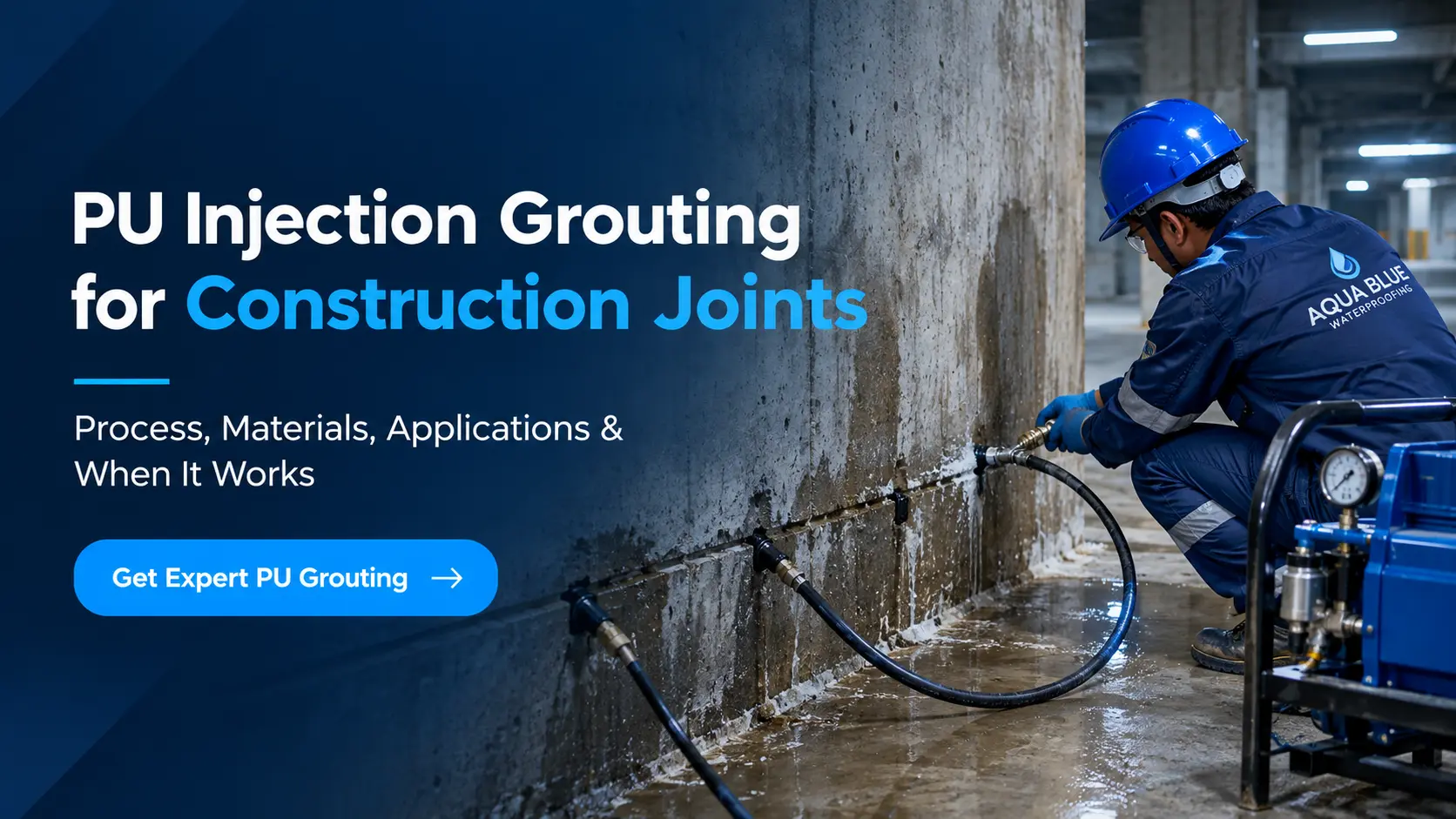
Employs liquid PU resin injected through mechanical steel packers under high pressure to react with internal moisture, expanding into a dense foam that stops active water flows.
Waterstop-Based Systems
PVC waterstops and swellable hydrophilic waterbars are embedded centrally inside concrete lifts during construction to physically block fluid passage across the joint.
Flexible Joint Tape / Membrane Systems
Hypalon-based elastomeric tapes bonded across joint faces with structural epoxy adhesives accommodate high dynamic joint movements without rupturing.
Concrete Repair Before Waterproofing
Deteriorated or honeycombed concrete surrounding a joint must be rebuilt with micro-concrete or structural polymer mortars before applying waterproofing layers.
When Does a Construction Joint Need More Than Waterproofing?
Waterproofing Repair vs Structural Concrete Repair
Waterproofing addresses water ingress, whereas structural concrete repair restores load-bearing capacity. If a construction joint shows severe spalling, exposed corroded rebar, structural displacement, or dynamic settlement cracks, waterproofing alone is insufficient. A full structural assessment and concrete rehabilitation must precede any joint sealing work.
Commercial Building Joint Repair in Bangalore
Where Construction Joint Problems Occur in Commercial Buildings
Subterranean joint failures frequently occur in commercial office buildings, IT parks, multi-level parking structures, basements, retaining walls, lift pits, podium slabs, and underground utility rooms across Bangalore.
Why Commercial Joint Repairs Need Minimal Operational Disruption
Commercial facilities require low-noise, dust-controlled, non-destructive interior repair methods (such as targeted pressure injection) that maintain business continuity and parking access.
What Commercial Property Managers Should Check Before Approving a Repair
- Clear identification of the internal leakage path.
- Detailed site preparation and substrate cleaning scope.
- Technical datasheets for proposed injection resins and sealants.
- Verification protocols and written warranty terms.
How to Choose a Concrete Joint Repair Contractor in Bangalore
When selecting a construction joint repair contractor in Bangalore, ensure they demonstrate engineering-led diagnostic capabilities rather than basic material application:
- Ask How They Identify the Leakage Source: Ensure they trace internal pathways rather than recommending surface patches.
- Ask Which Repair System They Recommend and Why: Verify they tailor materials (PU foam, flexible sealants, crystalline) to specific site conditions.
- Check Whether They Assess Concrete Condition: Confirm they inspect substrate hardness and honeycombing before mounting injection packers.
- Ask How They Handle Active Water Pressure: Check if they utilize specialized fast-setting chemical grouts for active water shut-off.
- Confirm Surface Preparation Steps: Ensure mechanical V-grooving and laitance removal are explicitly detailed in the scope of work.
- Ask How They Verify the Completed Repair: Confirm they monitor the repair under live groundwater head pressure.
- Request a Clear Scope of Work: Demand detailed proposals specifying packer placement, drill angles, resin specs, and surface finishing.
How to Prevent Construction Joint Repair From Failing Again
- Match the Repair System to Joint Movement: Ensure flexible tapes or sealants are selected for dynamic joints.
- Maintain the Joint and Adjacent Concrete: Keep drainage channels clear to lower hydrostatic pressure around retaining walls.
- Address New Leakage Early: Treat dampness immediately before water pressure expands internal micro-fissures.
- Monitor Previously Repaired Areas: Schedule periodic facility inspections following major monsoon seasons.
- Avoid Unplanned Surface Patching: Refrain from troweling standard plaster over active leaks.
- Keep Repair Records for Commercial Properties: Maintain technical logs documenting injection points and materials for future maintenance reference.
Frequently Asked Questions About Concrete Construction Joint Repair
What is a concrete construction joint?
A concrete construction joint is a planned stopping seam created when fresh concrete is poured against a previously hardened concrete lift during sequential placement in structural walls, slabs, or footings.
What causes construction joint failure?
Failure is caused by poor surface preparation (laitance), inadequate concrete consolidation (honeycombing), displaced waterstops, joint movement, and elevated subterranean hydrostatic water pressure.
Why do concrete construction joints leak?
Joints leak because the seam between concrete pours forms a microscopic interface. Groundwater driven by hydrostatic head pressure flows through these interconnected micro-voids into basement spaces.
How do you stop water leakage through concrete joints?
Identify the water path, prepare the joint by opening a clean V-channel, apply high-pressure PU injection grouting for active leaks, and finish with elastomeric sealants or non-shrink repair mortars.
What is the best method for concrete construction joint repair?
There is no single best method. Active leaks require PU chemical grouting; dynamic moving joints need elastomeric sealants or Hypalon tapes; and deteriorated concrete requires structural polymer repair prior to waterproofing.
Can PU injection repair a leaking construction joint?
Yes, PU injection effectively seals active leaks by expanding inside internal joint voids. However, it serves as a water-stopping treatment rather than a structural load-bearing repair.
Can a leaking construction joint be repaired from inside?
Yes. High-pressure polyurethane injection grouting allows negative-side repair directly from inside basements, sealing deep internal joint cavities without requiring external soil excavation.
Does every construction joint require waterproofing?
All below-grade construction joints or joints exposed to moisture, ground water tables, or weather elements require engineered joint sealing and waterstop systems to prevent water ingress.
How long does concrete construction joint repair last?
When properly diagnosed, mechanically prepared, and executed with high-grade elastomeric resins or sealants, professional joint repairs can last for decades, matching the structure's service life.
When does a construction joint require structural repair?
A joint needs structural repair when concrete spalling, severe rebar corrosion, structural displacement, or load-bearing cracks are present alongside water leakage.
How much does concrete construction joint repair cost in Bangalore?
Repair costs in Bangalore typically range from ₹150 to ₹450 per linear foot for standard surface grooving and elastomeric sealing. High-pressure PU injection grouting for active leaks generally costs between ₹1,200 and ₹2,800 per injection packer point, depending on site accessibility, water pressure, and resin selection. Rates reflect current Bangalore market benchmarks.
How do I choose a concrete joint repair contractor in Bangalore?
Select a contractor who conducts detailed leak diagnostics, tests concrete soundness, offers site-specific repair specifications, details mechanical surface preparation, and provides written performance warranties.
Get Concrete Construction Joint Repair in Bangalore
Dealing with persistent joint seepage in your basement, lift pit, or retaining wall? Aqua Blue Waterproofing provides expert site assessments, precise leakage diagnostics, specialized joint sealing, and high-pressure chemical injection services across residential and commercial properties in Bangalore.
📞 Contact Our Technical Waterproofing Specialists:
Phone: 88920 26121
Email: info@waterproofingcontractorsbangalore.com
📌 Visit Our Google Business Profile
Conclusion & Key Takeaways
Successful concrete construction joint repair relies on accurate diagnostic tracing, thorough substrate preparation, and selecting flexible or injection-based materials matched to hydrostatic pressure and joint movement. Avoiding common mistakes—such as applying rigid surface mortars over moving seams or ignoring concrete soundness—ensures durable protection for subterranean structures.
Are you facing complex joint leakage issues in your commercial or residential building in Bangalore? Share your questions or site conditions in the comments below, or contact our engineering team today for an on-site evaluation!

PRAVEEN P is the Founder of Aqua Blue Waterproofing and a Waterproofing Technical Specialist with over 16 years of industry experience. Since establishing the company in 2014, he has helped homeowners and businesses across Bangalore solve leakage and seepage issues through reliable, long-lasting waterproofing solutions and expert guidance.