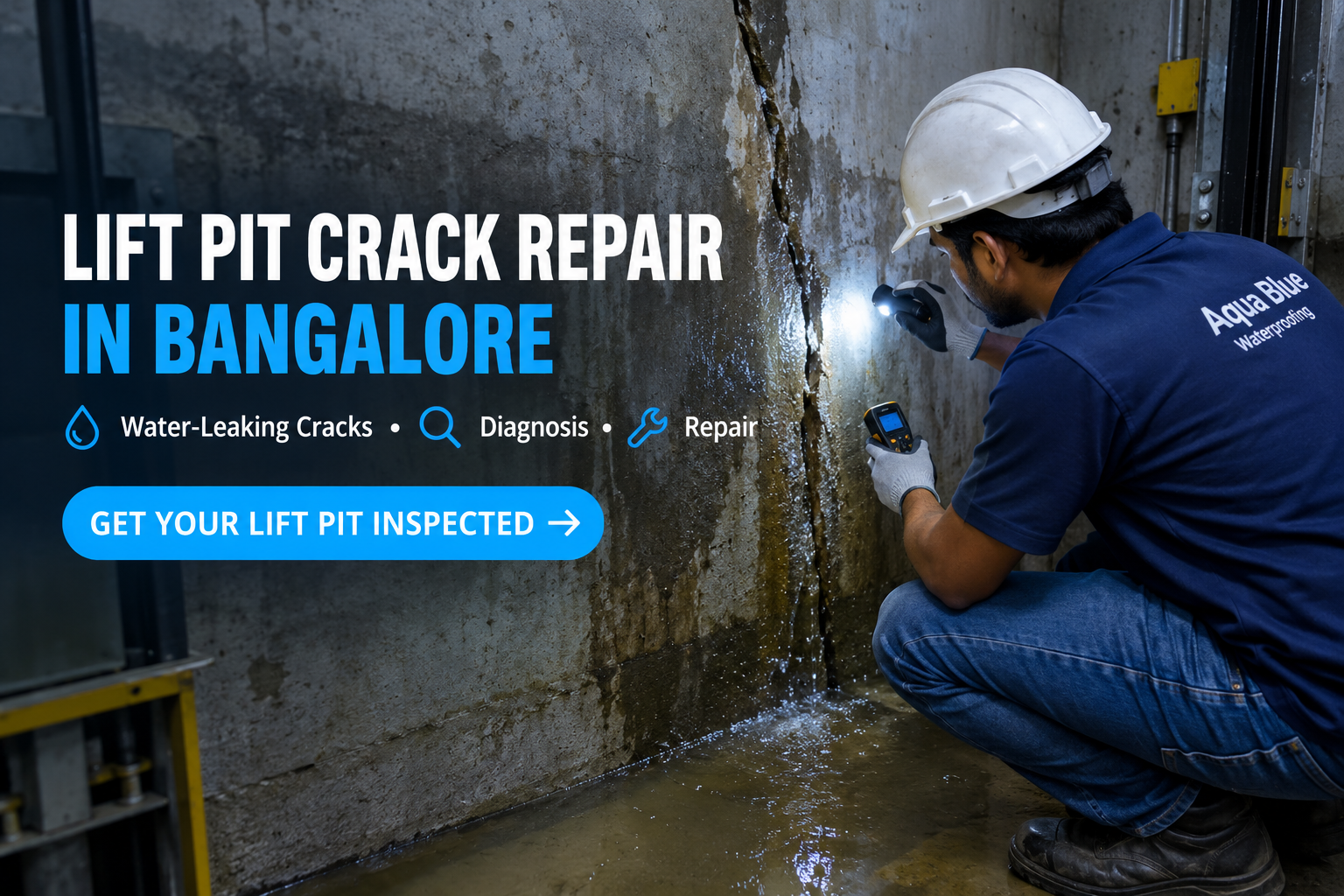
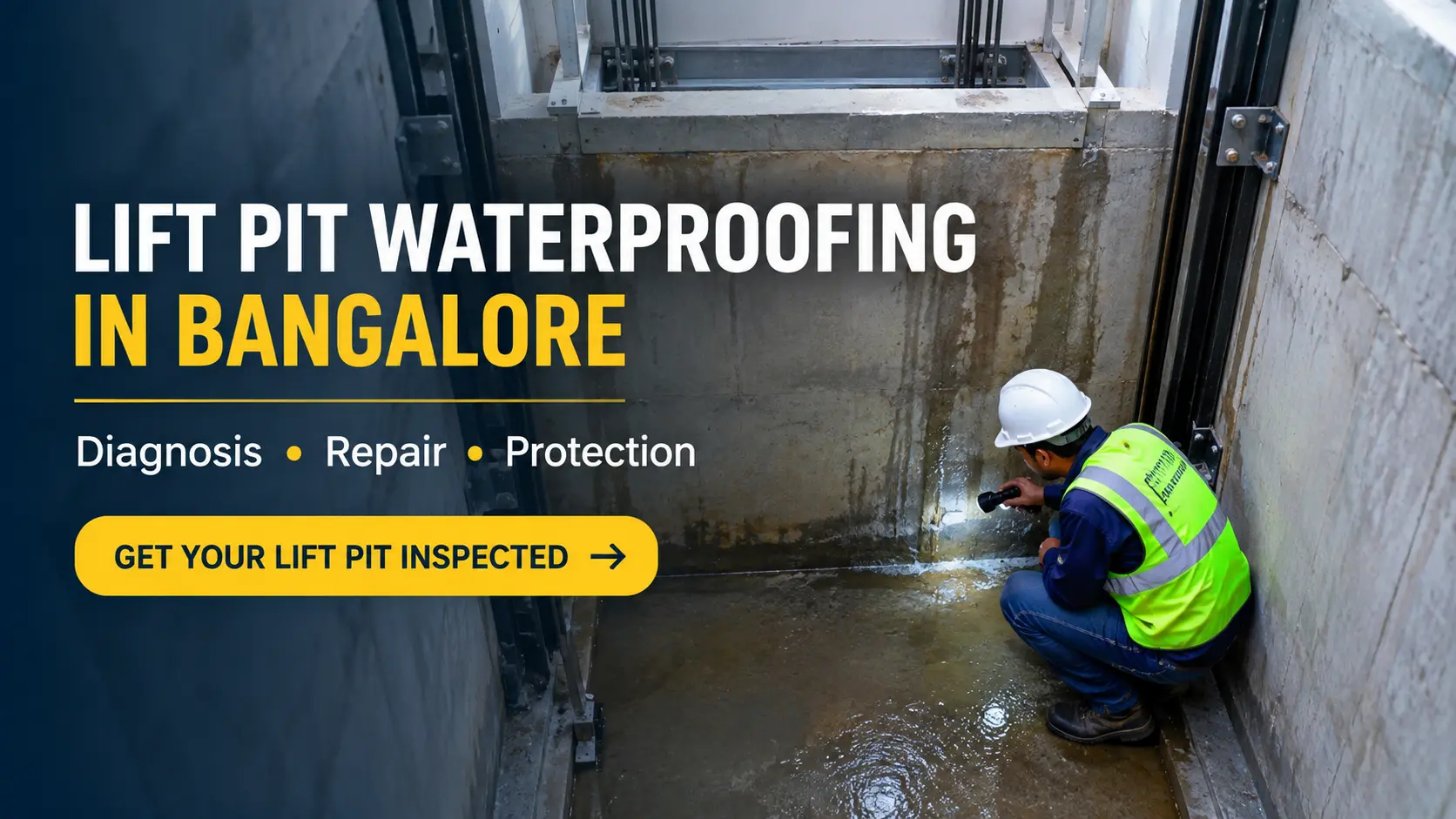
Water collects in a lift pit because it is the lowest below-grade structure in a building, making it directly vulnerable to subterranean hydrostatic pressure, cold construction joints, porous concrete, and unsealed service penetrations. When surrounding soil becomes saturated, groundwater actively migrates through microscopic cracks and wall-to-floor junctions. Resolving lift pit leakage permanently requires identifying the precise water-entry path rather than simply applying a surface coating.
For property developers, facility managers, and homeowners across Bangalore, a flooded or damp elevator shaft is more than a minor maintenance issue. It poses a severe risk to mechanical components, electrical wiring, and the overall structural integrity of the building.
Whether dealing with seasonal monsoon seepage in multi-story residential apartments in Indiranagar or managing high water table ingress in commercial IT parks in Whitefield, understanding the mechanics of subterranean water movement is vital. At Aqua Blue Waterproofing, we specialize in identifying and sealing subterranean leak paths to protect building infrastructure.
This comprehensive guide breaks down the core causes of elevator pit flooding, diagnostic testing protocols, modern repair systems, and site-specific prevention strategies tailored to Bangalore’s geology.
Need urgent site diagnosis or professional lift pit waterproofing in Bangalore?
📞 Call Aqua Blue Waterproofing Specialists: 08892026121
Table of Contents
- Why Does Water Collect in a Lift Pit?
- What Causes Lift Pit Water Leakage?
- How to Identify Where Water Is Entering the Lift Pit
- How to Prevent Water From Entering a Lift Pit
- What Is the Best Waterproofing Method for Lift Pits?
- Lift Pit Waterproofing Treatment Process
- Lift Pit Waterproofing for Apartments and Commercial Buildings
- Lift Pit Waterproofing vs Other Below-Ground Waterproofing
- What Happens If Lift Pit Water Leakage Is Ignored?
- When Does a Lift Pit Need More Than Waterproofing?
- How to Choose a Lift Pit Waterproofing Contractor in Bangalore
- Lift Pit Waterproofing in Bangalore: What Building Owners Should Check
- Frequently Asked Questions About Lift Pit Waterproofing
- Get Your Lift Pit Inspected by Aqua Blue Waterproofing
Why Does Water Collect in a Lift Pit?
Understanding why water accumulates in an elevator pit requires looking at a building's subterranean design.
+-----------------------------------------------------------+
|                   SURFACE RUNOFF & RAIN                  |
+-----------------------------------------------------------+
                             |
                             v
+-----------------------------------------------------------+
|                   SATURATED SOIL LAYER                    |
+-----------------------------------------------------------+
                             |
                             v
+-----------------------------------------------------------+
|               SUBTERRANEAN HYDROSTATIC HEAD              |
+-----------------------------------------------------------+
                             |
                             v
+-----------------------------------------------------------+
|  CONSTRUCTION JOINTS / CRACKS / POROUS CONCRETE INTERFACE |
+-----------------------------------------------------------+
                             |
                             v
+-----------------------------------------------------------+
|                LIFT PIT FLOOR & SUMP AREA                 |
+-----------------------------------------------------------+
Why Lift Pits Are More Exposed to Water Than Other Areas
Elevator pits sit deeper than standard basement raft slabs. Because they represent the absolute lowest point of a building's foundation, gravity naturally directs both surface drainage and subterranean water toward the pit. Surrounding soil acts as a reservoir, maintaining moisture against the pit's outer concrete walls long after surface rain stops.
How Groundwater and Hydrostatic Pressure Affect a Lift Pit
Hydrostatic pressure is the physical force exerted by standing fluids. When local groundwater levels rise, this pressure builds against below-grade concrete structures. Water molecules actively search for pathways of least resistance, forcing their way through microscopic capillary pores, cold seams, and hair-line shrinkage cracks in reinforced cement concrete (RCC).
Can Rainwater Cause Lift Pit Leakage?
Yes. Heavy surface runoff from intense monsoon downpours often overburdens surrounding storm drains. When water pools near perimeter walls, it percolates rapidly through backfilled soil, significantly elevating lateral hydrostatic pressure against elevator pit walls.
What Causes Lift Pit Water Leakage?
Identifying the exact root cause of water accumulation prevents costly trial-and-error repairs.
- Groundwater Ingress: High water tables exert continuous upward pressure against the bottom raft slab, seeking out unsealed structural interfaces.
- Leakage Through Wall-to-Floor Junctions: The cold construction joint formed where the vertical pit wall meets the horizontal floor slab is the most common failure point due to differential movement and poor bonding between concrete pours.
- Cracks in the RCC Lift Pit: Thermal expansion, structural settling, or curing shrinkage can create structural or non-structural cracks directly through the concrete wall or floor base.
- Honeycombing and Porous Concrete: Inadequate concrete compaction during initial casting leaves void pockets (honeycombing), rendering the matrix permeable to moisture.
- Failed or Missing Waterproofing: External membrane degradation, improper overlapping, or the complete absence of a continuous tanking system allows water to enter unimpeded.
- Water Entering Through Pipe or Service Penetrations: Unsealed conduits, drainage sleeves, and anchor bolt penetrations act as direct channels for water flow.
- Poor Drainage Around the Building: Malfunctioning perimeter French drains or clogged sumps cause localized water accumulation around subterranean structures.
How to Identify Where Water Is Entering the Lift Pit
A precise diagnostic process must precede any application of waterproofing materials.
+--------------------------------------------------------------------+
|                       DIAGNOSTIC WORKFLOW                          |
|                                                                    |
|  [Visual & Damp Checks] ---> [Efflorescence & Crack Mapping]       |
|                                         |                          |
|                                         v                          |
|  [Plumbing Elimination] <--- [Active Seepage Pressure Testing]     |
+--------------------------------------------------------------------+
Check the Wall-to-Floor Junction
Inspect the perimeter seam where the floor slab joins the vertical wall. Persistent dampness or standing water along this line indicates a cold construction joint failure.
Look for Active Water Seepage
Active leaks show visible trickling, bubbling, or jets of water pushing through concrete faces, especially during high groundwater conditions or following heavy rainfall.
Check Cracks, Joints, and Concrete Defects
Examine the pit walls for diagonal or vertical line patterns. Trace these lines to identify whether water is weeping through structural cracks or localized honeycombing.
Look for Efflorescence and Damp Marks
White, powdery mineral deposits (efflorescence) on concrete surfaces prove that water has been migrating through the slab, evaporating, and leaving dissolved salts behind.
Observe Whether Leakage Increases After Heavy Rain
Tracking seepage flow rates relative to weather patterns clarifies whether the issue stems from surface water infiltration or a permanently elevated water table.
Inspect Previous Waterproofing or Repair Work
Examine legacy cementitious patches or peeling surface membranes. Water often travels behind rigid surface repairs, emerging at weaker adjacent concrete points.
Rule Out Plumbing and Drainage Problems
Before treating a pit for groundwater ingress, test surrounding plumbing lines, sump pump discharge pipes, and HVAC condensate drains to rule out internal utility leaks.
How to Prevent Water From Entering a Lift Pit
Preventive engineering eliminates the need for emergency repairs later in the building's lifecycle.
Plan Waterproofing Before Lift Pit Construction
Incorporate external (positive-side) sheet membranes or heavy-duty liquid tanking systems over blinding concrete before pouring the main structural raft slab.
Use Suitable Waterstops at Concrete Joints
Install swellable hydrophilic waterbars or central PVC waterstops along all cold construction joints during initial concrete placement to block water at the seam.
+----------------------------------------------------+
|               COLD CONSTRUCTION JOINT              |
|                                                    |
|      [ Upper Concrete Wall Pour ]                  |
|      ============================                  |
|   <--- Hydrophilic / PVC Waterstop --->            |
|      ============================                  |
|      [ Lower Slab / Raft Concrete ]                |
+----------------------------------------------------+
Ensure Proper Concrete Compaction and Joint Preparation
Utilize mechanical immersion vibrators during concrete pouring to prevent honeycombing. Scrabble and clean construction joint interfaces before placing fresh concrete against hardened lifts.
Maintain Drainage Around Below-Ground Structures
Design positive slope grading away from the foundation and install perimeter drainage channels to redirect subsurface water away from subterranean walls.
Inspect Lift Pits Before Monsoon
Schedule routine pre-monsoon inspections of elevator pits, sump pumps, float switches, and check valves to ensure operational readiness before water tables rise.
What Is the Best Waterproofing Method for Lift Pits?
There is no single universal waterproofing system for every elevator pit. System selection depends on active flow pressure, concrete soundness, physical access, and whether work is executed during original construction or as a post-construction repair.
PU Injection Grouting for Active Water Leakage
Hydrophobic PU injection grouting is the primary method for stopping active, pressurized water flows. Injected under high pressure using mechanical steel packers, the liquid PU resin reacts with internal moisture, expanding into a dense, closed-cell foam that seals internal voids and deep-seated structural cracks.
Crystalline Waterproofing for Concrete Surfaces
Crystalline systems contain active chemicals that react with free lime and moisture within the concrete matrix. This reaction generates insoluble microscopic crystals inside capillary pores and micro-cracks, permanently turning the concrete itself into a water-resistant barrier.
Polymer-Based Waterproofing Systems
Flexible polymer-modified cementitious coatings or liquid elastomeric membranes form a protective surface barrier capable of bridging minor thermal micro-cracks on interior pit faces.
Joint Sealing and Waterstop Systems
New construction relies on embedded PVC or swellable hydrophilic waterbars. For remedial work on existing joints, combination systems using V-groove chase cutting, elastomeric polysulfide/PU sealants, and external Hypalon bonding tapes are used.
Concrete Repair Before Waterproofing
Applying waterproofing over soft, crumbling, or honeycombed concrete guarantees premature failure. Defective concrete must be removed, cleaned, and restored using non-shrink polymer-modified repair mortars or structural micro-concrete before applying sealant layers.
Lift Pit Waterproofing Treatment Process
A systematic methodology ensures consistent long-term repair performance.
Step 1: Diagnostic Site Inspection & Leakage Path Mapping
  │
  ▼
Step 2: Dewatering, Power Isolation & Equipment Safety Protocol
  │
  ▼
Step 3: Mechanical Surface Prep, Chipping & V-Groove Cutting
  │
  ▼
Step 4: Active Seepage Treatment (High-Pressure PU Injection Grouting)
  │
  ▼
Step 5: Substrate Repair with Non-Shrink Mortar & Flexible Crystalline System
  │
  ▼
Step 6: Final Verification Inspection & Water Pressure Test
1. Site Inspection and Leakage Diagnosis
Map out all visible water entry paths, evaluate concrete structural soundness, measure active hydrostatic pressure, and check previous repair attempts.
2. Dewatering and Work-Site Preparation
Coordinate with facility managers and lift engineers to lock out power, raise the elevator car, install temporary safety props, and pump out standing water.
3. Surface and Concrete Preparation
Mechanically remove loose debris, paint, or failed legacy coatings. Chase out cracks and cold construction joints into clean V-shaped channels measuring at least 25mm x 25mm.
4. Treat the Actual Water Entry Path
Install high-pressure mechanical injection packers along water-bearing cracks or construction joints. Inject hydrophobic PU resin to shut off active leaks within the deep concrete matrix.
           High-Pressure Mechanical Packer Detail
           --------------------------------------

             [ Drilled Port @ 45° Angle ]
                         \
                          \  <--- Mechanical Steel Packer
                           \
    Outer Soil/Water ===>   |====> Concrete Crack / Void
                           /
                          /  <--- Hydrophobic PU Expandable Foam
                         /
5. Apply the Selected Waterproofing System
Fill prepared V-chances with non-shrink polymer mortar. Apply two coats of a crystalline or flexible polymer-modified cementitious slurry system across all interior pit surfaces.
6. Inspection and Water-Leakage Verification
Allow required curing time, inspect the treated surfaces, and monitor the pit under active groundwater table conditions to verify complete water shut-off.
Lift Pit Waterproofing for Apartments and Commercial Buildings
Property type influences project logistics, safety protocols, and operational constraints.
+------------------------------------------------------------------------+
|                        PROPERTY TYPE MATRIX                            |
+--------------------------+---------------------------------------------+
| Residential Apartments   | High occupant coordination, seasonal leaks, |
|                          | multi-basement sumps, budget planning.      |
+--------------------------+---------------------------------------------+
| Commercial & IT Parks    | 24/7 access needs, strict safety audits,    |
|                          | high equipment risk, zero-downtime scope.   |
+--------------------------+---------------------------------------------+
Apartment Lift Pit Waterproofing in Bangalore
In residential high-rises across locations like Sarjapur Road, Electronic City, and Kanakapura Road, lift pit leaks often surface during monsoon seasons when underground parking levels flood.
- Residential Considerations: Requires clear communication with Resident Welfare Associations (RWAs) regarding temporary elevator downtime.
- Shared Infrastructure: Works often need to be coordinated alongside shared basement sump maintenance to lower surrounding water pressure.
Commercial Lift Pit Waterproofing in Bangalore
Commercial complexes, shopping malls, and IT corridors in Marathahalli, Bellandur, and Manyata Tech Park face strict uptime requirements.
- Operational Continuity: Waterproofing repairs must be executed during low-traffic night windows or weekends using low-odor, fast-setting materials.
- Equipment Protection: High-speed commercial elevators carry expensive electronic control units requiring complete, verifiable moisture isolation.
Lift Pit Waterproofing vs Other Below-Ground Waterproofing
While all below-grade structures contend with water ingress, elevator pits demand specialized technical approaches.
| Area | Main Water Concern | Structural Stress Factors | Primary Repair Focus |
|---|---|---|---|
| Basement Floor / Wall | Lateral dampness, slab seepage | Distributed hydrostatic head over large areas | Continuous crystalline slurries, drainage boards |
| Lift Pit | Dynamic water accumulation at lowest point | High localized pressure, mechanical vibrations, oily water | High-pressure PU injection, heavy-duty joint sealing |
| Retaining Wall | Soil moisture, lateral earth pressure | Constant soil movement, surface water drainage | External sheet membranes, filter drainage media |
| Underground Utility Area | Pipe penetrations, service sleeve leaks | Vibration from pumps, high pipe density | Elastomeric sleeve seals, flexible grouts |
Why Lift Pit Waterproofing Needs a Site-Specific Approach
Elevator shafts experience ongoing structural vibration from car movement. Rigid surface coatings that perform adequately on stationary basement walls will crack over time in a lift pit. Consequently, joint systems must remain flexible while offering high resistance to oil and grease residue from guide rail lubricants.
What Happens If Lift Pit Water Leakage Is Ignored?
Delaying necessary repairs leads to compounding damage and elevated financial costs.
- Corrosion of Metal Components: Moisture speeds up oxidation on elevator guide rails, steel counterweights, tension sheaves, and floor anchors.
- Persistent Damp Conditions: High humidity inside the hoistway can short-circuit electrical travelling cables, pit limit switches, and safety sensors.
- Concrete Deterioration: Continuous water passage leaches calcium hydroxide from concrete, weakening the structural matrix over time.
- Damage to Finishes & Mold Growth: Stagnant water generates foul odors and fosters mold, deteriorating interior finishes in adjacent basement lobbies.
- Recurring Maintenance Costs: Repeatedly pumping out standing water treats the symptom while allowing underlying structural degradation to worsen.
- Operational Disruptions: Elevator service shutdowns caused by flooded pit safety trips lead to major tenant inconvenience and compliance issues.
When Does a Lift Pit Need More Than Waterproofing?
Waterproofing alone cannot resolve structural instability or compromised concrete strength.
Structural Cracks or Significant Concrete Damage
Wide, structural cracks caused by ground settlement or heavy seismic shifting require structural epoxy resin injection to restore load-bearing capacity before waterproofing.
Severe Honeycombing or Concrete Deterioration
When concrete is crumbling, hollow, or deeply spalled, defective material must be removed down to sound concrete and rebuilt using structural micro-concrete.
Active Structural Movement
If a construction joint or crack experiences ongoing dynamic structural movement, standard rigid mortars will break. These locations require specialized elastomeric joint tape systems bonded with structural epoxies.
Persistent Leakage Despite Previous Waterproofing
If repeated surface coatings have failed, water is likely bypassing the internal wall matrix entirely. This scenario calls for deep curtain grouting or comprehensive structural rehabilitation.
How to Choose a Lift Pit Waterproofing Contractor in Bangalore
Selecting the right applicator ensures a long-term engineering solution rather than a temporary cover-up.
- Look for Proper Leakage Diagnosis: Ensure the contractor uses diagnostic tools to locate the exact entry path instead of prescribing a generic surface paint.
- Ask What Water-Entry Path Has Been Identified: A qualified contractor will explain whether water is entering via cold joints, floor cracks, or porous concrete.
- Check Whether Concrete Condition Has Been Assessed: Confirm they inspect for structural soundness, hollow sounds, and honeycombing prior to proposing materials.
- Ask Why a Particular System Is Recommended: Verify that material choices (PU resin, crystalline, polymer mortar) match site conditions like water pressure and joint movement.
- Check How the Repair Will Be Verified: Confirm the scope includes a post-repair verification period under active water conditions.
- Ask About Previous Lift Pit Projects: Review past commercial and residential lift pit projects completed within the local region.
- Confirm the Scope Before Work Begins: Require a detailed written quotation specifying surface prep steps, drill angles, packer layouts, and material specs.
Lift Pit Waterproofing in Bangalore: What Building Owners Should Check
Bangalore’s distinct soil geography and construction density require specialized local considerations.
       BANGALORE REGIONAL WATERPRINT CONSIDERATIONS
       --------------------------------------------

  [ North / East Corridors ]  ---> High Clay Content
                                   (Retains water; high lateral pressure)

  [ South / Central Zones ]   ---> Granitic Ridge / Variable Tables
                                   (Sharp seasonal groundwater spikes)
- Monsoon Rainfall Intensity: Bangalore receives heavy monsoon spells that suddenly raise subterranean water pressure around deep foundations.
- Soil Type Variations: Red clay soil common in areas like HSR Layout and Whitefield retains moisture, maintaining high lateral hydrostatic pressure against subterranean walls long after rains stop.
- Older Buildings with Legacy Repairs: Multi-story structures built during early development phases often lack modern internal waterstops, requiring negative-side PU injection.
- High-Density Construction: Closely spaced urban foundations can alter local natural groundwater drainage paths, unexpectedly directing water toward low-lying elevator shafts.
Frequently Asked Questions About Lift Pit Waterproofing
Why does water collect in a lift pit?
Water accumulates in a lift pit because it is the lowest point in a building's foundation. Subterranean hydrostatic pressure forces groundwater through cold construction joints, concrete cracks, porous honeycombing, or unsealed pipe sleeves.
What causes lift pit water leakage?
Primary causes include missing or damaged external waterproofing membranes, degraded wall-to-floor construction joint seals, structural concrete cracks, poor concrete compaction, elevated local water tables, and inadequate surrounding foundation drainage.
Can a leaking lift pit be waterproofed from inside?
Yes. Using high-pressure hydrophobic polyurethane (PU) injection grouting combined with interior negative-side crystalline and elastomeric polymer coatings, leaking lift pits can be sealed effectively from the inside without requiring external soil excavation.
What is the best waterproofing method for a lift pit?
There is no single best method. Active leaks require high-pressure PU chemical grouting to shut off flowing water. Dynamic construction joints need flexible sealants or Hypalon tapes, while porous concrete surfaces benefit from deep-penetrating crystalline treatments.
Can PU injection be used for lift pit leakage?
Yes. Hydrophobic PU injection grouting is ideal for stopping active groundwater ingress. The injected liquid resin reacts with moisture, expanding rapidly into a flexible closed-cell foam that fills deep internal voids and seals active leaks.
How is lift pit waterproofing done?
The process involves dewatering the pit, mechanically cleaning all surfaces, chasing out cracks and construction joints into V-grooves, injecting PU resins into active leak paths, filling grooves with non-shrink polymer mortar, and applying a surface waterproofing system.
Does lift pit waterproofing work for apartment buildings?
Yes. Specialized negative-side waterproofing and high-pressure chemical grouting are designed specifically to seal apartment lift pits with minimal disruption to residents and basement parking access.
Do commercial buildings need a different lift pit waterproofing approach?
Commercial properties often require fast-setting, low-odor injection grouting materials and low-noise application equipment to allow night or weekend execution, ensuring zero disruption to daily business operations.
When does lift pit leakage require structural assessment?
A structural assessment is necessary if the lift pit displays severe concrete spalling, exposed corroded steel reinforcement, widening structural cracks, or floor displacement alongside water leakage.
How much does lift pit waterproofing cost in Bangalore?
In Bangalore, standard surface treatment using polymer-modified or crystalline slurry coatings typically ranges between ₹40 to ₹100 per sq. ft. High-pressure PU injection grouting for active leakage shut-off generally costs between ₹850 to ₹1,500 per sq. ft. (or per injection packer point), depending on water pressure, site accessibility, and the volume of resin required.
Get Your Lift Pit Inspected by Aqua Blue Waterproofing
Facing persistent dampness, water accumulation, or active leakage in your elevator shaft? Aqua Blue Waterproofing offers expert diagnostic site inspections across Bangalore. Our engineering team identifies the exact water-entry path and implements targeted waterproofing solutions designed for your building's specific conditions.
Take Action Before Water Causes Severe Component Damage:
📞 Direct Phone: 08892026121
📧 Email: info@waterproofingcontractorsbangalore.com
📌 Visit Aqua Blue Waterproofing on Google Maps
🌐 Explore Basement & Below-Ground Waterproofing Solutions
Summary & Final Thoughts
Resolving elevator pit water leakage permanently requires moving past superficial surface patches. By correctly diagnosing whether water enters through construction joints, floor cracks, or porous concrete, you can select the precise combination of high-pressure PU injection, crystalline barriers, or elastomeric sealants needed to keep your pit dry.
Have you experienced recurring water issues in your building's lift pit after heavy rains? Share your questions or site conditions in the comments below, or contact our engineering team directly to schedule a professional site inspection!

PRAVEEN P is the Founder of Aqua Blue Waterproofing and a Waterproofing Technical Specialist with over 16 years of industry experience. Since establishing the company in 2014, he has helped homeowners and businesses across Bangalore solve leakage and seepage issues through reliable, long-lasting waterproofing solutions and expert guidance.