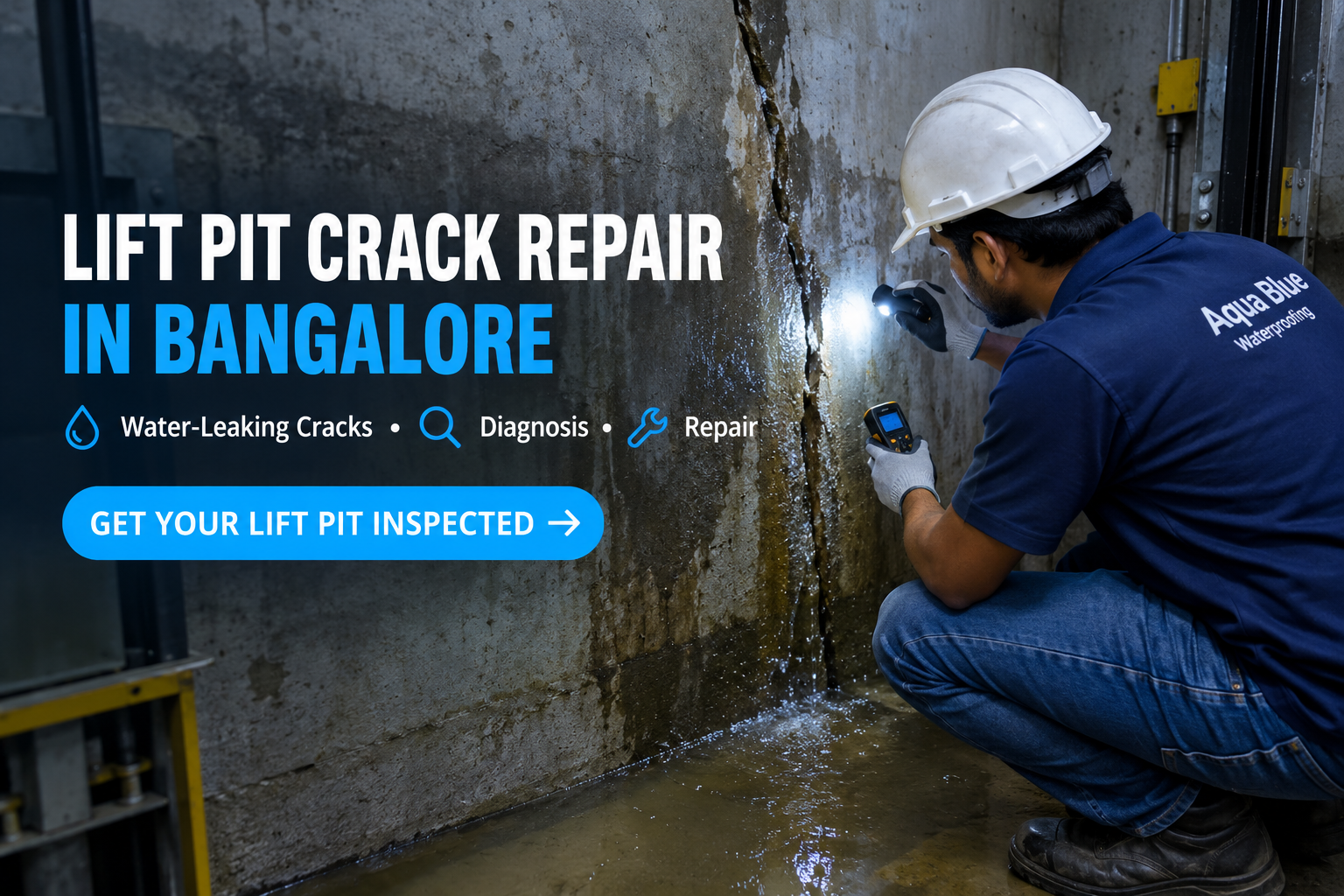
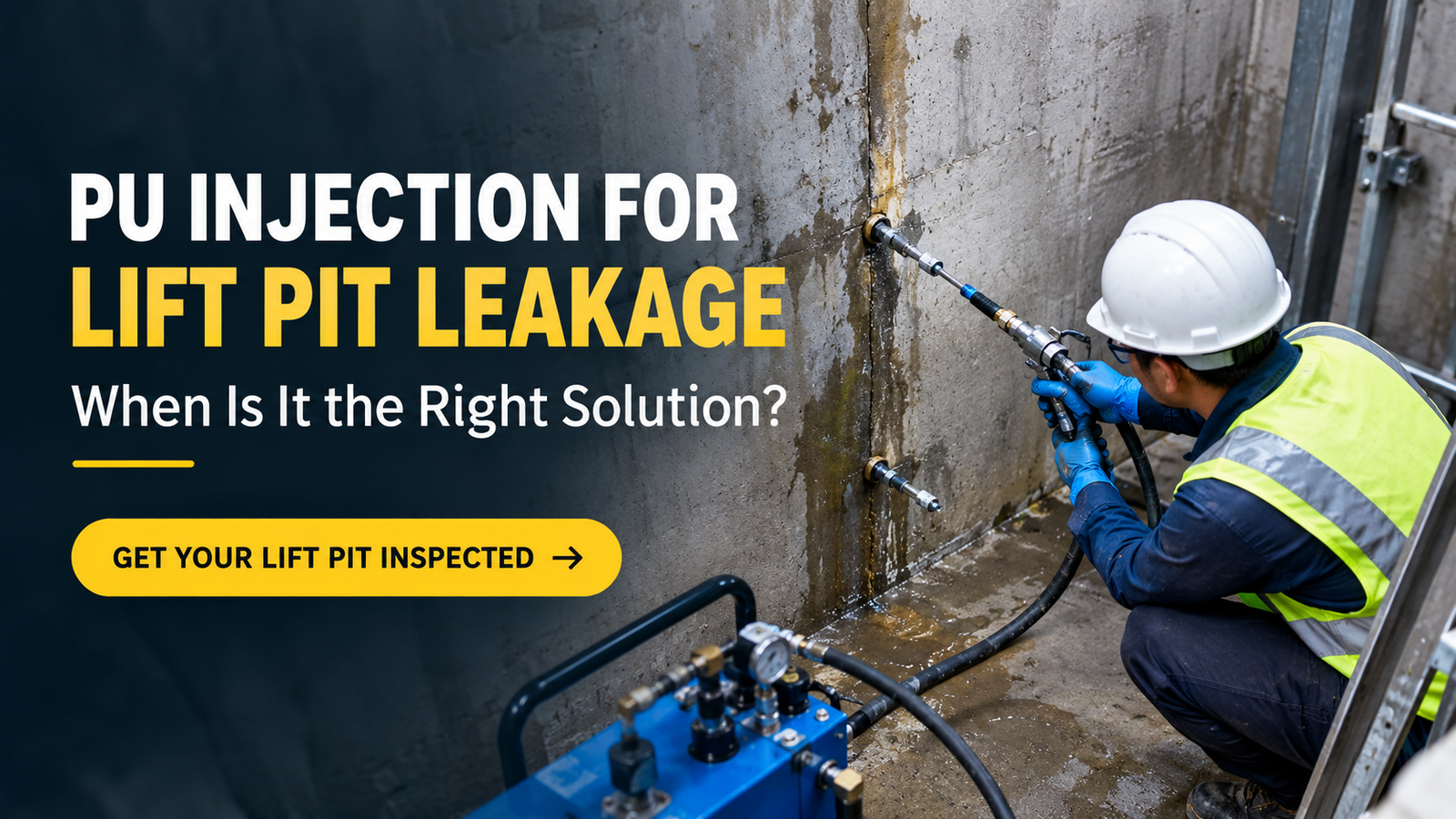
Dealing with standing water or persistent moisture in an elevator pit is one of the most frustrating challenges for building owners, facility managers, and Resident Welfare Associations (RWAs) across Bangalore. Because the elevator pit sits at the absolute lowest point of your foundation, subterranean hydrostatic pressure continuously forces groundwater inward. When leaks appear, PU injection for lift pit leakage is often discussed as a primary repair method.
PU injection can be exceptionally effective for shutting off active water ingress through defined cracks, cold construction joints, and honeycombed concrete. However, its suitability depends heavily on identifying the true source of water, evaluating the structural condition of the concrete, and measuring surrounding hydrostatic head pressure. At Aqua Blue Waterproofing, we prioritize accurate diagnosis over quick surface fixes to ensure long-term structural protection.
This guide provides a comprehensive breakdown of how polyurethane grouting functions, when it should be utilized, scenarios where it shouldn't be the sole treatment, and how to execute a durable repair tailored to local subterranean conditions.
Need an immediate site inspection or expert leak diagnosis for your lift pit?
📞 Call Aqua Blue Waterproofing Specialists: 08892026121
Table of Contents
- What Is PU Injection for Lift Pit Leakage?
- How Does PU Injection Stop Lift Pit Leakage?
- When Should PU Injection Be Used for Lift Pit Leakage?
- When Should PU Injection NOT Be the Only Solution?
- How to Repair Lift Pit Leakage Using PU Injection
- What Type of PU Is Used for Lift Pit Leakage?
- PU Injection vs Other Lift Pit Leakage Treatments
- PU Injection Grouting for Lift Pits in Bangalore
- How to Choose a PU Injection Contractor for Lift Pit Leakage in Bangalore
- Frequently Asked Questions About PU Injection for Lift Pits
- Get Your Lift Pit Inspected by Aqua Blue Waterproofing
What Is PU Injection for Lift Pit Leakage?
PU (Polyurethane) injection is a specialized liquid resin grouting technique engineered to seal internal concrete voids, cold seams, and deep structural cracks from the inside (negative side) of a below-grade structure.
+-----------------------------------------------------------+
|               EXTERIOR GROUNDWATER / SOIL                 |
+-----------------------------------------------------------+
                             |
                             v  (Hydrostatic Pressure)
+-----------------------------------------------------------+
|    CONCRETE CRACK / COLD SEAM / HONEYCOMB VOID MATRIX    |
|                                                           |
|       ===>( High-Pressure Liquid PU Injection )<===       |
|                                                           |
|   [ Liquid PU + Water Reaction -> Flexible Closed Cell ]  |
+-----------------------------------------------------------+
                             |
                             v  (Water Entry Arrested)
+-----------------------------------------------------------+
|                     LIFT PIT INTERIOR                     |
+-----------------------------------------------------------+
Understanding Polyurethane Grout
Polyurethane grout is a low-viscosity synthetic resin formulated to react dynamically when it encounters water. Upon contact with moisture, the liquid chemical expands rapidly—filling microscopic capillary networks, fractures, and internal voids within the reinforced concrete (RCC) matrix.
PU Injection vs Surface Waterproofing
- PU Injection: Targets the internal leakage path within the concrete wall or floor slab. Rather than holding water back at the interior surface, it travels deep into the core of the concrete to block fluid movement at its origin.
- Surface Waterproofing: Creates a continuous membrane or slurry barrier over the interior face of the concrete. While vital for protecting surfaces, flexible coatings alone can blister or delaminate if applied over active, pressurized water streams.
How Does PU Injection Stop Lift Pit Leakage?
Polyurethane injection works by transforming dynamic water pathways into solid, elastomeric barriers deep inside the concrete.
How Polyurethane Grout Reacts With Water
When pumped under controlled mechanical pressure, the liquid resin contacts water trapped inside structural cracks. This triggers a rapid chemical reaction, causing the liquid to foam and expand into a durable, water-impermeable closed-cell structure.
How PU Reaches the Internal Leakage Path
- Drilled Injection Ports: Ports are drilled at a precise 45-degree angle to intersect the crack or joint mid-way through the concrete slab.
- Mechanical Injection Packers: Heavy-duty steel or brass packers with non-return valves are tightened into the drilled holes.
- Pressure-Controlled Injection: High-pressure pumps force liquid resin into the packers, pushing resin deep into the crack network and displacing standing water.
How PU Helps Control Active Water Ingress
Unlike rigid cementitious mortars that wash away under active flow, hydrophobic and hydrophilic PU resins react rapidly with moving water. This makes PU injection an effective choice when groundwater is actively trickling or jetting through concrete seams during high water table conditions.
When Should PU Injection Be Used for Lift Pit Leakage?
PU chemical grouting delivers strong results when applied to defined, localized entry paths.
- Active Water Leakage Through Concrete Cracks: Ideal for narrow structural or shrinkage cracks where water is actively weeping under pressure.
- Leakage Through Construction Joints: Effective at sealing cold seams between separate concrete pours where water barrier strips were omitted or installed improperly during construction.
- Water Ingress at Wall-to-Floor Junctions: Seals the perimeter joint where the vertical pit walls meet the bottom raft slab—one of the most common failure points in below-grade structures.
- Water-Bearing Voids or Honeycombed Concrete: Fills hidden internal air pockets caused by incomplete concrete vibration during casting.
- Leakage That Cannot Be Accessed From Outside: Provides a viable negative-side repair solution when external soil excavation around the elevator shaft is physically or financially impossible.
When Should PU Injection NOT Be the Only Solution?
While effective, stopping an active leak with PU resin is not always equivalent to fully waterproofing an entire lift pit.
The Concrete Is Severely Damaged
If concrete in the pit is spalling, crumbling, or hollow, injecting resin into a structurally compromised base will fail. Defective concrete must be mechanically removed and rebuilt with structural micro-concrete or polymer repair mortars before sealing.
The Crack Is Structurally Significant
If water leakage stems from ongoing structural settlement or major load distribution failure, injecting polyurethane alone will not restore structural integrity. Structural cracks require structural epoxy injection to restore tensile strength, followed by flexible waterproofing.
The Leakage Source Is Plumbing or Drainage
If water is entering the pit due to a ruptured freshwater line, overflowing storm drain, or malfunctioning sump pump discharge pipe, chemical grouting will not solve the underlying issue. Utility leaks must be repaired at the source.
Water Is Entering Through Multiple Uncontrolled Paths
When concrete is uniformly porous across large areas without clear crack lines, injecting localized packers becomes inefficient. These conditions require surface-applied crystalline systems, full-pit renders, or curtain grouting.
How to Repair Lift Pit Leakage Using PU Injection
A durable, long-term repair requires a systematic, step-by-step process.
Step 1: Inspect & Map Water Entry Paths
  │
  ▼
Step 2: Dewater Pit & Prepare Work Area
  │
  ▼
Step 3: Drill Staggered Injection Holes (45° Angle)
  │
  ▼
Step 4: Install Mechanical Packers with Non-Return Valves
  │
  ▼
Step 5: Inject PU Resin Under Controlled Hydraulic Pressure
  │
  ▼
Step 6: Verify Active Leak Shut-Off & Flush Packers
  │
  ▼
Step 7: Patch Drill Ports & Apply Secondary Waterproofing Layer
- Inspect the Lift Pit and Identify Water Entry Paths: Conduct a diagnostic survey to map active leaks, construction joints, structural cracks, and service penetrations.
- Dewater and Prepare the Work Area: Pump out standing pit water, lock out elevator electrical power safely, and clean concrete surfaces around target cracks.
- Mark the Leakage Path: Trace visible cracks and seams with specialized markers to determine the drilling pattern.
- Drill Injection Holes: Drill holes at a 45-degree angle toward the crack, alternating sides in a staggered pattern to intersect the defect midway through the concrete wall.
- Install Injection Packers: Insert mechanical steel packers equipped with rubber expansion sleeves and internal non-return zerk fittings into the drilled ports.
- Inject Selected PU Grout: Connect a high-pressure electric or pneumatic grout pump to the packers. Inject liquid resin at controlled pressures until expanding foam emerges from adjacent ports or crack faces.
- Check Active Leak Arrest: Monitor the treated section to confirm that active water flow has ceased.
- Repair the Surface and Finalize Waterproofing: Knock off packer heads after resin cure, seal drill ports with non-shrink polymer repair mortar, and apply a protective crystalline or polymer-modified cementitious slurry coat over the prepared surface.
What Type of PU Is Used for Lift Pit Leakage?
Choosing between hydrophobic and hydrophilic polyurethane resins depends on specific site conditions.
Hydrophobic PU Injection
- Characteristics: Requires only a tiny amount of moisture to react; expands into a closed-cell foam that does not absorb water.
- Best Application: Ideal for heavy, pressurized groundwater leaks and locations exposed to alternating wet and dry seasonal cycles, as cured hydrophobic foam does not shrink in dry conditions.
Hydrophilic PU Injection
- Characteristics: Absorbs moisture during its chemical reaction, forming a flexible, rubber-like gel matrix.
- Best Application: Performs well in continuously damp or fully submerged environments where moisture remains present to maintain gel flexibility.
Matching PU Systems to Site Conditions
| Parameter | Hydrophobic PU | Hydrophilic PU |
|---|---|---|
| Water Requirement | Triggers with trace moisture | Absorbs surrounding water |
| Cured Structure | Dense, rigid/flexible closed-cell foam | Flexible, elastomeric gel |
| Dry Cycle Stability | Extremely stable (No shrinkage) | May shrink if completely dried out |
| Primary Use Case | Gushing active leaks, seasonal monsoon cracks | Continuously saturated below-grade joints |
PU Injection vs Other Lift Pit Leakage Treatments
Understanding how PU injection compares to other remediation techniques helps clarify proper system selection.
| Treatment Method | Typical Purpose | Suitable Situation |
|---|---|---|
| PU Injection | Stops active water ingress through internal cracks | Active, pressurized leaks in defined cracks/joints |
| Epoxy Injection | Restores structural concrete bonding strength | Dry or damp structural cracks requiring load transfer |
| Joint Sealing Systems | Seals surface movement seams | Surface chase sealing along accessible construction joints |
| Crystalline Systems | Reacts inside capillary pores to reduce permeability | Sound concrete faces exposed to dampness or moisture |
| Polymer Slurry Systems | Creates a flexible surface protection barrier | Clean, sound interior pit faces as secondary protection |
| Perimeter Drainage | Diverts exterior groundwater away from walls | High groundwater tables requiring water diversion |
Diagnostic-First Method Selection
System selection should depend on site conditions rather than applying a single method everywhere. Stopping an active flow with PU injection often serves as the essential preliminary step that allows secondary crystalline or polymer surface systems to cure properly.
PU Injection Grouting for Lift Pits in Bangalore
Executing subterranean waterproofing in Bangalore requires accounting for regional soil characteristics and monsoon weather patterns.
        BANGALORE SUBTERRANEAN HYDROMETRIC PROFILE
        ------------------------------------------

  [ East/North Corridors ]  ---> Deep Red Clay / Low Drainage
  (Whitefield, Electronic City)  (Holds subsurface water against walls)

  [ South/Central Corridors] ---> Granitic Bedrock / Fracture Pathways
  (Jayanagar, Indiranagar)      (Pockets of high seasonal hydrostatic pressure)
- Monsoon Hydrostatic Pressure: Heavy rainfall during monsoon seasons raises localized water tables, placing significant pressure on elevator pits in residential high-rises and commercial tech parks.
- Subterranean Clay Soils: Areas such as HSR Layout, Bellandur, and Whitefield feature heavy clay soils that retain subterranean moisture, maintaining hydrostatic pressure against below-grade walls long after surface rain stops.
- Vibration and Dynamic Load: Bangalore's busy commercial IT parks run elevators constantly. Waterproofing solutions must maintain flexible elastomeric seals capable of handling mechanical vibrations without cracking.
How to Choose a PU Injection Contractor for Lift Pit Leakage in Bangalore
Because polyurethane grouting requires specialized equipment and chemical handling, selecting an experienced contractor is critical.
- Leakage-Source Diagnosis: Ensure the contractor conducts a thorough assessment using moisture meters and site inspection tools rather than applying generic surface paints.
- Crack & Concrete Assessment: Confirm they evaluate structural soundness, honeycombing, and concrete density prior to recommending injection pressures.
- Appropriate PU Selection: Verify they choose between hydrophobic and hydrophilic resins based on whether the leak is dynamic, seasonal, or continuously submerged.
- Clear Treatment Scope: Look for detailed written proposals that outline drill hole spacing, packer specifications, pumping pressure thresholds, and surface patching steps.
- Post-Treatment Verification: Confirm the contractor provides a post-injection monitoring period under active water conditions to verify leak shut-off.
- Pricing Transparency: In Bangalore, standard PU injection grouting for localized leak paths generally ranges between ₹650 to ₹1,500 per sq. ft. (or ₹350 to ₹800 per packer point installed) depending on resin type, pump pressure, and access conditions.
Frequently Asked Questions About PU Injection for Lift Pits
Can PU injection stop lift pit water leakage?
Yes. High-pressure polyurethane injection is one of the most reliable methods for stopping active groundwater leaks through concrete cracks, cold construction joints, and wall-to-floor junctions in below-grade elevator pits.
How does PU injection work in an elevator pit?
Technicians drill angled ports to intersect internal concrete cracks, install mechanical injection packers, and pump liquid PU resin under pressure. When the resin meets water inside the crack, it expands into a dense closed-cell foam that seals fluid pathways.
When should PU injection be used for lift pit leakage?
PU injection should be used when water is actively leaking or weeping through defined structural cracks, cold construction joints, or honeycombed concrete voids that cannot be accessed from the exterior side of the building.
Can PU injection repair lift pit cracks?
Yes, PU injection seals cracks against water penetration. However, if the crack is a load-bearing structural fault, structural epoxy injection must be used first to restore mechanical strength, followed by flexible waterproofing.
Is PU injection enough to waterproof an entire lift pit?
Not always. While PU injection stops active flow through defined cracks, comprehensive protection often requires a complete waterproofing approach—combining PU injection for active leaks with crystalline or polymer-modified surface coatings across the pit walls and floor.
When is PU injection not suitable?
PU injection is not suitable for crumbling or structurally decayed concrete, unsealed plumbing line leaks, or uniform surface dampness lacking clear crack pathways. In these scenarios, structural concrete restoration or broad surface tanking is required.
Get Your Lift Pit Inspected by Aqua Blue Waterproofing
Dealing with active water seepage or standing water in your building's elevator pit? Aqua Blue Waterproofing provides expert diagnostic assessments across Bangalore to identify water entry paths and determine whether high-pressure PU injection is the right solution for your site.
Stop Water Ingress Before It Causes Mechanical Damage:
📞 Direct Phone: 08892026121
📧 Email: info@waterproofingcontractorsbangalore.com
📌 Find Aqua Blue Waterproofing on Google Business
🌐 Explore PU Injection & Basement Waterproofing Solutions
Summary & Final Thoughts
Polyurethane injection grouting is a proven, highly effective method for arresting active groundwater leaks in subterranean elevator pits. By identifying whether water is migrating through construction joints, shrinkage cracks, or concrete voids, building managers can implement targeted repairs that stop leaks without expensive external excavation.
Is your building currently battling seasonal elevator pit seepage? Share your questions or site conditions in the comments below, or reach out to our technical team today to arrange a site evaluation!

PRAVEEN P is the Founder of Aqua Blue Waterproofing and a Waterproofing Technical Specialist with over 16 years of industry experience. Since establishing the company in 2014, he has helped homeowners and businesses across Bangalore solve leakage and seepage issues through reliable, long-lasting waterproofing solutions and expert guidance.