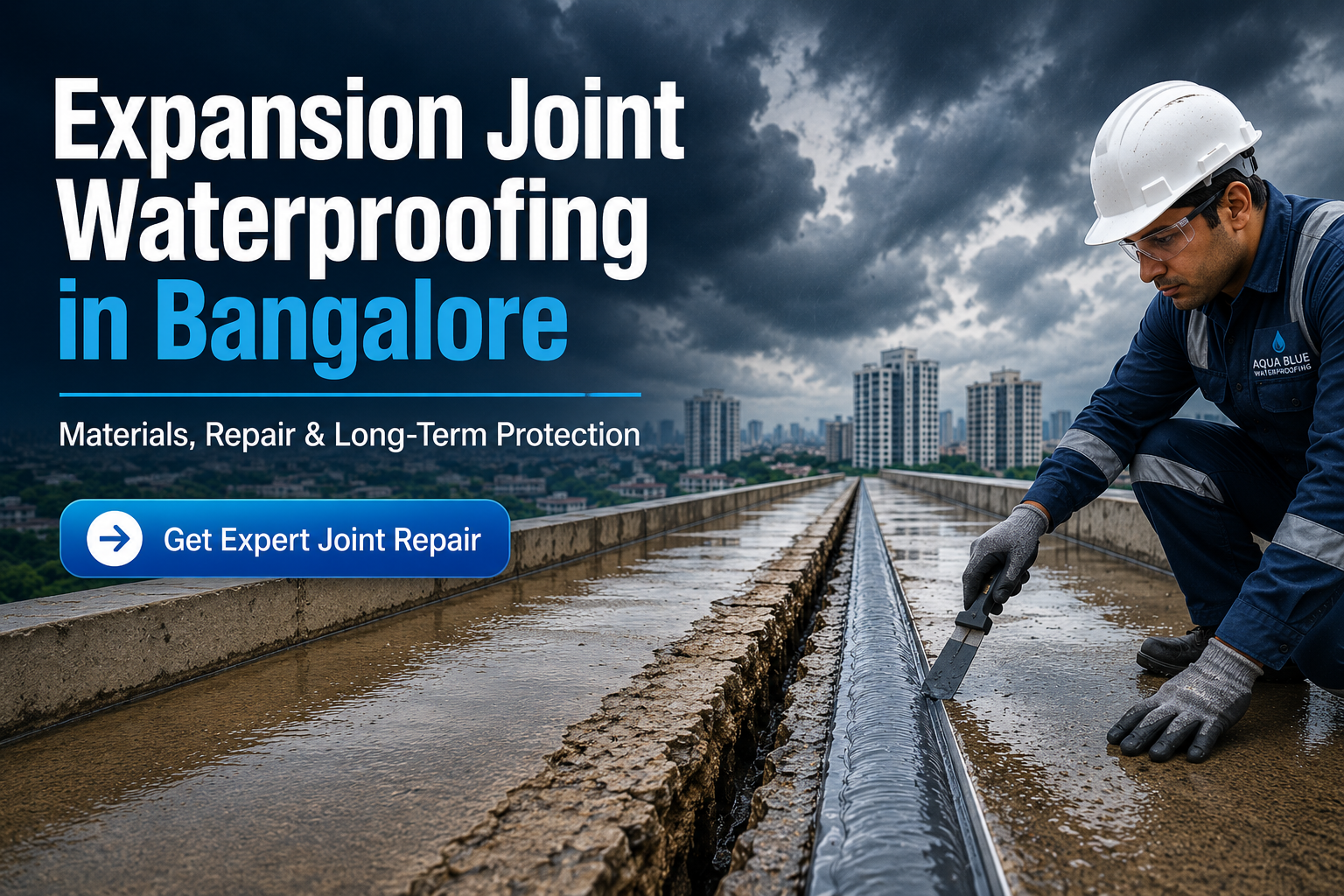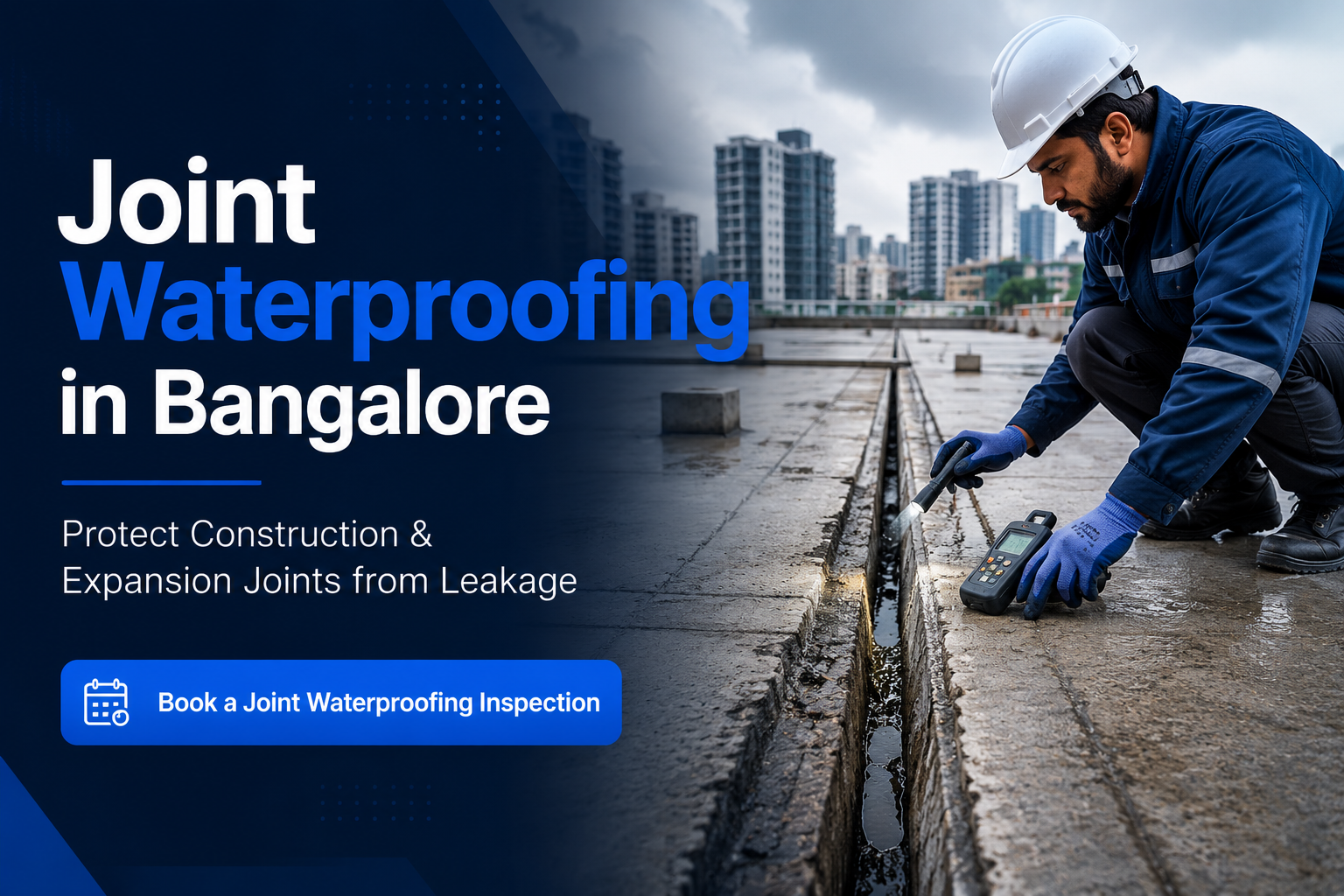

Water leakage along structural concrete seams is one of the most persistent issues affecting residential apartments, commercial complexes, and industrial sites across Bangalore. During heavy monsoon downpours, water collects on flat roofs, podium decks, and basement walls, quickly finding micro-fractures along concrete cold joints in Bangalore properties. Securing specialized joint treatment is essential for protecting structural integrity, preventing steel rebar corrosion, and eliminating recurring interior dampness.
This comprehensive guide details the mechanics of cold joint formation, preventive construction practices, advanced diagnostic techniques, and high-performance repair methodologies. Whether managing an ongoing leakage problem or planning new construction, understanding proper joint treatment ensures long-term protection against water ingress.
Need immediate technical help or a site inspection for leaking building joints in Bangalore?
Contact our senior specialists at Aqua Blue Waterproofing by calling +91-88920 26121.
Table of Contents
-
What Are Concrete Cold Joints?
-
What Happens When Concrete Pouring Is Interrupted?
-
Where Do Cold Joints Occur in Buildings?
-
How to Identify a Cold Joint in Concrete
-
Can Concrete Cold Joints Cause Water Leakage?
-
How Can Cold Joints Be Prevented During Concrete Construction?
-
What to Do When Water Leaks Through a Concrete Cold Joint?
-
Concrete Cold Joint Repair: What Does the Process Involve?
-
Cold Joint Waterproofing in Bangalore: Choosing the Right Treatment
-
Concrete Cold Joint Repair in Bangalore: When Should You Seek Professional Help?
-
Why Cold Joint Treatment Can Fail
-
Frequently Asked Questions About Concrete Cold Joints
-
Conclusion: Protecting Concrete Cold Joints for Long-Term Performance
What Are Concrete Cold Joints?
A concrete cold joint is an unplanned boundary formed when fresh concrete is placed against a previous pour that has already started setting. This delay prevents mechanical interlocking and chemical bonding, creating a structural seam vulnerable to water ingress. Identifying and treating these interfaces is essential for long-term structural protection when managing concrete cold joints in Bangalore.
In concrete construction, a cold joint represents a plane of weakness where two successive placements of concrete meet without forming a unified monolithic mass. When fresh concrete comes into contact with concrete that has already passed its initial setting phase, the two batches cannot mix or bond together seamlessly at the interface.
Bonding at this interface becomes a significant concern because the shear strength and tensile capacity across the seam are reduced compared to continuous concrete. However, a cold joint is not automatically equivalent to a structural failure. With proper engineering evaluation, mechanical bonding agents, and surface preparation, cold joints can be managed without compromising the safety of the structure.
Cold Joint vs Planned Construction Joint
| Feature | Cold Joint | Planned Construction Joint |
| Origin | Results unexpectedly from an unplanned pour delay | Intentionally designed and scheduled in structural drawings |
| Location | Occurs randomly wherever the pour was halted | Predetermined at points of minimum shear stress |
| Bonding Interface | Weak bond due to setting without joint preparation | Prepared with keyways, bonding slurry, or water stops |
| Sequence Role | Corrective measure required post-placement | Formally incorporated into the construction sequence |
What Happens When Concrete Pouring Is Interrupted?
When concrete placement is halted mid-pour, a distinct timeline of material state changes occurs:
Concrete Placement → Unplanned Interruption → Initial Setting of First Pour → Subsequent Concrete Placement → Cold Joint Interface Formation
As the first batch of concrete sits undisturbed, hydration begins and the cement paste hardens. When subsequent concrete is poured over or against it, the new mix cannot consolidate with the stiffened surface below, forming a distinct cold-joint boundary.
Why Concrete Setting Time Matters
The time window before a cold joint forms depends entirely on ambient site conditions and concrete mix characteristics:
-
Site Delays and Transit Interruptions: Ready-mix concrete trucks stuck in urban traffic or pump breakdowns on-site cause unexpected delays that allow concrete to reach initial set.
-
Weather and Temperature Shifts: High temperatures and low humidity accelerate hydration, shortening the available window for continuous placement.
-
Admixtures and Mix Design: Retarders extend workable times, whereas accelerators speed up setting times.
-
Coordinated Concrete Pouring: Maintaining synchronized batching, transportation, and vibration schedules ensures fresh layers integrate before the underlying concrete sets.
Where Do Cold Joints Occur in Buildings?
Unplanned cold joints develop across various structural elements during construction:
Cold Joints in RCC Slabs
Large slab casts frequently experience cold joints when concrete pumping pauses between mixer truck deliveries, creating horizontal weakness planes across floor decks.
Cold Joints in Beams and Columns
Vertical cold joints form when column lifts are poured in stages or when high beam-column junctions experience placement delays during congested rebar pours.
Cold Joints in Foundations and Raft Slabs
Massive concrete pours for raft foundations are susceptible to cold joints if pour rates lag behind setting times across large surface areas.
Cold Joints in Basement Walls
Pouring retaining and basement walls in lifts creates horizontal cold joints that are continually exposed to external soil moisture and groundwater.
Cold Joints in Water-Retaining Structures
Cold joints in sumps, overhead water tanks, and swimming pools disrupt continuous concrete density, opening direct paths for stored water to escape.
How to Identify a Cold Joint in Concrete
A visible line on a concrete surface does not automatically confirm an active cold joint. Proper diagnosis distinguishes superficial surface marks from structural discontinuities.
Common Signs to Look For
-
Visible Interface Lines: A distinct, dark, or uneven seam line running across the concrete face.
-
Surface Discontinuity: Rough texture differences, slight offsets, or lack of aggregate continuation across the boundary.
-
Cracks Along the Interface: Micro-fractures following the exact line of the concrete pour seam.
-
Dampness and Seepage: Dark wet patches or active water droplets along the seam line during rain.
-
Efflorescence: White powder or mineral deposits left behind as moisture evaporates through the joint.
-
Localized Concrete Deterioration: Scaling, flaking, or spalling concrete along the seam.
What Is Checked During a Professional Inspection?
-
Joint Location and Orientation: Mapping whether the joint lies in a high-shear or high-bending zone.
-
Concrete Surface Cohesion: Testing sound transmission and surface hardness along the joint using hammer tapping or ultrasonic pulse velocity.
-
Extent of Ingress and Voids: Checking for honeycombing, internal air pockets, or continuous leakage pathways.
When Is Structural Assessment Necessary?
A formal structural assessment by a chartered structural engineer is required when a cold joint occurs in primary load-bearing elements (such as transfer girders, critical columns, or heavily loaded raft foundations), or when wide cracking and structural displacement are visible along the seam line.
Can Concrete Cold Joints Cause Water Leakage?
Yes, concrete cold joints are prime pathways for water leakage. The sequence follows a clear path:
Cold-Joint Interface → Physical Boundary Discontinuity → Capillary Water Pathway → Active Seepage
Cold joints become water conduits due to several contributing factors:
-
Poor Surface Preparation: Leaving laitance, dust, or loose particles on the set concrete prevents fresh paste from adhering.
-
Honeycombing and Voids: Insufficient compaction at the interface leaves interconnected air pockets.
-
Hydrostatic Pressure: Below-ground water or standing surface water exerts pressure that forces moisture through microscopic capillary pores.
-
Failed Joint Treatments: Surface mortars that crack or lack flexibility crumble as the building undergoes thermal expansion.
How Can Cold Joints Be Prevented During Concrete Construction?
Preventing cold joints relies on rigorous site management and proper concrete handling during the build phase:
Plan Concrete Pour Sequences
Design pour maps that match site placement capacity, ensuring fresh concrete is always placed over plastic, un-set layers.
Maintain Continuous Concrete Placement
Schedule pour steps so that workers cover previous layers within the initial setting window.
Coordinate Concrete Supply and Site Operations
Maintain open lines between the ready-mix concrete supplier, pump operators, and site crews to adjust delivery intervals in real time.
Minimize Unplanned Pouring Delays
Keep backup concrete pumps, vibrators, and power generators on standby to avoid stoppages during active pours.
Ensure Proper Compaction and Consolidation
Insert mechanical vibrators through the fresh top layer and deep into the upper portion of the underlying layer to re-consolidate the interface.
Prepare Planned Concrete Interfaces Correctly
If an unplanned delay occurs, roughen the exposed concrete face, clean away laitance, and apply a specialized epoxy or polymer bonding slurry before resuming placement.
What to Do When Water Leaks Through a Concrete Cold Joint?
When an existing cold joint leaks, systematic repair stops water ingress and restores joint integrity.
Step 1 — Locate the Actual Leakage Path
Trace moisture back to its true point of entry, as water frequently travels internally along reinforcement bars or concrete voids before exiting elsewhere.
Step 2 — Assess the Cold Joint Condition
Determine if the seam is static, subjected to active movement, dry, or under continuous hydrostatic groundwater pressure.
Step 3 — Prepare the Concrete Surface
Cut a V-groove or U-shaped chase along the joint line to remove weak material, create depth, and expose clean, sound aggregate.
Step 4 — Select the Appropriate Treatment
Match the repair material to the specific environmental exposure:
-
Polyurethane (PU) Injection Grouting: High-pressure injection of water-reactive expanding PU resin to seal internal voids against active leaks.
-
Crystalline Repair Mortars: Cementitious mortars that react with moisture to grow non-soluble crystals inside concrete pores.
-
Elastomeric Joint Sealants: Flexible polyurethane sealants designed to handle surface movement.
What Do Professionals Check Before Treatment?
Before applying any waterproofing system, specialists analyze:
-
Joint location, orientation, and access points
-
Presence of active water ingress or static dampness
-
Internal honeycombing and concrete soundness
-
Below-ground exposure and hydrostatic head pressure
-
Whether the structure holds potable water (requiring non-toxic materials)
Concrete Cold Joint Repair: What Does the Process Involve?
-
Inspection Before Repair: Map the joint extent, trace moisture channels, and check concrete soundness.
-
Removing Unsound Concrete: Chisel away weak, laitance-heavy, or honeycombed concrete along the seam line.
-
Cleaning and Surface Preparation: Mechanically brush and flush the joint chase with high-pressure air or water to remove all dust and loose particles.
-
Treating Cracks, Voids or Honeycombing: Pack deep voids with polymer-modified structural repair mortar.
-
Applying the Selected Repair System: Inject hydrophobic PU resin deep into internal voids or seal surface chases with crystalline repair compounds.
-
Curing and Protecting the Repaired Area: Maintain moist curing for cementitious treatments to achieve full hydration and bond strength.
-
Verifying the Repair: Perform water ponding or monitor the repair site over 48 hours to confirm complete watertightness.
Cold Joint Waterproofing in Bangalore: Choosing the Right Treatment
Selecting the correct strategy for cold joint waterproofing Bangalore projects depends on environmental exposure, local soil dampness, and structural orientation:
Treatment for Above-Ground Cold Joints
Above-ground joints exposed to weather require UV-resistant, flexible polyurethane (PU) joint sealants paired with breathable elastomeric surface coatings.
Treatment for Basement and Below-Ground Cold Joints
Below-ground wall seams face high lateral soil moisture. A combination of hydrophobic PU resin injection grouting and negative-side crystalline waterproofing coats provides lasting protection.
Treatment Where Hydrostatic Pressure Is Present
Under active water pressure, standard surface coatings peel off. High-pressure injection of hydrophobic polyurethane resin reacts instantly with water, expanding into a dense foam that seals deep internal pathways.
Treatment for Water-Retaining Structures
Overhead tanks, sumps, and pools require non-toxic, food-grade crystalline repair mortars and flexible elastomeric waterproofing tapes capable of withstanding continuous submersion.
When Injection Grouting May Be Considered
Injection grouting is essential when water actively leaks through deep, inaccessible concrete sections, basement walls, or thick foundation slabs where surface patches cannot reach internal voids.
When Surface Waterproofing Alone May Not Be Enough
Surface membranes fail when water pressure pushes from behind the coating (negative side pressure). Internal void sealing through injection must precede surface membrane application.
Concrete Cold Joint Repair in Bangalore: When Should You Seek Professional Help?
DIY patches and general surface cement coatings fail on cold joints. Professional intervention for concrete cold joint repair Bangalore is required when experiencing:
-
Active, gushing water seepage during monsoon periods
-
Recurring dampness on basement walls or retaining structures
-
Visible concrete spalling, cracking, or mineral staining along structural seams
-
Cold joints located in critical load-bearing columns, slabs, or water storage tanks
Expert Solutions by Aqua Blue Waterproofing
At Aqua Blue Waterproofing, we deliver engineered cold joint and expansion joint treatments tailored to Bangalore’s climate and soil conditions. Our technicians use advanced leak detection, high-pressure PU injection equipment, and specification-grade waterproofing materials to permanently resolve joint leakage.
Need help with concrete cold joints in Bangalore? Contact Aqua Blue Waterproofing at +91-88920 26121 for a professional site assessment.
Why Cold Joint Treatment Can Fail
Understanding common execution errors helps ensure long-term repair success:
-
Treating Only the Visible Damp Patch: Applying surface paint over a damp spot ignores the internal void network where water accumulates.
-
Poor Surface Preparation: Failing to remove dust, laitance, or loose sand prevents repair mortars from bonding to the substrate.
-
Applying Rigid Material Over Moving Joints: Using standard cement or rigid epoxy on joints subject to thermal expansion causes the patch to snap.
-
Ignoring Active Water Pressure: Applying surface mortars while water actively flows pushes the uncured material out of the joint.
-
Incorrect Treatment Selection: Using non-elastomeric sealants outdoors leads to early breakdown under direct sunlight and weather exposure.
-
Failing to Address Cracks or Voids: Leaving honeycombed concrete untreated behind a surface seal creates structural pockets for water accumulation.
-
Inadequate Curing: Allowing cementitious repair mortars to dry out prematurely reduces bond strength and causes shrinkage cracks.
-
Not Identifying the Actual Leakage Path: Sealing an exit mark on the surface while leaving the true water entry point unaddressed leads to water migrating to adjacent walls.
Frequently Asked Questions About Concrete Cold Joints
Q1.What are concrete cold joints?
Ans: Unplanned seams formed when fresh concrete is placed against concrete that has already begun its initial setting phase.
Q2.Where do cold joints occur in buildings?
Ans: They occur in RCC slabs, beams, columns, raft foundations, basement retaining walls, overhead tanks, and sumps.
Q3.What happens when concrete pouring is interrupted?
Ans: The first concrete batch stiffens, preventing mechanical mixing and aggregate interlocking with the subsequent pour.
Q4. How can you identify a cold joint in concrete?
Ans: Look for visible seam lines, surface texture changes, micro-cracks along pour lines, dampness, or white efflorescence salt marks.
Q5. Can concrete cold joints cause water leakage?
Ans: Yes, the lack of continuous aggregate bonding creates capillary pathways that allow water under pressure to seep through.
Q6. How can cold joints be prevented in concrete?
Ans: By coordinating transit-mixer schedules, maintaining continuous placement, vibrating fresh concrete deeply into underlying layers, and using retarding admixtures.
Q7. How do you stop water leakage through a cold joint?
Ans: Cut a V-groove chase, clean the interface, inject hydrophobic polyurethane resin for active leaks, and pack the chase with crystalline or polymer-modified repair mortar.
Q8. Can a concrete cold joint be repaired?
Ans: Yes, cold joints can be permanently sealed using professional surface preparation, high-pressure injection grouting, and elastomeric joint sealants.
Q9. Does every cold joint require waterproofing?
Ans: Only cold joints exposed to moisture, weather, groundwater, or retained liquids require dedicated waterproofing.
Conclusion: Protecting Concrete Cold Joints for Long-Term Performance
Resolving concrete cold joint leakage requires a clear, systematic approach: Identify → Assess → Prepare → Repair → Protect → Verify. Identifying the root cause and applying specialized materials such as expanding polyurethane injection resins and crystalline repair mortars ensures your structure remains dry and durable over time.
 Call Aqua Blue Waterproofing Today at +91-88920 26121
 Visit Our Google Business Profile
 Book a Professional Waterproofing Inspection in Bangalore

PRAVEEN P is the Founder of Aqua Blue Waterproofing and a Waterproofing Technical Specialist with over 16 years of industry experience. Since establishing the company in 2014, he has helped homeowners and businesses across Bangalore solve leakage and seepage issues through reliable, long-lasting waterproofing solutions and expert guidance.