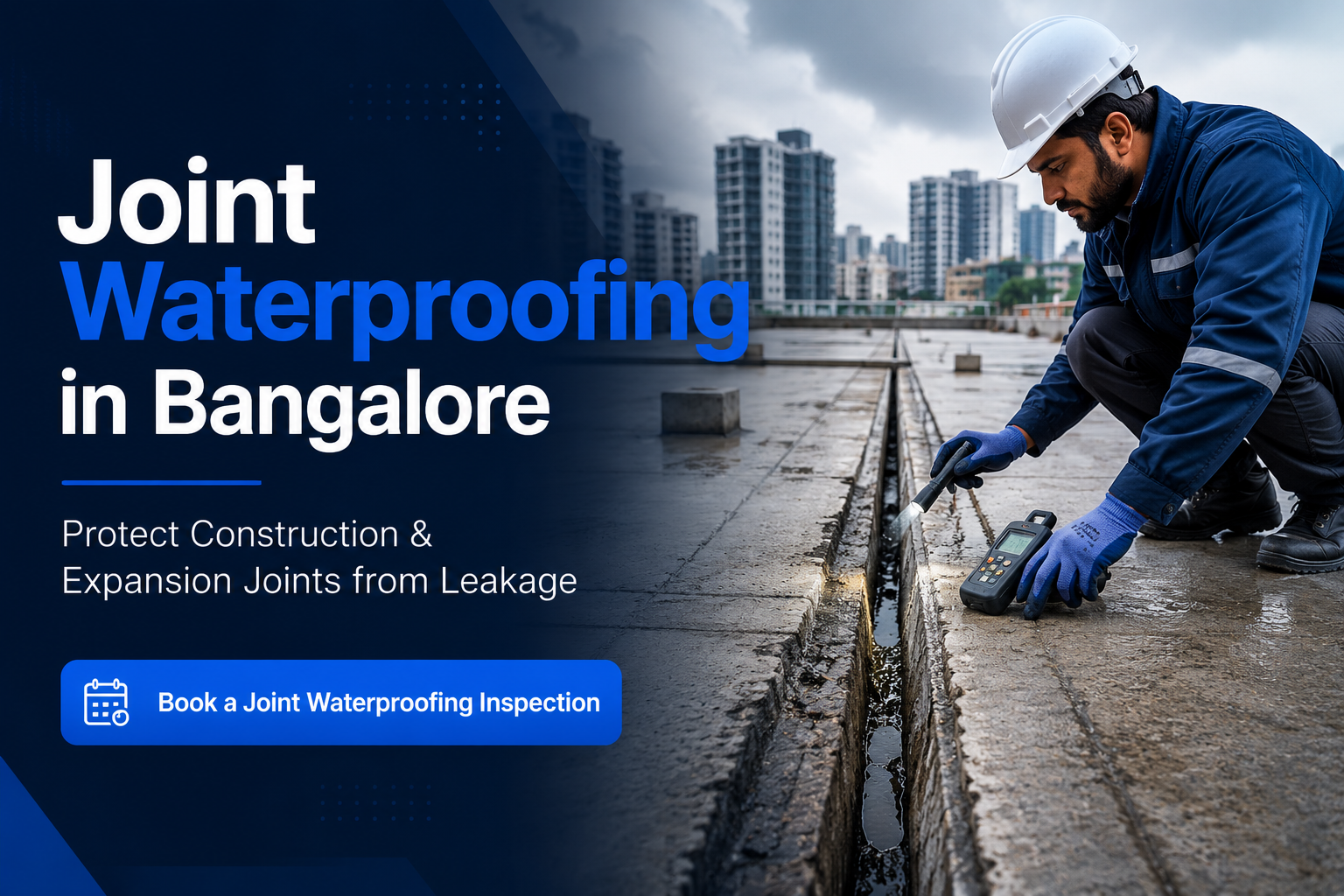
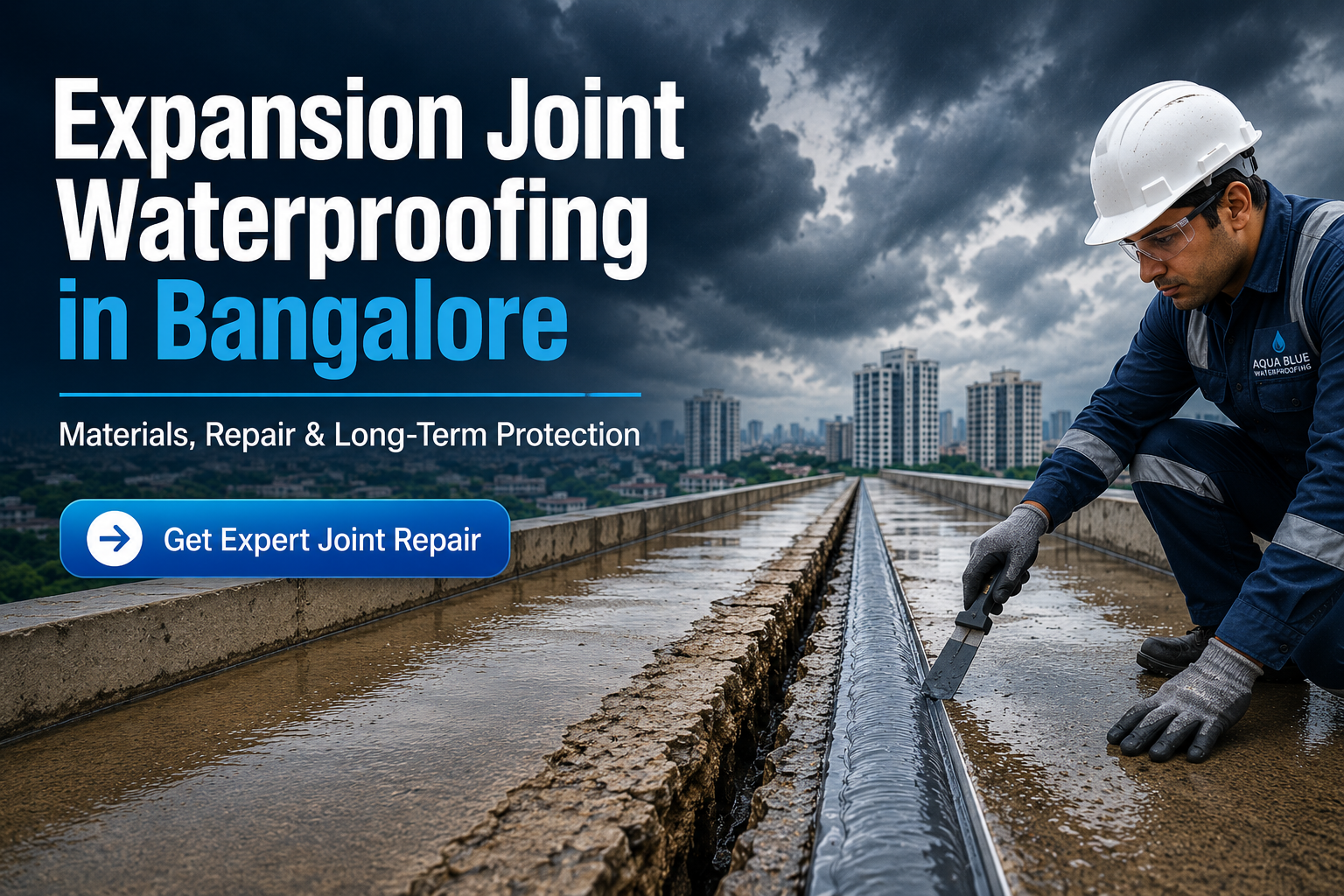
If you have noticed damp patches creeping along your ceilings, wall stains, or active water dripping near concrete slabs during Bangalore's heavy monsoons, a failed expansion joint is usually to blame. Concrete structures naturally shift, expand, and contract as temperature and weather conditions change. Expansion joints are built-in structural gaps designed to absorb this movement safely. However, when the flexible waterproof seals inside these gaps dry out or tear, rainwater gets a direct path inside your building.
Securing professional expansion joint waterproofing Bangalore services is essential to protect your property from structural damage and costly interior repairs. This comprehensive guide breaks down why building joints leak, the best flexible materials to fix them, simple step-by-step repair methods, and long-term protection strategies for apartment complexes and commercial properties.
Need immediate expert help with a leaking expansion joint? Speak directly with our technical team at Aqua Blue Waterproofing: Call +91-88920 26121 for an on-site joint inspection.
Table of Contents
- Expansion Joint Waterproofing: Core Overview
- Why Do Expansion Joints Leak?
- What Causes Water Leakage Through Expansion Joints?
- How Do Expansion Joints Prevent Cracks?
- How Does Expansion Joint Waterproofing Work?
- What Is the Best Waterproofing for Expansion Joints?
- How to Repair Leaking Expansion Joints
- How to Stop Water Leakage Through Expansion Joints
- Expansion Joint Waterproofing for Apartments & Commercial Buildings
- What Happens If Expansion Joint Leakage Is Ignored?
- How Often Should Expansion Joint Sealant Be Inspected?
- When Should You Hire Expansion Joint Waterproofing Contractors in Bangalore?
- Frequently Asked Questions
- Conclusion & Next Steps
Expansion Joint Waterproofing: Core Overview
Expansion joint waterproofing protects structural movement gaps from rainwater and moisture while allowing the concrete slabs to expand and contract freely. Choosing the right repair approach depends on the width of the joint, how much the building moves, water pressure levels, and the overall condition of the surrounding concrete.
In Bangalore, specific local conditions place continuous stress on these movement gaps:
- Heavy monsoon rainfall: Prolonged rains create standing water on flat rooftop decks and podiums, forcing moisture into poorly sealed joints.
- Daily temperature swings: Hot afternoons followed by cooler nights cause concrete slabs to expand and shrink repeatedly.
- Building movement: Multi-story concrete buildings experience continuous micro-vibrations, minor settling, and structural shifts.
- Aging sealants: Standard caulking and cheap sealants harden, crack, and peel away from concrete edges over time.
- Poor drainage: Water pooling around joint lines creates continuous pressure against the sealant.
Why Do Expansion Joints Leak?
Expansion joints leak when the sealing material loses its stretch or separates from the concrete edges. Understanding why seals fail helps prevent repeating the same mistakes.
Failed or Deteriorated Joint Sealant
Sunlight and weather exposure wear down joint sealants over time. As sealants age, they lose their elasticity and become hard and brittle. This causes the sealant to either split down the middle or peel away from the concrete edge. Using basic silicone or low-grade caulking outdoors speeds up this breakdown.
Joint Movement Beyond the Sealant's Capacity
Every expansion joint moves as the building shifts. If a joint widens beyond what the sealant can handle, the material stretches past its limit and tears apart.
Incorrect Joint Detailing
Common installation mistakes that lead to early failure include:
- Shallow sealant application: Applying too thin a layer prevents the sealant from gripping the joint walls firmly.
- Missing backer rods: Without a foam backer rod at the bottom, sealant sticks to three sides instead of two, restricting its ability to stretch.
- Dirty joint walls: Dust, loose sand, or moisture on the concrete prevents proper bonding.
- Narrow joints: Joints cut too narrow concentrate movement forces on a very small area of sealant.
Water Accumulation Around the Joint
When water cannot drain away quickly from horizontal deck joints, it forms standing pools. Over time, standing water builds up hydrostatic pressure, pushing moisture through microscopic gaps or porous concrete near the joint lines.
What Causes Water Leakage Through Expansion Joints?
Water leakage through expansion joints involves physical breakdown combined with water finding the path of least resistance.
Rainwater Ingress
During monsoon downpours, rainwater runs off vertical walls and collects on flat roofs and podiums. If the joint seal is broken, water flows directly into the gap under gravity and wind pressure.
Failed Joint Sealant and Joint Filler
A complete expansion joint relies on three core layers:
- Joint Sealant: The flexible top layer that keeps water out.
- Joint Filler: The soft board material that fills the deep gap.
- Backer Rod: The foam strip that sets the sealant depth and allows free stretching.
If any of these parts crumble or compress permanently, the entire joint loses its defense against moisture.
Concrete Deterioration Around the Joint
Heavy traffic, building movement, or poor concrete mixes can cause the sharp edges of a joint to chip and crack. Even if the sealant stays intact, water simply seeps through the damaged concrete right beside the joint.
Waterproofing System Discontinuity
A common mistake is treating the movement joint separately from the roof or deck waterproofing. If the surface membrane stops right at the joint edge instead of overlapping into the joint seal, water slips under the coating and leaks straight into the joint gap.
How Do Expansion Joints Prevent Cracks?
What Is an Expansion Joint?
An expansion joint is a pre-planned gap engineered into large concrete floors, walls, and roofs. It breaks a large structure into smaller, independent sections so it can flex safely.
How Building Movement Is Accommodated
Concrete naturally expands when warm and shrinks when cold. Without expansion joints, these size changes build up tension inside the slab. Expansion joints provide controlled space for concrete to expand into, preventing chaotic structural cracking across your floors and walls.
Expansion Joint vs Ordinary Concrete Crack
| Feature | Expansion Joint | Ordinary Concrete Crack |
|---|---|---|
| Origin | Carefully planned gap created during construction | Uncontrolled split caused by stress or structural settling |
| Function | Safely absorbs ongoing building movement | Indicates a point of stress failure in the concrete |
| Movement | Continuously moves with seasonal temperature shifts | Static or unpredictably widening split |
| Repair Method | Requires flexible sealants and foam backer rods | Requires rigid epoxy or structural crack filling |
How Does Expansion Joint Waterproofing Work?
Waterproofing a movement joint requires a clear step-by-step process. Skipping basic preparation work leads to early failure.
Step 1 — Joint Inspection
Examine the joint gap along its full length. Check its width, depth, sealant condition, and pinpoint where water is entering.
Step 2 — Remove Failed Sealant
Completely cut away all old, hardened sealant, rotten filler boards, and dirt down to the bare concrete. Never apply fresh sealant over old material.
Step 3 — Prepare the Joint
Clean both vertical sides of the joint using wire brushes or grinding wheels to remove dust and loose particles. Blow out debris with oil-free air and ensure the surface is clean and dry.
Step 4 — Install Backer Rod / Joint Filler
Push a closed-cell polyethylene foam backer rod into the joint gap. Select a rod slightly wider than the joint so it fits snugly. This controls how deep the sealant goes and ensures it only sticks to the two side walls.
Step 5 — Apply Joint Sealant
Fill the joint using a high-grade Polyurethane (PU) joint sealant with a caulking gun. Apply it evenly from the bottom up to prevent air bubbles, then smooth the surface with a tool to press the sealant firmly against the concrete walls.
Step 6 — Integrate the Waterproofing System
Cover the sealed joint with a flexible bridging tape or elastomeric detailing membrane that ties smoothly into the surrounding deck or roof waterproofing system.
Step 7 — Quality Inspection & Water Testing
Allow the sealant to cure completely. Perform a standing water test on horizontal surfaces to confirm the joint is completely watertight.
What Is the Best Waterproofing for Expansion Joints?
No single product works for every joint. The right material depends on joint movement, location, and exposure to traffic or weather.
Polyurethane (PU) Joint Sealants
Polyurethane sealants are the preferred choice for concrete expansion joints. They offer strong adhesion, high flexibility, excellent tear resistance, and can easily handle movement up to ±25% or ±50% without cracking.
Waterproof Membrane Systems
Pre-formed elastomeric cover tapes (such as Hypalon or EPDM bands) are installed over wide expansion joints on podiums and terraces. They act as a flexible protective shield against heavy movement, UV rays, and standing water.
Injection Grouting for Active Leakage
When an expansion joint suffers from active, running water leaks under pressure, polyurethane injection grouting is used. Expanding hydrophobic PU resin is injected deep into the joint void. It reacts with water instantly, expanding into a flexible foam that stops flowing water immediately so permanent surface repairs can follow.
Joint Filler and Backer Rod Systems
Closed-cell foam backer rods support the sealant layer from underneath, maintaining correct sealant geometry and preventing sagging.
How to Select the Right Expansion Joint Waterproofing System
| Site Condition | Recommended Waterproofing Solution |
|---|---|
| Old, cracked sealant (no active leak) | Remove old material, clean edges, insert backer rod, and apply fresh PU sealant |
| Wide joints with heavy movement (podiums/roofs) | Flexible PU sealant paired with an elastomeric joint tape system |
| Active water leaking through basement joints | Polyurethane injection grouting to block water, followed by flexible joint sealing |
| Chipped or broken concrete joint edges | Repair edges with polymer mortar before applying backer rod and PU sealant |
| Heavy vehicular traffic areas (driveways/parking) | Heavy-duty metal joint covers combined with internal flexible PU sealants |
Read more: Joint Waterproofing in Bangalore
How to Repair Leaking Expansion Joints
Repairing a leaking joint means finding where water gets in and restoring its ability to flex without leaking.
- Find the Entry Point: Trace where water enters on top, as water often travels horizontally before dripping inside.
- Assess the Damage: Check joint width, movement, and whether the concrete edges are crumbling.
- Clean Out Old Material: Scrape away all old silicone, hard cement, dirt, and damaged filler material.
- Fix Broken Edges: Rebuild chipped concrete shoulders using high-strength polymer repair mortar to ensure a flat bonding surface.
- Install Backer Rod and Sealant: Insert a foam backer rod and apply high-performance PU sealant smoothly along the entire joint length.
- Stop Active Leaks: If water is actively gushing through, inject expanding PU resin to block the water flow first.
- Perform Water Testing: Fill the area with water for 24 to 48 hours to confirm the repair is fully watertight.
How to Stop Water Leakage Through Expansion Joints
Avoid these common mistakes when dealing with expansion joint repairs:
- Don't Apply New Sealant Over Old: Applying fresh sealant over damaged material guarantees early peeling and failure.
- Don't Use Hard Cement or Epoxy Mortar: Never fill an expansion joint with rigid cement, tile grout, or hard epoxies. As soon as the building shifts, rigid materials crack instantly.
- Fix the Joint Before Coating the Floor: Complete all deep joint repairs and sealing before applying liquid waterproofing coats across the surrounding floor.
- Use Exterior-Grade Flexible Sealants: Choose sealants rated specifically for high movement and UV resistance (such as PU sealants). Standard indoor acrylic caulks will fail outdoors.
- Overlap Surrounding Waterproofing: Make sure surrounding roof membranes overlap onto the flexible joint protection system rather than ending right at the joint edge.
For technical guidance, work with specialized waterproofing services in Bangalore to ensure correct execution.
Expansion Joint Waterproofing for Apartments & Commercial Buildings
Multi-story apartments and commercial complexes face higher risks due to large floor areas and constant usage.
Apartment Buildings
- Podiums: Landscaped podium decks and driveways carry heavy vehicle loads while exposed to weather. Joints here require high-durability, flexible systems.
- Terraces: Exposed rooftop joints expand significantly under the sun, requiring UV-resistant elastomeric seals.
- Basements & Lift Pits: Below-ground joints face groundwater pressure, requiring high-pressure injection grouting combined with flexible surface seals.
- External Facades: Vertical wall expansion joints require non-sag PU sealants that block wind-driven rain.
Commercial Buildings
- Large Roof Slabs: IT parks and commercial centers feature wide concrete roofs where expansion joints absorb large building shifts.
- Multi-Level Parking Structures: Driveways and parking decks need abrasion-resistant, chemical-proof joint systems that withstand constant tire traffic.
- High-Traffic Pedestrian Areas: Walkway joints must remain flush with the floor to eliminate tripping hazards while staying completely watertight.
What Happens If Expansion Joint Leakage Is Ignored?
Ignoring a leaking expansion joint leads to serious damage over time:
- Corroding Internal Rebar: Water entering the joint reaches internal steel support bars, causing them to rust, expand, and crack the surrounding concrete from within.
- Concrete Spalling: Ongoing water seepage weakens concrete edges along the joint, causing large chunks to break off.
- Interior Wall and Ceiling Damage: Water leaking through joints ruins paint, causes plaster decay, stains false ceilings, and promotes harmful mold growth.
- Costly Structural Repairs: Temporary surface patches fail quickly, resulting in ongoing repair expenses while underlying structural damage worsens.
How Often Should Expansion Joint Sealant Be Inspected?
Inspect expansion joint sealants every 12 to 18 months, as well as right after the annual monsoon season.
Signs Your Expansion Joint Needs Resealing
- Visible splits or cracks along the sealant bead
- Hardened, brittle, or shrinking sealant material
- Sealant peeling away from concrete sides
- Damp patches or white mineral stains on ceilings directly below joint lines
- Water dripping in basements or parking areas near joint lines
- Sunken or missing joint filler boards
- Recurring water seepage during heavy rain
When Should You Hire Expansion Joint Waterproofing Contractors in Bangalore?
DIY fixes and general painting patches rarely work on moving structural joints. Call professional specialists when:
- Water continues leaking through terrace or podium joints despite surface repairs.
- You see active, running water entering basement walls or floor-wall gaps.
- Joint sealants across large spans are cracked, hardened, or peeling off.
- Concrete shoulders along the joint gap are chipped, cracked, or crumbling.
Trusted Expertise from Aqua Blue Waterproofing
At Aqua Blue Waterproofing, we deliver engineered, long-term solutions for expansion joint repair Bangalore projects across residential complexes, commercial properties, and industrial sites.
Our team provides:
- Thorough Site Inspection: Identifying root causes, movement levels, and water entry points.
- Professional Joint Cleaning & Prep: Mechanical edge cleaning, dust removal, and edge repairs.
- High-Performance Material Installation: Specification-grade PU sealants, backer rods, and flexible EPDM/Hypalon tape systems.
- Specialized PU Injection Grouting: High-pressure grouting to permanently block active underground water flow.
- Quality Verification: Standing water testing to ensure 100% leak-proof results.
Frequently Asked Questions
Why do expansion joints leak?
Expansion joints leak when sealants age, lose their elasticity, or peel away from concrete walls due to sunlight exposure, building shifts, poor surface cleaning, or incorrect installation depth.
What is the best sealant for expansion joints?
Polyurethane (PU) joint sealants are the most reliable option for concrete movement joints. They offer strong flexibility, excellent adhesion to concrete, high tear resistance, and long-term weather durability.
How do you repair a leaking expansion joint?
Repairing a leaking joint involves removing all old sealant, grinding concrete walls clean, repairing damaged edges with polymer mortar, inserting a foam backer rod, and applying fresh polyurethane sealant.
Can expansion joint leakage be fixed permanently?
Yes. When joints are thoroughly cleaned, backed with correct foam rods, sealed with high-grade PU materials, and connected properly to surrounding waterproofing layers, they provide long-term leak protection.
How long does expansion joint sealant last?
High-grade polyurethane joint sealants typically last 7 to 12 years depending on sunlight exposure, weather, and building movement. Regular inspections help catch minor wear early.
Can injection grouting stop expansion joint leakage?
Yes. High-pressure polyurethane injection grouting is ideal for active basement joint leaks. The expanding resin reacts with water to form a dense, flexible foam seal inside the concrete gap.
How much movement can a waterproofed joint handle?
Professional-grade polyurethane sealants and flexible tape systems safely handle dynamic movement ranges from ±25% to ±50% of the joint width without tearing or debonding.
Conclusion — Protect Expansion Joints Before Leakage Spreads
Waterproofing structural expansion joints requires careful preparation, correct material choices, and precise execution. Using flexible polyurethane sealants, foam backer rods, and protective joint tapes keeps your building watertight while allowing it to flex naturally.
Routine inspections and timely repairs prevent small sealant cracks from turning into major structural repairs.
Schedule Your Joint Inspection Today
For reliable expansion joint sealing Bangalore solutions, contact our technical team today.
Phone: +91-88920 26121
Services: Joint Inspections, PU Sealant Replacement, Injection Grouting, Complete Overhauls
To get started, you can book an expansion joint inspection in Bangalore our visit our Google Business Profile to learn more about our recent waterproofing projects and client reviews.

PRAVEEN P is the Founder of Aqua Blue Waterproofing and a Waterproofing Technical Specialist with over 16 years of industry experience. Since establishing the company in 2014, he has helped homeowners and businesses across Bangalore solve leakage and seepage issues through reliable, long-lasting waterproofing solutions and expert guidance.